
Republican groups outspend Democrats where Democrats lead the polls
Outside money has gone heavily to Republicans in Texas, Ohio and Michigan, yet the side with more outside money is our favorite in only 10 of 36 big-money races.
 Polling Forecast
4 min read
Written in house from our poll data and our forecast.
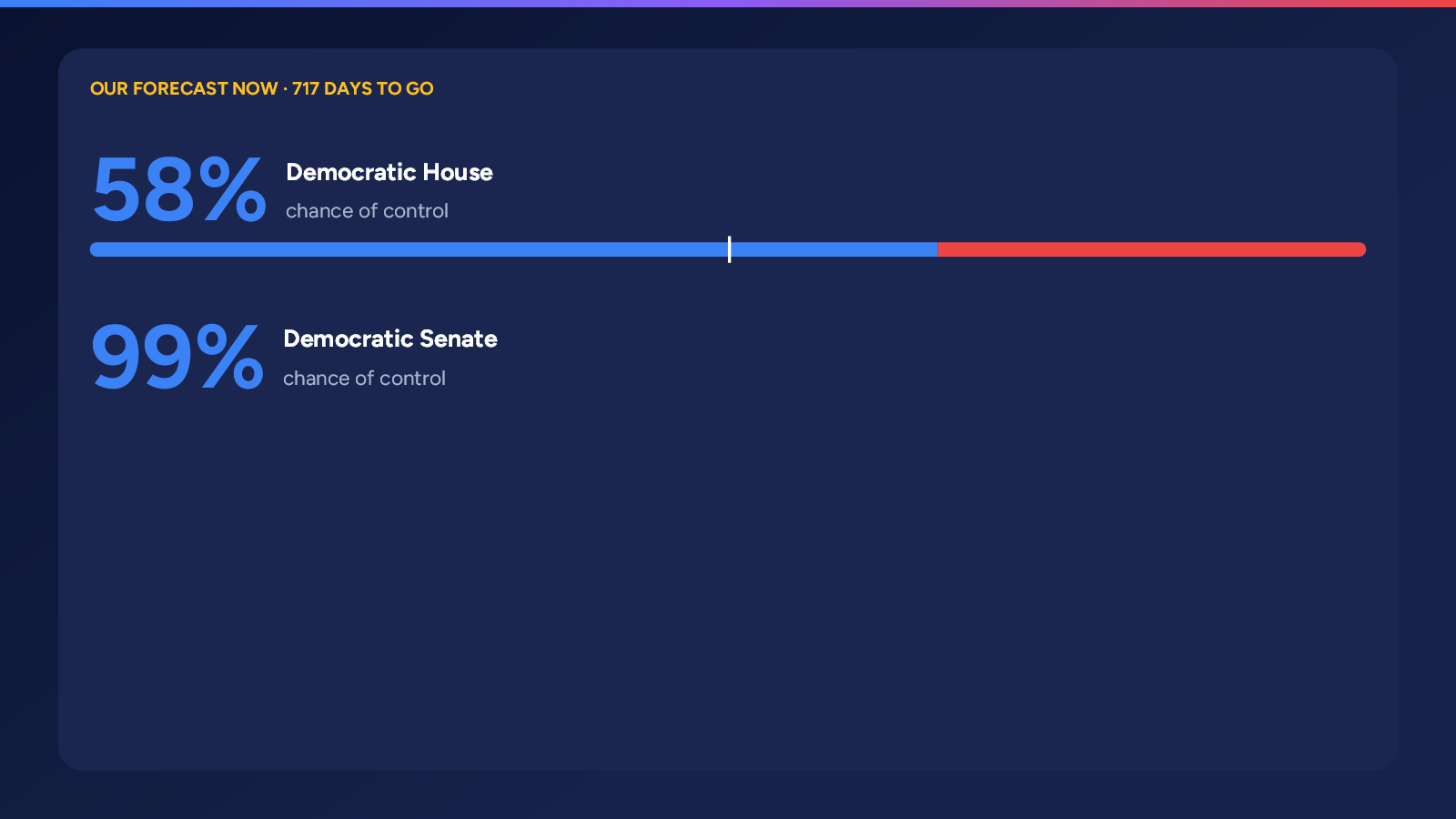
Outside groups have spent $125 million to help Republicans in the Texas Senate race, seven times the $17.6 million spent to help Democrats, according to Federal Election Commission filings to 29 September. Our forecast still gives James Talarico, the Democrat, a 57% chance against Ken Paxton.
Texas is the most expensive race of the cycle in our tables, at $296 million once candidates' own spending and the primaries are counted. It is also the clearest example of a pattern that runs through this year's money: the heaviest outside spending is going to the side that is behind.
Where the money has gone
The FEC files show House candidates have spent $1.50 billion this cycle, primaries included, and Senate candidates $642 million. Outside groups, meaning parties, super PACs and other committees spending independently, have reported $1.51 billion more, split roughly evenly between primaries and the general election.
The Senate dominates the top of the list. After Texas come Michigan ($172 million in all), Ohio's special election ($136 million) and Maine ($86.5 million). In each, Republican-side groups have outspent Democratic-side groups in the general election: $69.9 million to $31.6 million in Ohio, $37.1 million to $23.4 million in Michigan, $24.2 million to $16.5 million in Maine. New Hampshire shows the same, $12.5 million to $6.2 million.
Our forecast has the Democrat ahead in all five. Sherrod Brown wins Ohio in 64% of our simulations, Abdul El-Sayed Michigan in 71%, Troy Jackson Maine in 61% and Chris Pappas New Hampshire in 87%.
The candidates' own accounts point the other way in several of these races. In reports to the end of June, the latest both Texas nominees had filed, Talarico had raised $68.6 million and Paxton $9.2 million. Brown had raised $38.6 million to Jon Husted's $14.4 million. Add the outside money and the balance reverses. In Texas, Talarico's campaign had spent $47.0 million by the end of June and Paxton's $7.5 million; outside groups have since spent $125 million on Paxton's side and $17.6 million on Talarico's.
The bigger spender is often behind
Not in our forecast, at least so far. We looked at the 36 races where outside groups have spent more than $3 million on the general election, leaving out near coin flips, races that are all but settled and contests without a Democrat facing a Republican. The side with more outside money is our favorite in only 10 of them. Where Republican-side groups spent more, 21 races, the Democrat is our favorite in 18.
That is not evidence that money does nothing. It shows that party committees and allied super PACs spend where they think a seat is at risk, so spending follows the polls at least as much as it leads them. Our data on money covers only this cycle, so we cannot test the relationship in past elections ourselves.
Others have. Sherwood News, drawing on OpenSecrets data, reported that House candidates who spent more won 91% of the time over four cycles. Most of that reflects incumbents in safe seats, who raise more and would win anyway. Races that are close by our measure are exactly the ones where both sides spend heavily, and where the simple rule tells you least.
Texas, week by week
The timing in Texas is worth following. Our forecast gave Talarico 51% on 1 August and 62% on 1 October. It has since fallen back to 57%. His lead in our poll average is 1.9 points across 47 polls, within the range a single polling miss could erase.
The Republican push came late. NPR reported on 18 September, citing the ad tracker AdImpact, that pro-Paxton groups had reserved more than $94 million in September ads against about $20 million supporting Talarico. In the FEC filings, Texas PAC, a super PAC aligned with Senate Republicans, has reported $37.1 million supporting Paxton and $33.0 million opposing Talarico. MAGA Inc. has added $12.5 million against Talarico and $7.5 million for Paxton. On the other side, Lone Star Rising PAC has spent $12.6 million against Paxton.
Our forecast's dip came after that money arrived, but we cannot separate the ads from everything else that happened in the same weeks, including new polls. NPR also reported that, according to AdImpact, virtually no ads had been booked by either side in Texas from October onward. That may change.
The latest
By AdImpact's count, Ohio is now the costliest Senate contest in advertising. Newsweek reported on 2 October that the Senate Leadership Fund, aligned with Senate Republicans, had raised its commitment to $93 million and Senate Majority PAC, on the Democratic side, to about $60 million. Citing AdImpact, it put ad spending in the race at nearly $250 million, with $137 million more booked to polling day. Those figures are larger than the FEC totals because they include candidates' own ads, future reservations and spending that is not reported as an independent expenditure.
Brown's chance in our forecast rose from 37% on 1 August to 71% on 1 October and stands at 64%. Across the nine most competitive Senate races, NPR reported, Republicans had pledged more than $557 million against $343 million for Democrats, and led in every one except Georgia.
AdImpact projected in June, according to Campaigns and Elections, that 2026 would be the most expensive cycle on record, at $11.6 billion in political advertising, against $8.9 billion in the 2022 midterms. Money may matter at the margin in close races. On this year's evidence, it is a guide to where the parties think they are in trouble, and our polls mostly agree with them.
Polling Forecast reads every poll in ten countries, corrects for how pollsters have missed before, and turns them into seats. Our forecasts, the polls and our methods are free to explore.
Elsewhere on Polling Forecast
 Rome prosecutors open a file on Vannacci's Futuro Nazionale
Futuro Nazionale is on 6.5% in our average and would win 23 seats outside both coalitions; the centre-left wins the Camera in 63% of our simulations.
 AfD's Siegmund will stand for premier in Saxony-Anhalt on 8 December
The AfD holds 39 of the 83 seats in Magdeburg; nationally it leads our average by 5.7 points and would win 193 Bundestag seats.
 Nawrocki promotes Domański reluctantly as the tribunal fight deepens
The government keeps a majority in only 10% of our simulations, while PiS, Konfederacja and KKP together would have 245 seats.