Early mail ballots trail 2022 in two of three tracked states
Fewer ballots are back in Pennsylvania and North Carolina than at this point in 2022, and past cycles warn against reading the party mix as a forecast.
 Polling Forecast
4 min read
Written in house from our poll data and our forecast.
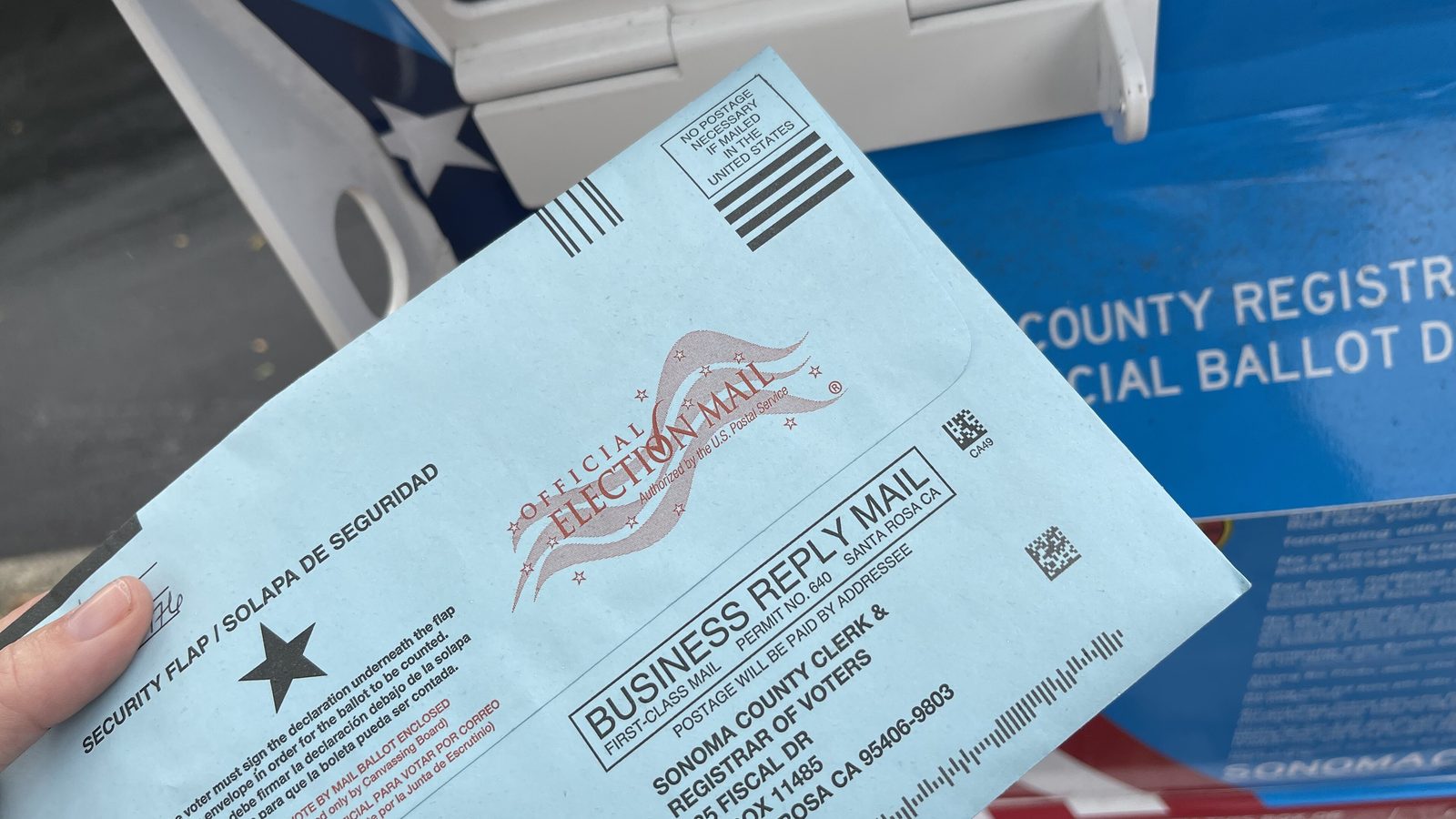

Pennsylvania voters had returned 277,188 mail ballots by 13 October, 21 days before polling day. That is 25% fewer than at the same point in 2022 and 56% fewer than in 2024. North Carolina is running 29% behind 2022. Maine, the one other state where we can make a same-day comparison, is 54% ahead of it.
Across the four states whose 2026 files we read so far, Florida, Maine, North Carolina and Pennsylvania, 878,992 ballots have been cast. We read the counts from each state's own election office and rebuild 2022 and 2024 day by day from the states' final files, so each year is measured the same number of days before its election. Colorado and Maryland have not yet published 2026 figures.
Pennsylvania: the ballots are out, the returns are slow
The gap in Pennsylvania is in returns, not requests. The state had sent 1,110,033 mail ballots by 13 October, only 4% fewer than the 1,158,509 sent by the same point in 2022. What has changed is how many have come back: 25% so far, against 32% in 2022 and 38% in 2024. Three weeks out, that can still close.
The party mix has moved a little toward Republicans compared with the last midterm. Registered Democrats account for 72% of the ballots returned, against 74% at this point in 2022; Republicans for 20%, against 19%. Among requests the shift is larger. Republicans have been sent 263,578 ballots, 18% more than at this stage four years ago, while Democrats have been sent 732,210, 12% fewer. Both remain well short of 2024, a presidential year, when Republicans were sent 477,781 ballots by this stage.
North Carolina and Maine
North Carolina's 29,467 ballots compare with 41,672 at the same point in 2022 and 61,840 in 2024. Registered Democrats cast 45% of them, unaffiliated voters 39% and Republicans 17%, close to the 2022 mix at this stage (50%, 34% and 17%). The 29,745 ballots returned by 12 October, of which 29,467 had been accepted, compare with about 133,315 sent or requested by the same date, so a little over a fifth have come back. North Carolina began mailing ballots on 4 September, WFAE reported, and requests stay open until 20 October, so the number sent will still grow.
Maine's 44,439 ballots by 9 October, 25 days out, are well ahead of 2022's 28,944 though behind 2024's 57,555. Democrats cast 55% of them and Republicans 19%, against 56% and 21% at the same point in 2022.
Florida: a familiar mix
Florida keeps only final counts for past years, so there is no same-day comparison. By 12 October, 527,898 mail ballots had come back of 2,298,572 sent. Registered Democrats cast 43%, Republicans 36% and others 21%.
That is almost exactly the mix of Florida's final mail vote in 2022: Democrats 43.1%, Republicans 36.1%. That year Ron DeSantis won the governorship by 19 points. Florida Republicans lean toward voting in person: in 2022 they cast 51% of the state's in-person early votes, against 30% for Democrats. A Democratic lead among mail ballots tells us how each party's voters choose to vote, not how the state will go. Our figures for Florida are mail ballots only for now.
What the early vote has told us before
The record in our own files is a warning against reading party shares as a score. In Pennsylvania in 2024, registered Democrats cast 55% of the final mail vote and Republicans 33%. Donald Trump carried the state by 1.7 points. In 2022, Democrats cast 69% of Pennsylvania's mail ballots and John Fetterman won the Senate seat by about five points, a margin nothing like the mail split.
North Carolina makes the same point. In 2022 registered Democrats cast 38% of the ballots before polling day and Republicans 31%, yet Ted Budd won the Senate race by 3.2 points. In 2024 the early electorate there was almost evenly split by party, and Trump won by 3.2 points.
Three things limit what these numbers can say. A registered Democrat can vote Republican, and the other way round. Unaffiliated voters are a large and growing share, and their votes are unknown until the count. And the mix of early and polling-day voting shifts from year to year: when one party pushes its voters to vote early, it often has fewer left to vote on the day. That is why our forecast does not use these figures. What the early vote can show is pace, and the pace so far is mixed.
Elsewhere
Reports from other states point to stronger returns than ours. Fox 2 Detroit reported that Michigan voters had returned 201,909 absentee ballots by 6 October, 30% more than at the same point in 2022. Straight Arrow News reported that Illinois had sent 1,036,090 mail ballots by early October, against fewer than 620,000 at that stage of 2022, and that Minnesota had sent more than 426,000, against 343,000. In-person early voting began in Georgia on 13 October, WRDW reported.
Those figures are ballots sent and returned, not final turnout, and the comparisons are with a different set of states from ours. Mail is also a small part of the vote in some places: in 2022, WFAE reported, 187,660 North Carolinians voted by absentee ballot, just under 5% of all ballots cast. With three weeks to go and in-person early voting just under way in Georgia, most of the vote is still to come.
Polling Forecast reads every poll in ten countries, corrects for how pollsters have missed before, and turns them into seats. Our forecasts, the polls and our methods are free to explore.
Elsewhere on Polling Forecast
 353 seats? The mega-poll's Labour majority comes from a split right, not tactical voting
Run the mega-poll's own vote shares through our model and Labour still gets 358 seats. The difference from our 316 is a weaker Conservative Party and a stronger Restore Britain, not the tactical voting the coverage focused on.
 Polls understated PiS in 31 of 32 final surveys since 2024
At four national votes since Tusk took office, final polls put PiS or its candidate too low. Our forecast makes no allowance for it.
 Private polls understated Spain's PSOE at six of eight elections
104 of 142 private final polls since 2004 had the PSOE too low, but even a repeat of 2023 would probably leave the PP and Vox a majority.