
Polls understated PiS in 31 of 32 final surveys since 2024
At four national votes since Tusk took office, final polls put PiS or its candidate too low. Our forecast makes no allowance for it.
 Polling Forecast
6 min read
Polling Forecast
6 min read
Written in house from our poll data and our forecast.
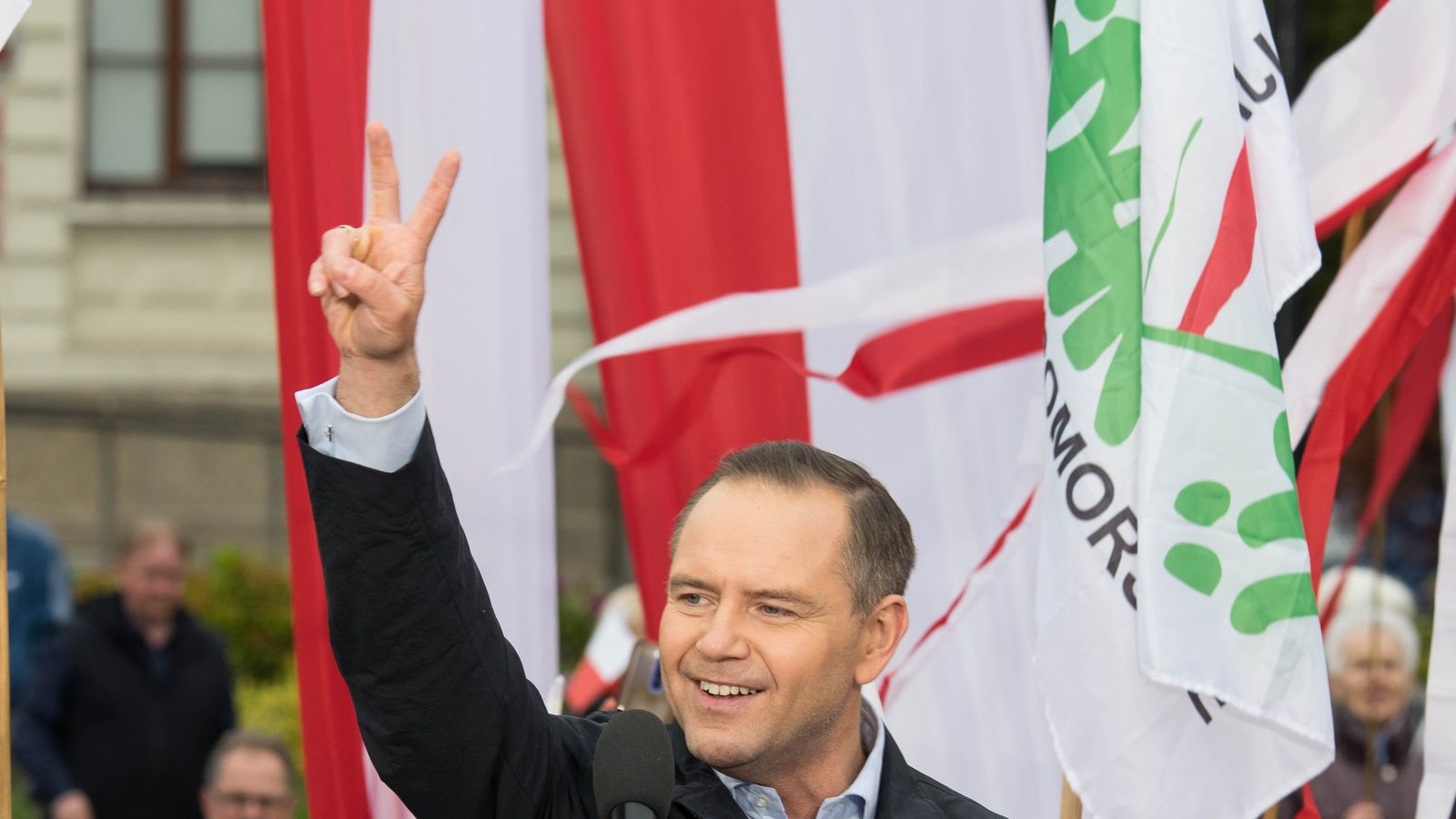

Poland's final polls put Law and Justice (PiS), or the candidate it backed, too low at every nationwide vote since Donald Tusk took office in December 2023. Of the 32 final polls published before those four votes, 31 had PiS below its result. The 32nd, by Social Changes, matched it to one decimal place. On average they missed PiS by 2.6 points.
That is a reversal. At the Sejm elections of 2019 and 2023 the same industry erred the other way: the average of the final polls overstated PiS by 2.6 points in 2019 and 1.5 points in 2023, and 15 of the 21 final polls had it too high. Our Sejm forecast is built on that longer record and takes the polls as published. If the newer pattern carries into next year's election, the parties of the right are stronger than our projection shows.
What we counted
We took each pollster's last poll before each of the four votes: the regional assembly (sejmik) elections of 7 April 2024, the European Parliament election of 9 June 2024, and both rounds of the presidential election, on 18 May and 1 June 2025. Each poll's don't-knows were removed and the rest rescaled to 100, as we do for every Polish poll. We set the figures against the official results of the Państwowa Komisja Wyborcza. That gives 6 final polls for the sejmiki, 8 for the European election, 8 for the first round and 10 for the run-off.
PiS was too low at all four. At the sejmiki the average had it on 29.5% against a result of 34.3%, a miss of 4.7 points, and all six polls were short. At the European election it was 33.1% against 36.2%, 3.0 points short, with all eight polls too low. In the first presidential round the polls had Karol Nawrocki, the PiS-backed candidate, on 26.8%. He won 29.5%, 2.7 points more, and again every poll was short. In the run-off the polls put him on 49.9% to Rafał Trzaskowski's 50.1%. He won by 50.9% to 49.1%.
That last miss looks small, but in a two-way race it understated Nawrocki's margin by about two points and pointed to the wrong winner. Nine of the ten final polls had him too low. Even the exit poll was caught out. Notes from Poland reported that Ipsos's first exit poll at 9pm gave Trzaskowski a lead of 0.6 points, and only the later count put Nawrocki ahead.
Is it PiS, or the whole right
The answer depends on the vote, so the claim needs care. Konfederacja was understated at the European election, by 0.9 points, and in the first presidential round, where Sławomir Mentzen finished 1.9 points above his polls and Grzegorz Braun 2.0 points above. But at the 2024 sejmiki Konfederacja was overstated by 2.8 points. It stood on a joint list with Bezpartyjni Samorządowcy, which makes the comparison rough.
Taken together, PiS and Konfederacja were understated at all four votes: by 2.0 points at the sejmiki, 3.9 at the European election and 4.7 in the first round, with Nawrocki's 1.0 in the run-off. The first round was the starkest case. Nawrocki, Mentzen and Braun had 44.0% between them in the final polls and won 50.7%.
The first-round miss did not go unnoticed. The Polish Press Agency quoted Marcin Duma, head of IBRiS, saying three days after the vote that pollsters had systematically underestimated the whole right of the political scene, and that a certain group of respondents would not take part in surveys. In the same report Jarosław Flis of the Jagiellonian University argued that much pointed to the governing coalition's voters staying at home. What has had less attention is that the miss was not a one-off. It ran the same way at four votes in fourteen months, after two Sejm elections that ran the other way.
Checking it
The finding does not rest on one bad pollster. The Centrum Badania Opinii Społecznej (CBOS) had PiS 9.9 points too low at the sejmiki, with fieldwork that ended 16 days before the vote. Without CBOS the sejmik miss is 3.7 points and the European miss 2.7. In the presidential rounds CBOS was close to the pack, and leaving it out changes nothing.
Nor does it rest on a lenient count. Requiring a poll to be at least half a point too low still leaves 29 of 32. Every pollster that published a final poll at more than one of the four votes had PiS too low each time. The closest firm, OGB, missed by 0.1 points at the European election and 0.9 in the first round, still on the low side.
The contrast with the Sejm record is real but less one-sided than it looks. In 2023 much of the PiS overstatement came from CBOS, which had the party on 46.1%, more than ten points too high. Without it, the other eleven final polls overstated PiS by 0.6 points. Across seven Sejm elections since 2001 the average miss on PiS was 0.8 points too high. That record is why our test of a correction, which uses Sejm elections only, finds nothing to correct for PiS.
What it would mean now
Our poll average today has the Civic Coalition (KO) on 33.4%, PiS on 21.1%, Konfederacja on 14.4%, Braun's Konfederacja of the Polish Crown (KKP) on 9.2% and Mateusz Morawiecki's Rozwój Plus on 5.1%. The four parties of the right have 49.8% between them. Our projection gives the governing coalition 214 seats, 17 short of the 231 needed for a majority, and the right 246. The coalition keeps a majority in 12% of our 2,000 simulations.
We ran the seat model with the right moved up or down as a group. If the polls understate it by one point, the coalition falls to 212 seats. Understated by three points, close to the European miss for PiS and Konfederacja, KO drops to 174, the coalition to 194 and the right rises to 266. In 500 simulated elections on those shares the coalition held a majority in 2%.
To reach 231 on its own, the coalition needs the polls to be overstating the right by about 2.7 points: the opposite of what happened at all four recent votes. Half of that gain comes in one step. Two points off the right push Rozwój Plus below the 5% threshold, and its seats pass to the other parties.
The right's extra seats would not settle who governs. Even at three points, PiS, Konfederacja and Rozwój Plus would have 221 seats without Braun's party, ten short. Jarosław Kaczyński, the PiS leader, ruled out any alliance with Braun's party in February, Polish Radio reported. The right is also not one party any more. PiS expelled the Morawiecki group in August, Notes from Poland reported. Morawiecki had promised a party by 15 October, but PAP reported on 2 October that the formal founding would come in a few months, and Rozwój Plus remains for now an association. Morawiecki wrote that it would stand alone at next year's election. It has never stood at a vote, so there is no record of how well it is polled.
The limits
Three of the four tests were not Sejm elections. Turnout and the choice on the ballot differed, and a presidential run-off is a contest between two people, not lists. Four votes is a short record, and the 2019 and 2023 Sejm elections show the direction of a polling miss in Poland can turn within a few years.
Even so, PiS has the largest and most consistent miss in our record of these four votes. Our forecast does not adjust for it, because the rule we use only learns from Sejm elections. Since this week our what-if page also offers a reading that applies the same rule to the four recent votes instead: it puts PiS on 22.2% and 125 seats, two more than our projection's 123. On the record of these four votes, the right's 49.8% is more likely to be low than high.
Polling Forecast reads every poll in ten countries, corrects for how pollsters have missed before, and turns them into seats. Our forecasts, the polls and our methods are free to explore.
Elsewhere on Polling Forecast
 353 seats? The mega-poll's Labour majority comes from a split right, not tactical voting
Run the mega-poll's own vote shares through our model and Labour still gets 358 seats. The difference from our 316 is a weaker Conservative Party and a stronger Restore Britain, not the tactical voting the coverage focused on.
353 seats? The mega-poll's Labour majority comes from a split right, not tactical voting
Run the mega-poll's own vote shares through our model and Labour still gets 358 seats. The difference from our 316 is a weaker Conservative Party and a stronger Restore Britain, not the tactical voting the coverage focused on.
 North Carolina mail ballots trail 2022 pace equally for both parties
Measured against their own registered voters, North Carolina Democrats and Republicans are returning mail ballots at about 70 percent of their 2022 pace, with Maine ahead.
North Carolina mail ballots trail 2022 pace equally for both parties
Measured against their own registered voters, North Carolina Democrats and Republicans are returning mail ballots at about 70 percent of their 2022 pace, with Maine ahead.
 Private polls understated Spain's PSOE at six of eight elections
104 of 142 private final polls since 2004 had the PSOE too low, but even a repeat of 2023 would probably leave the PP and Vox a majority.
Private polls understated Spain's PSOE at six of eight elections
104 of 142 private final polls since 2004 had the PSOE too low, but even a repeat of 2023 would probably leave the PP and Vox a majority.