
Poland's right splinters, but together it still outnumbers Tusk's coalition
Our projection puts KO first on 193 seats, yet four parties to its right would hold 246, and the 5% threshold decides much of the rest.
 Polling Forecast
4 min read
Polling Forecast
4 min read
Written in house from our poll data and our forecast.
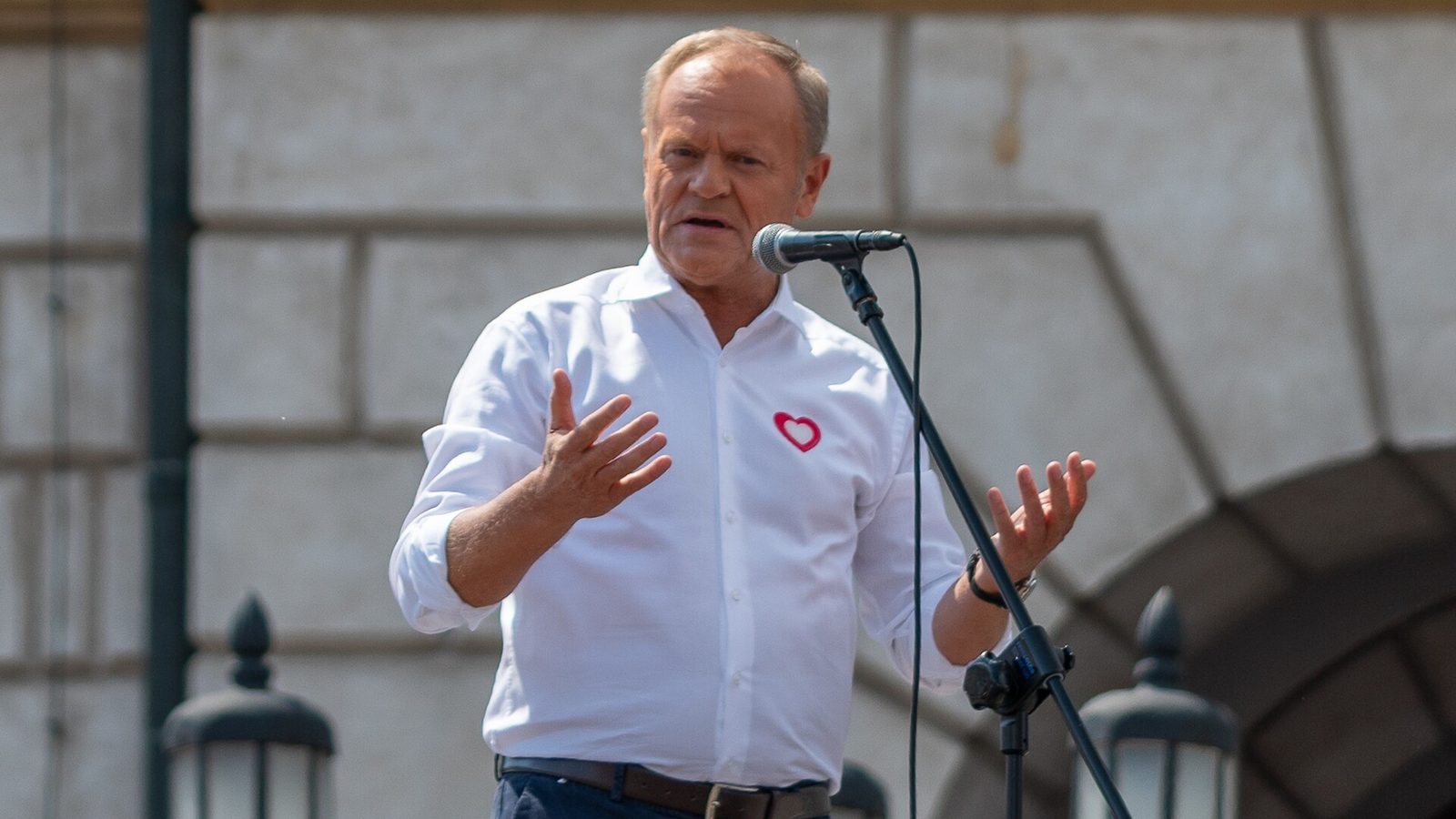

Donald Tusk's Civic Coalition (KO) would win 193 of the Sejm's 460 seats if Poland voted today, our projection shows, 70 more than Law and Justice (PiS) on 123. But KO's lead hides a harder sum. Its governing coalition would hold 214 seats, 17 short of the 231 needed for a majority, while the four parties to its right would have 246 between them.
Our poll average has KO on 33.4%, PiS on 21.1%, Konfederacja on 14.4% and Grzegorz Braun's Konfederacja of the Polish Crown (KKP) on 9.2%. Lewica has 7.2% and Mateusz Morawiecki's Rozwój Plus 5.1%. In our 2,000 simulated elections the governing coalition keeps its majority 12% of the time. The right-wing parties together reach 231 in 85%.
PiS splits, the right holds
The biggest change this year is on the right. In our average rebuilt for the first week of January, PiS stood at 29%, enough for 168 seats. Its fall since has been steady, and it accelerated in July when Morawiecki, the former prime minister, led 40 MPs into a new parliamentary club, Rozwój Plus. PiS expelled 38 MPs and two senators on 13 August, Notes from Poland reported. Morawiecki has said he would register Rozwój Plus as a party by 15 October, according to Brussels Signal.
The split has moved votes within the right more than away from it. In early July, in our average rebuilt for that week, PiS, Konfederacja and KKP together had 49.5%. Today the same parties plus Rozwój Plus have 49.8%. What has changed is efficiency. Rozwój Plus sits just above the 5% threshold and wins eight seats on our projection; a little lower and its votes would elect no one.
Even 246 seats would not make a government by themselves. The count includes Braun's KKP, and Konfederacja has not said it would govern with Braun. Without KKP, PiS, Rozwój Plus and Konfederacja have 205.
Thresholds decide the government's fate
Poland's thresholds, 5% for a party and 8% for a coalition list, matter more for the governing side and its neighbours on the left. Three small parties sit below the line: Razem on 4.2%, the Polish People's Party (PSL) on 2.8% and Polska 2050 on 1.5%. Their votes, about 8.5% in all, would elect nobody if they stood alone.
How they stand changes the result more than a typical polling error. Our projection assumes every party runs on its own list. If PSL and Polska 2050 revived their 2023 Third Way pact, they would need 8% together and have 4.3%, so nothing changes. A single list of KO, PSL, Polska 2050 and Centrum, with Lewica separate, would take the coalition to 227 seats. The one joint list Tusk reportedly argued for in August, with Lewica included, would win 44.9% and 241 seats, a majority, on today's polls.
There is a reason for caution about the small parties' figures. At the 2023 election final polls understated the Third Way alliance of PSL and Polska 2050 by 3.7 points, the largest miss of any party that year.
The president's veto
A majority is not the only line that matters. President Karol Nawrocki, elected in 2025 with PiS's backing, has vetoed dozens of the government's laws, and overriding a veto takes three fifths of those voting, 276 seats if all 460 vote. Neither side comes close to that on our projection.
The president also sets the date. The Sejm first sat on 13 November 2023, and the election must fall on a non-working day in the 30 days before its four-year term ends: no later than Thursday 11 November 2027, a public holiday. An earlier election is possible.
Nawrocki remains more popular than the government. CBOS found 51% rating his work as good and 40% as bad at the end of August, and Instytut Badań Pollster had 44% approving and 39% disapproving in late September. Tusk's ratings are negative: CBOS found 33% satisfied and 55% dissatisfied in late September.
Who polls what
Polish pollsters differ in consistent ways, and those house effects matter when parties sit near a threshold. Measured against other pollsters in the same fortnight, Social Changes puts PiS 2.3 points higher than average and KO a point lower. OGB puts KO 2.4 points higher. CBOS and Opinia24 put PiS about one and a half points lower, and CBOS puts Konfederacja one and a half points higher. Two polls completed on 7 October show the spread: Opinia24 had KO 17 points ahead of PiS, Instytut Badań Pollster 11 points.
Most Polish pollsters publish a don't-know share inside their headline figures. We remove it and rescale the parties to 100, so our figures run higher than the published ones. IBRiS's poll for Polsat News in early August, for example, put KO on 27.5% with 8.8% undecided; on our basis that is 30.1%.
We do not correct Polish polls for past misses. Final polls at the seven elections since 2001 missed by 1.7 points per party on average, and applying a correction would have helped at only three of them. If today's polls missed the way they did in 2019, KO would win 204 seats; a miss like 2005's would leave it on 157.
What to watch
KO's lead is not in question on current polls: it comes first in more than 99% of our simulations. The questions are whether Morawiecki's new party holds above 5%, whether the small governing parties merge their lists, and whether the right can agree to govern together. Each could move the result by more than the polls have moved all year.
Polling Forecast reads every poll in ten countries, corrects for how pollsters have missed before, and turns them into seats. Our forecasts, the polls and our methods are free to explore.
Elsewhere on Polling Forecast
 353 seats? The mega-poll's Labour majority comes from a split right, not tactical voting
Run the mega-poll's own vote shares through our model and Labour still gets 358 seats. The difference from our 316 is a weaker Conservative Party and a stronger Restore Britain, not the tactical voting the coverage focused on.
353 seats? The mega-poll's Labour majority comes from a split right, not tactical voting
Run the mega-poll's own vote shares through our model and Labour still gets 358 seats. The difference from our 316 is a weaker Conservative Party and a stronger Restore Britain, not the tactical voting the coverage focused on.
 North Carolina mail ballots trail 2022 pace equally for both parties
Measured against their own registered voters, North Carolina Democrats and Republicans are returning mail ballots at about 70 percent of their 2022 pace, with Maine ahead.
North Carolina mail ballots trail 2022 pace equally for both parties
Measured against their own registered voters, North Carolina Democrats and Republicans are returning mail ballots at about 70 percent of their 2022 pace, with Maine ahead.
 Private polls understated Spain's PSOE at six of eight elections
104 of 142 private final polls since 2004 had the PSOE too low, but even a repeat of 2023 would probably leave the PP and Vox a majority.
Private polls understated Spain's PSOE at six of eight elections
104 of 142 private final polls since 2004 had the PSOE too low, but even a repeat of 2023 would probably leave the PP and Vox a majority.