
Eleven races could decide the Senate, and the margin is thin
Our forecast gives the Democrats a 57% chance of Senate control, but the deciding seat is spread across 11 races and the edge is under two points.
 Polling Forecast
5 min read
Written in house from our poll data and our forecast.
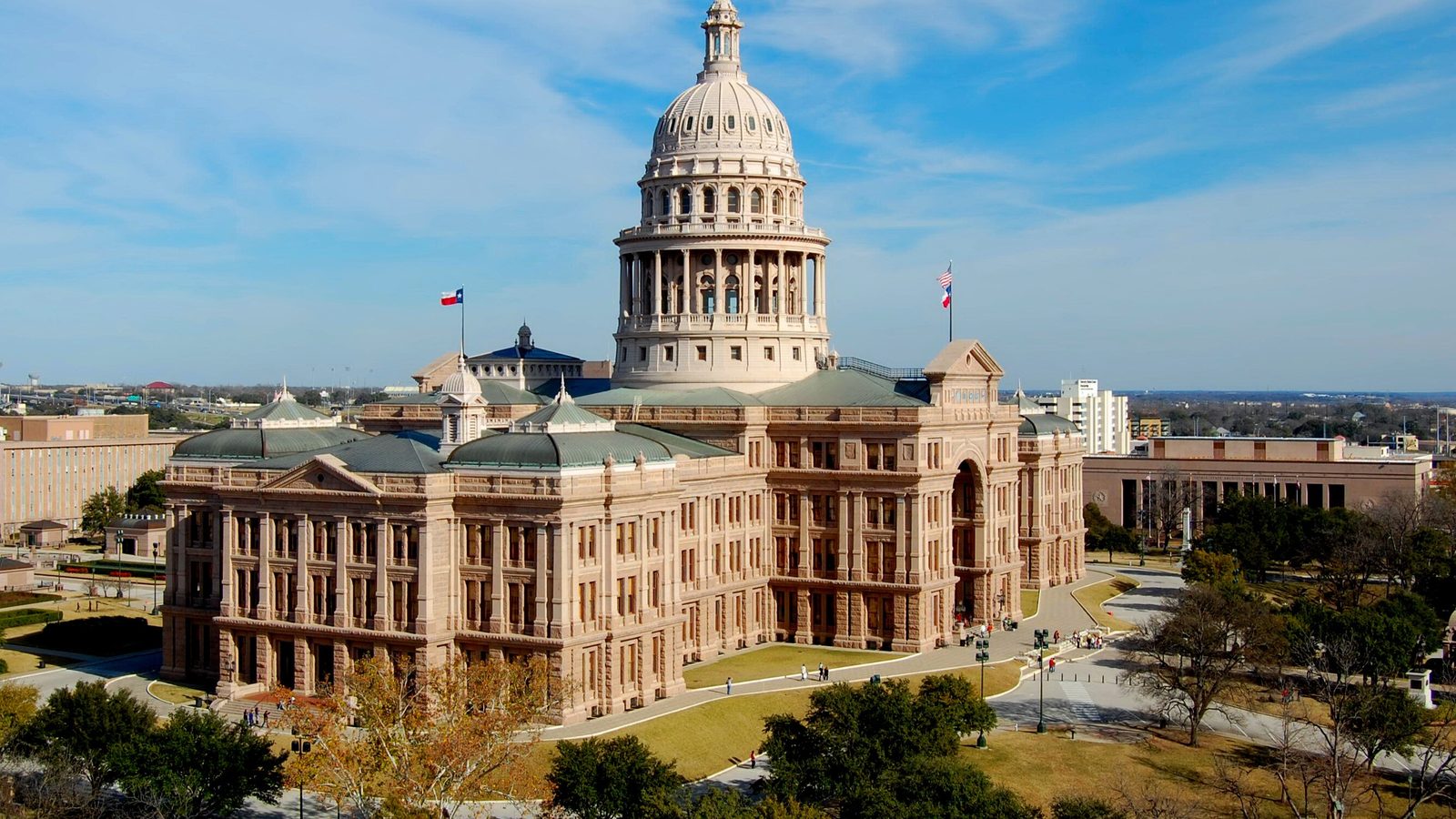

The Democrats win control of the Senate in 57% of our 5,000 simulations. The Republicans keep it in 38%, and in most of the rest an independent who has promised to sit with neither party holds the balance. Our projection is a 52-48 Democratic Senate, but no single race carries that result, and a modest polling miss would reverse it.
The arithmetic
Thirty-five seats are on the ballot: the 33 of class II and special elections in Florida and Ohio. The Democrats, with the two independents who caucus with them, hold 34 seats that are not up this year; the Republicans hold 31. Vice President JD Vance breaks a 50-50 tie, so the Democrats need 17 of the 35 races and the Republicans 19.
Line the races up by our chance of a Democratic win and the 51st seat, the one that hands over control in our projection, is Texas. James Talarico leads Ken Paxton by 1.5 points in our projection and wins 57% of simulations. Just behind sit Iowa, where Josh Turek wins 51% against Ashley Hinson, and Kansas, where Adam Hamilton wins 47% against Roger Marshall. All three are toss-ups, and none is separated by more than 1.5 points in our projection.
Which seat decides it
The simulation does more than draw that line once. In each run it orders the races from the winner's safest to its weakest and records the seat that gave the winner its 51st seat, or its 50th for the Republicans. No race does this often. Iowa is the deciding seat in 10% of simulations, and Kansas and the Ohio special in 9% each. Maine, Nebraska and Michigan follow on 8%, and Alaska, South Carolina and Minnesota on 7%. Texas, the seat at the line in our central projection, decides control in only 6% of runs. In all, 11 races are the deciding seat in at least 4% of simulations.
The spread follows from how the races move together. Every race shares the national environment and the national polling error. In a run where the Democrats do well across the country they take Texas and Iowa early, and the 51st seat falls further into Republican ground, in Kansas, Alaska or Nebraska. In a run where they do badly, the line falls back into races they currently lead: Maine, where Troy Jackson is on 61% against Susan Collins, Ohio, where Sherrod Brown is on 64% against Jon Husted, and Michigan, where Abdul El-Sayed is on 71% against Mike Rogers.
The two paths
For the Democrats, the shortest route is to win the 16 races where they lead by 1.9 points or more in our projection, which takes them to 50, and add one more from Texas, Iowa, Kansas or Alaska. Of those, Texas is the most likely. For the Republicans, the route is to win every race in which they lead, 17 of them, for 48 seats, and take two more. The two cheapest are the closest Democratic leads, Texas and Iowa.
Independents complicate both sums. Todd Achilles in Idaho, a former Democratic state lawmaker, has committed to staying out of either party's caucus if he wins, according to a July report carried by KOMO News, and KFGO reported on 13 October that Dan Osborn in Nebraska and Brian Bengs in South Dakota say they would not caucus with either party. Our forecast counts their seats apart from both parties. In a run where one of them wins and the other seats split evenly, the Democrats can reach 50 without control and the Republicans fall short of 50. That is the 6% of runs in which neither side controls the chamber. Osborn wins 38% of our simulations, Bengs and Achilles 14% each.
What a normal polling miss does
Our forecast already allows for the polls' record. It takes 2.1 points off the Democratic lead on the generic ballot, from D+8.8 in the polls to D+6.7 in our national House vote, and half the average statewide miss off each Senate race. The question is what happens if the polls miss again beyond that.
Our what-if page replays each past cycle's average error in the final Senate and governor polls on every race at once. Of the 12 cycles from 2002 to 2024, seven still leave the Democrats in control and five hand the Senate to the Republicans: 2002, 2014, 2016, 2020 and 2024. A repeat of 2024, which leaves the national lead 4.3 points more Republican than today's polls, flips Ohio, Maine, Texas and Iowa and gives the Republicans 52 seats. A repeat of 2020 gives them 54. A repeat of 2022 costs the Democrats only Iowa and leaves them in control on 51. The cycles in which the polls understated the Democrats most, 2010 and 2012, take them to 53 and 54.
The same page shows how fine the edge is. Moving the national House vote from our D+6.7 to D+5.7 still leaves a 51-49 Democratic Senate. At D+4.7, the Republicans win it 51-49. A miss of between one and two points against the Democrats, on top of the correction already made, is enough. The House, by comparison, stays Democratic until the national lead falls to about D+4.
The latest
The past week has gone the Republicans' way at the margin. Our reading of the national vote slipped from D+7.5 on 6 October to D+6.7, and every close race moved with it. Iowa fell from 63% for Turek to 51%, and Texas from 62% to 57%.
The newest race polls point both ways. Quantus Insights had Texas tied at 47 on 11 October, after Siena College had Talarico ahead by four. In Iowa, Emerson College had Hinson up two on 6 October. In Maine, The Washington Post and the Schar School had Jackson ahead 50 to 46, and Newsweek reported that Barack Obama endorsed him this week. YouGov had it level at 50 on 1 October.
Money is following the same map. KCUR, carrying a Kansas Reflector report, said Cook Political Report moved Kansas to Toss Up on 6 October, and NPR reported that Republican groups shifted money from the North Carolina Senate race to Kansas. Our forecast now gives Roy Cooper a 96% chance in North Carolina, which is why that seat no longer appears among the ones that decide control.
With three weeks left, the Democrats lead in enough races to win the Senate, but they lead the deciding ones by less than the polls have usually missed by.
Polling Forecast reads every poll in ten countries, corrects for how pollsters have missed before, and turns them into seats. Our forecasts, the polls and our methods are free to explore.
Elsewhere on Polling Forecast
 353 seats? The mega-poll's Labour majority comes from a split right, not tactical voting
Run the mega-poll's own vote shares through our model and Labour still gets 358 seats. The difference from our 316 is a weaker Conservative Party and a stronger Restore Britain, not the tactical voting the coverage focused on.
 Polls understated PiS in 31 of 32 final surveys since 2024
At four national votes since Tusk took office, final polls put PiS or its candidate too low. Our forecast makes no allowance for it.
 Private polls understated Spain's PSOE at six of eight elections
104 of 142 private final polls since 2004 had the PSOE too low, but even a repeat of 2023 would probably leave the PP and Vox a majority.