
Burnham's honeymoon looks brief by Ipsos's measure, longer by others'
Ipsos's long series puts Andy Burnham's start among the weakest since 1990, yet most pollsters rate him positively and Labour is six points up.
 Polling Forecast
5 min read
Written in house from our poll data and our forecast.
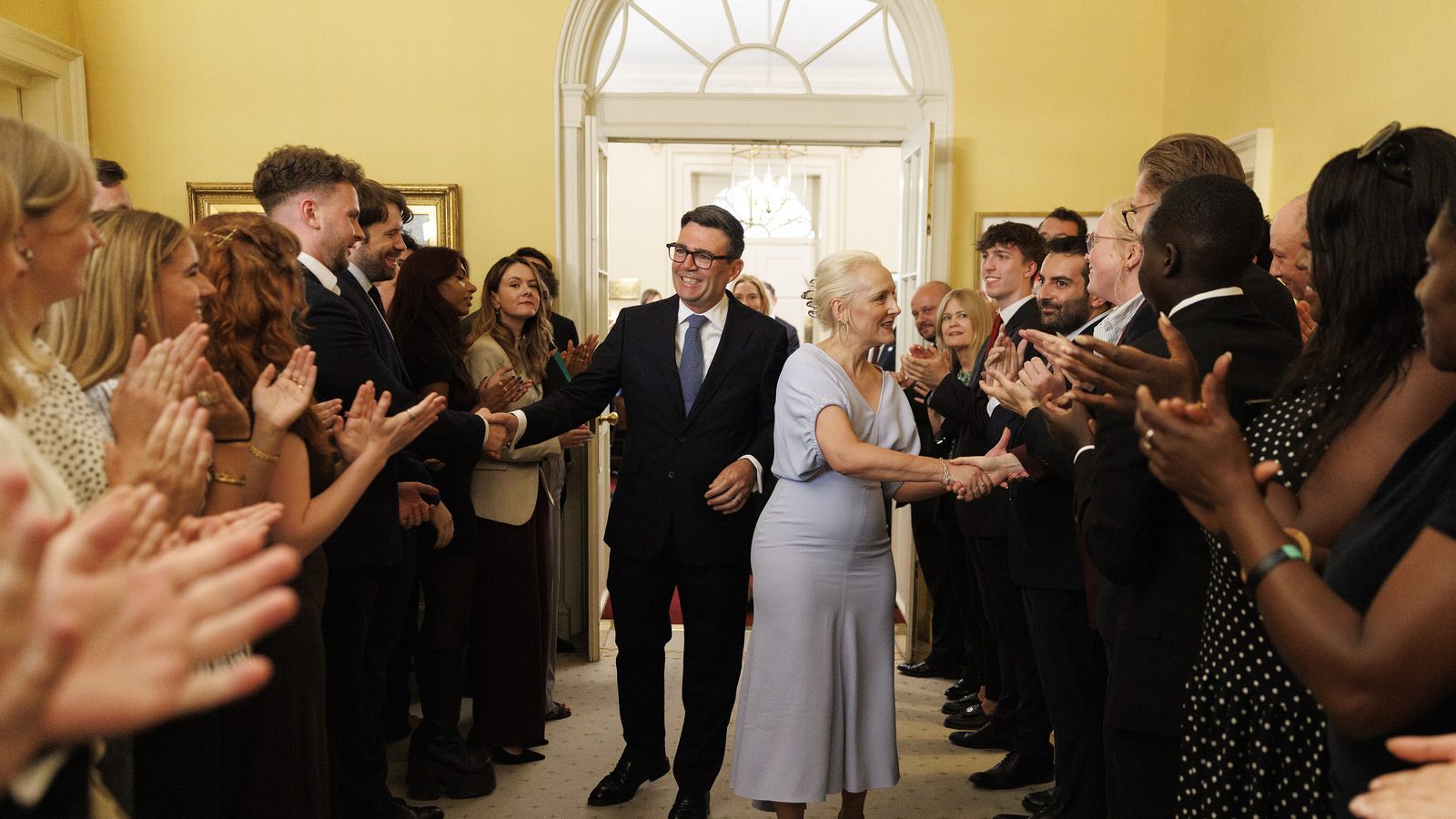

Andy Burnham's net satisfaction rating with Ipsos fell from minus 1 to minus 13 in his first two months as prime minister. In the pollster's series, which runs back to 1977, only three other prime ministers began at or below zero: Boris Johnson, Liz Truss and Rishi Sunak. Most other pollsters still rate him positively, and Labour has gained six points in our polling average since he took office on 20 July.
Ipsos's first reading, taken from 30 July to 4 August, found 29% satisfied with the way he was doing his job and 30% dissatisfied, with 41% unsure. By 10 to 15 September the satisfied share had barely moved, at 31%, but dissatisfaction had risen to 44% as the undecided made up their minds.
Ipsos since Callaghan
Our database holds every Ipsos satisfaction rating for every prime minister since 1977. Callaghan's series begins a year into his term and Thatcher's four months in, so neither shows a first reading. For everyone since, the opening months fall into two groups.
Five prime ministers began well clear of zero. Tony Blair scored plus 60 ten days after the 1997 election and plus 65 at about eight weeks. John Major reached plus 46 at a similar point, Theresa May began on plus 35 and David Cameron on plus 31. Gordon Brown started on plus 16 and was on plus 20 two months in.
Three began underwater. Boris Johnson opened on minus 7 and was on minus 18 by mid-September 2019. Rishi Sunak went from minus 8 to minus 21 in his first seven weeks. Liz Truss went from minus 2 to minus 51 in October 2022, the fastest fall in the series. Keir Starmer is the bridge between the groups: plus 7 three weeks in, then minus 21 at about ten weeks, a fall of 28 points.
Burnham, on minus 1, joins the second group. His fall of 12 points in six weeks is smaller than Starmer's or Truss's, but he began from a lower base than Starmer.
How long the good ratings lasted
The length of a honeymoon in Ipsos's figures varies widely. Blair's net rating stayed positive for 1,152 days, more than three years. Major's lasted 671 days, May's 323 and Cameron's 258. Brown's turned negative after 118 days, in the autumn of 2007. Starmer's lasted 74 days at most: his second Ipsos reading was already negative.
Low points matter as well as starts. Starmer fell to minus 71 in late 2025, with 11% satisfied and 82% dissatisfied, the lowest rating in the Ipsos series we hold. The next lowest were Major and Sunak on minus 59 and Thatcher on minus 56. Burnham replaced a prime minister who was on minus 59 in Ipsos's final reading for him, in June 2026.
Other pollsters are kinder
Ipsos asks whether people are satisfied with how the prime minister is doing his job. Most other pollsters ask whether people view him favourably, or approve of his performance, and their figures for Burnham are positive. More in Common had him on plus 14 in mid-August and plus 16 on 5 October. Survation went from plus 19 in mid-August to plus 15 on the same date, while Deltapoll moved from plus 26 to plus 21 and Public First from plus 18 to plus 15 between August and September. Opinium, which polls weekly, put him on plus 16 at the end of July and plus 8 on 2 October, with approval up three points and disapproval up 11.
In our database only Ipsos has him below zero. The direction is mixed: Ipsos, Opinium, Survation, Deltapoll and BMG Research show falls since August, while More in Common, Freshwater Strategy and Find Out Now show small rises. The comparison with his predecessor is stark on any measure. Opinium's last reading for Starmer, in mid-July, was minus 38, 46 points below Burnham's latest.
What it did for Labour
A new prime minister's ratings tend to move with his party's, at least for a while. On 19 July, the day before Burnham took office, our average of each pollster's latest poll in the previous 28 days had Labour on 22%, Reform UK 25%, the Conservatives 20% and the Greens 13%. By 12 October Labour was on 28%, Reform 23%, the Conservatives 21% and the Greens 10%.
Most of Labour's rise came in the first four weeks: by 19 August it was on 26%. Sir John Curtice told The Independent on 1 September that the bounce was over after two weeks. Since then Labour has added 1.7 points in our average, a slow drift rather than a jump. Of the 71 voting-intention polls in our database with fieldwork ending after 20 July, Labour led in 50 and tied in five. From May until Burnham took over, it led in one of 66.
Where the gain came from matters. Labour's six points are matched by falls of 3.5 points for the Greens, 1.6 for the Lib Dems and 1.5 for Reform. Tim Bale of Queen Mary University of London told Al Jazeera that "very little" of the recovery came from Reform voters. The net changes in our average are consistent with that, though they cannot show who switched.
History suggests early bounces fade. Labour led most polls in the summer of 2007, under a new prime minister with positive ratings, and trailed the Conservatives by the end of the year after Brown decided against an autumn election. The Conservatives held large poll leads through May's first year in 2016 and 2017 and then lost their majority at the June 2017 election. Major's honeymoon, by contrast, lasted long enough to win him the 1992 election.
The tests ahead
Labour's conference in Liverpool at the end of September was upbeat, Channel 4 News reported, but the government faces a budget that Bale described as "going to be tough". Peter Kellner told The Independent that Labour would need a sustained double-digit lead for six to eight weeks before an early election made sense. On our average its lead over Reform is five points.
On Ipsos's measure, Burnham's start resembles Johnson's and Sunak's more than Blair's or Major's. On most other measures he remains more popular than not. Next May's local elections will be the first large test of which reading is nearer the mark.
Polling Forecast reads every poll in ten countries, corrects for how pollsters have missed before, and turns them into seats. Our forecasts, the polls and our methods are free to explore.
Elsewhere on Polling Forecast
 When the polls agree too much: herding, and how our forecast guards against it
Polls of a close race should scatter by chance. In 2024 they barely did. Here is why that matters, and the four things our model does so a pack of look-alike polls cannot make it overconfident.
 Polls understated PiS in 31 of 32 final surveys since 2024
At four national votes since Tusk took office, final polls put PiS or its candidate too low. Our forecast makes no allowance for it.
 Private polls understated Spain's PSOE at six of eight elections
104 of 142 private final polls since 2004 had the PSOE too low, but even a repeat of 2023 would probably leave the PP and Vox a majority.