
Greens have shed two-fifths of their poll peak, Reform a quarter
The Greens have lost a larger share of their peak support than any other party, yet the two by-elections they fought hardest were their best since 2015.
 Polling Forecast
5 min read
Polling Forecast
5 min read
Written in house from our poll data and our forecast.


The Greens have lost 41% of their peak poll support in six months, a bigger proportional fall than any other party's. On a simple average of each pollster's latest poll in the previous 28 days, they stood at 16.8% on 8 April and on 9.9% on 12 October, almost exactly where they were a year ago. Our headline poll average, built slightly differently, has them on 10.5%. Reform UK, whose decline has drawn far more attention, is down 27% from its own peak, from 31.7% in October 2025 to 23.1%.
In points, Reform's fall is the larger, 8.6 against 6.9. But the Greens started from a smaller base, and they have lost two of every five voters they held at the top. The pattern is not the work of one pollster. Taking each firm's three-poll average, eight of the ten pollsters still active since mid-August show the Greens losing a larger share of their peak than Reform. YouGov has them down 43%, Find Out Now 42% and More in Common 39%. Ipsos and Lord Ashcroft Polls are the exceptions.
Reform's figure needs one caveat. Restore Britain, which several pollsters began to list in the spring, now takes 2.7% in our headline average, which counts only the polls that list it. Counting the two together, the fall from Reform's peak is 19%, still under half the Greens' rate.
Half the fall came before Burnham
Labour's recovery under Andy Burnham, prime minister since 20 July, is the obvious explanation, and Reuters reported last week that his tougher line on Israel and more ambitious approach to the EU had won back left-leaning voters. But the Greens were already falling. Between their April peak and 19 July they dropped 3.4 points, to 13.4%. They have lost another 3.5 points since.
Comparing each pollster's polls from 1 June to 19 July with its polls from 20 August to 12 October gives 11 firms with figures on both sides. Labour rose in all 11, by 6.0 points on average. The Greens fell in all 11, by 2.4, and so did the Lib Dems, by 1.7. Reform fell in 10, by 2.5 on average, but the Conservatives rose by 0.7 and Restore Britain by 1.1, so the three parties of the right together lost 0.7. The Greens and Lib Dems together lost 4.1 points, more than the right lost in 10 of the 11 series. Freshwater Strategy is the exception.
These are net changes and cannot show who switched. Tim Bale of Queen Mary University of London told Al Jazeera that "very little" of Labour's recovery came from Reform voters, which fits the figures. Part of More in Common's Reform fall also coincides with it adding Restore Britain to its list.
The leader trails his party
Zack Polanski's own ratings have fallen further. Each of the seven pollsters that have rated him repeatedly since late 2025 or early 2026 now has him 18 to 29 points below his best reading with them. Opinium had him level in November 2025; its latest, on 9 October, is minus 29. Ipsos has gone from minus 5 to minus 28 and More in Common from minus 6 to minus 28. Survation, the kindest to him, had him on plus 11 in March and has him on minus 15 now.
The sharpest drop came in spring. Ipsos, More in Common, Opinium and Freshwater Strategy each recorded their biggest monthly fall between April and May, the month of the local elections. Nigel Farage has slid too, but more slowly: Opinium had him on minus 5 in September 2025 and minus 26 on 9 October.
Where a pollster rated Polanski and his party in the same poll, he ran 5 points behind it on average, and behind it in 28 of 35 cases. Farage has run 1.8 points behind Reform in 54 such polls. Over the past 90 days of paired polls, 22% had a good view of Polanski and 27% of the Greens. Survation is the exception: in its last three polls he is ahead of his party. Ben Walker of the New Statesman, quoted by The Week, said the Greens "may have just reached their natural ceiling".
Except where they fight
The national slide sits beside the party's two best by-elections in our records. Our by-election check compares each party's result with what the national polls implied: its share in the seat at the previous general election, scaled by its change in the polls since. It covers 39 by-elections in Great Britain since 2015, leaving out those where the main parties stood aside, and the Greens stood in 33.
In Gorton and Denton in February, Hannah Spencer won 40.7%, 15.7 points above the 24.9% the polls implied, and took the seat from Labour. Sir John Curtice called the result "seismic". In Holborn and St Pancras on 8 October, Polanski took 32.8%, 18.6 points above the 14.2% implied, but lost to Labour's Sagal Abdi-Wali by 3,364 votes. No other Green by-election result since 2015 beat its implied share by more than 0.9 points. In the other 31 contests the party ran 2.2 points below it on average, and below it in 26.
The gap between the seats the party fights and the rest was stark this year. In Makerfield in June, where Burnham entered the Commons with 54.8%, the Green candidate took 0.7% against an implied 7.8%. In Aberdeen South the same day, the Scottish Greens took 3.4% against 7.0%.
Holborn is open to two readings. The Green share rose 22.4 points on 2024, which a party spokesperson called an "incredible result", ITV reported. But it was a loss in a seat the party had hoped to win, and Polanski is under pressure over his decision not to vote on a conference motion declaring Zionism racism. Caroline Lucas said he "should have been there", ITV reported. Polanski told Reuters that many voters on the doorstep "want to give Andy Burnham a chance".
What it means for seats
Our projection gives the Greens 4 seats, in a range of 4 to 6. Since this week it starts seats that have held a by-election from that result rather than from 2024, and moves them with the national polls since. Even so, Gorton and Denton, which has a Green MP, shows as a Labour gain, with Labour on 38.0%, the Greens on 28.9% and Reform UK on 21.9%, and the Greens keep it in only 8% of our simulations. Holborn and St Pancras shows the Greens on 23.8% against Labour's 44.1%, well short of what Polanski won last week. Survation's poll of Gorton and Denton for Datapraxis in March, after the by-election, still had the Greens first on 37.5%.
The two contests show what a party on 10% nationally can do when it pours its activists into one seat against a weakened Labour Party, and also the limit. When Gorton and Denton voted, Labour was on 19.6% in the simple average. By polling day in Holborn it was on 28.5%, and it held on. A general election does not let a small party concentrate its effort in one place, and the national figures are the better guide to how wide the Greens' appeal now runs. On those, the party has given back almost everything it gained after Polanski became leader in September 2025.
Polling Forecast reads every poll in ten countries, corrects for how pollsters have missed before, and turns them into seats. Our forecasts, the polls and our methods are free to explore.
Elsewhere on Polling Forecast
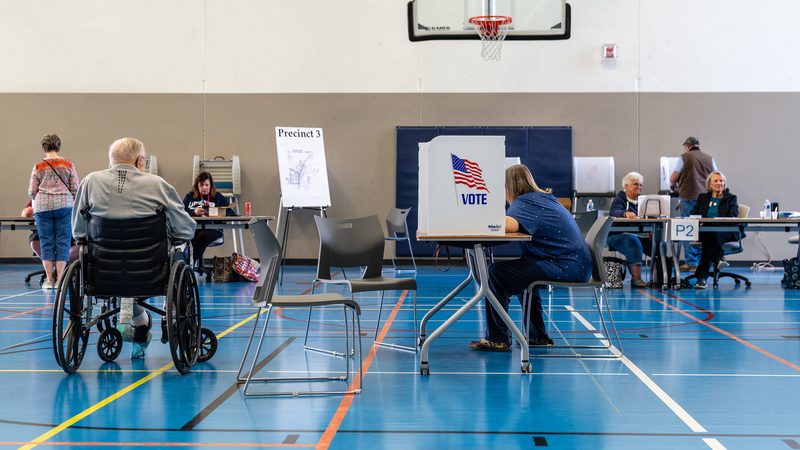 North Carolina mail ballots trail 2022 pace equally for both parties
Measured against their own registered voters, North Carolina Democrats and Republicans are returning mail ballots at about 70 percent of their 2022 pace, with Maine ahead.
North Carolina mail ballots trail 2022 pace equally for both parties
Measured against their own registered voters, North Carolina Democrats and Republicans are returning mail ballots at about 70 percent of their 2022 pace, with Maine ahead.
 Polls understated PiS in 31 of 32 final surveys since 2024
At four national votes since Tusk took office, final polls put PiS or its candidate too low. Our forecast makes no allowance for it.
Polls understated PiS in 31 of 32 final surveys since 2024
At four national votes since Tusk took office, final polls put PiS or its candidate too low. Our forecast makes no allowance for it.
 Private polls understated Spain's PSOE at six of eight elections
104 of 142 private final polls since 2004 had the PSOE too low, but even a repeat of 2023 would probably leave the PP and Vox a majority.
Private polls understated Spain's PSOE at six of eight elections
104 of 142 private final polls since 2004 had the PSOE too low, but even a repeat of 2023 would probably leave the PP and Vox a majority.