
YouGov's Labour share now runs four points below other pollsters
Through 2025 YouGov's Labour figure matched the rest of the industry. Since spring a four-point gap has opened, and YouGov's own first-stage answers show little of it.
 Polling Forecast
6 min read
Polling Forecast
6 min read
Written in house from our poll data and our forecast.
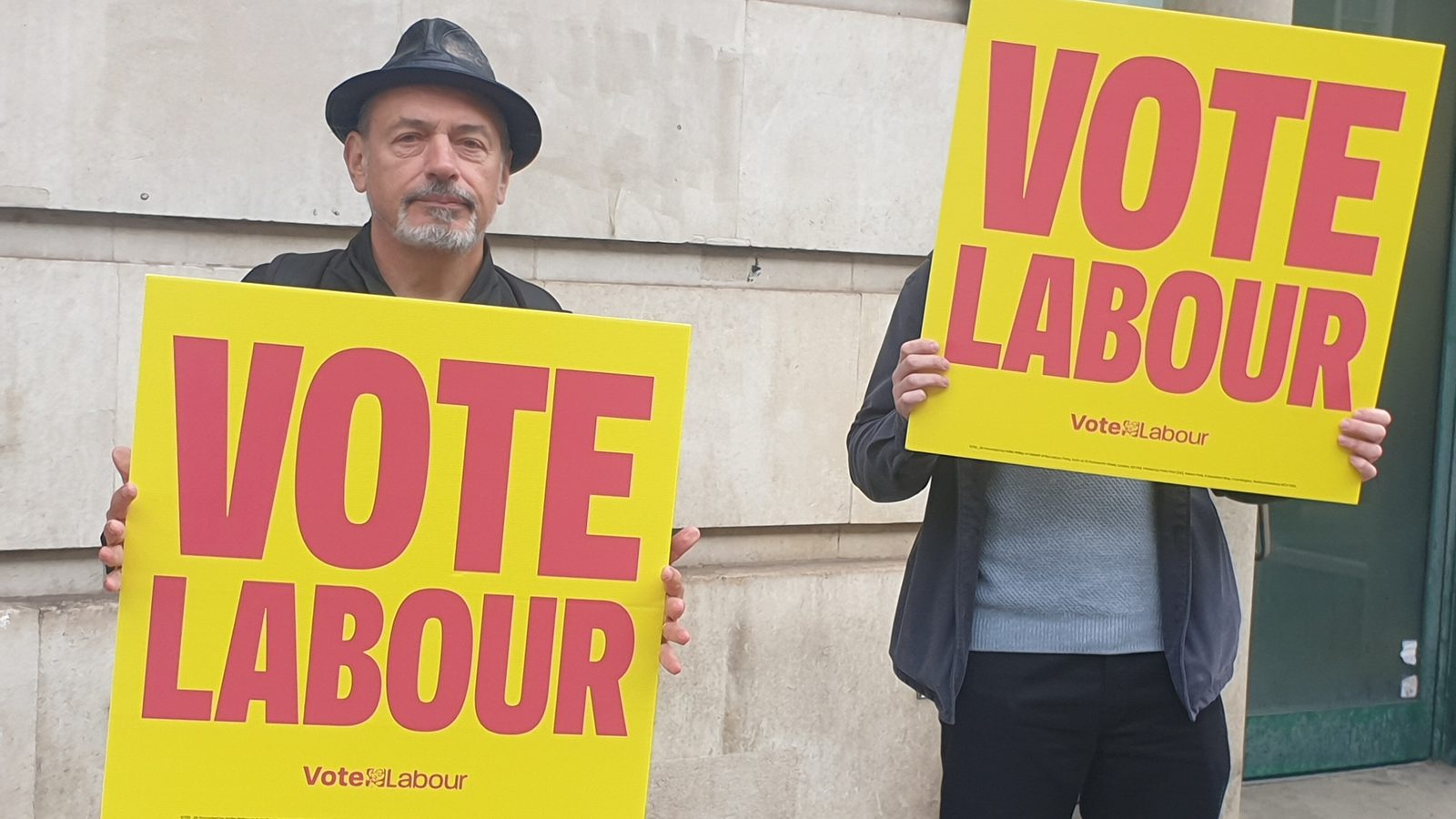

YouGov now puts Labour about four points lower than other pollsters do. In the third quarter of 2026 its Labour share averaged 4.1 points below the average of other firms polling at the same time. In every quarter of 2025 the gap was under a point. Labour's lead over the Conservatives shows the same drift: YouGov had it between 0.4 and 1.1 points larger than other pollsters in each quarter of 2025, and 4.2 points smaller in the third quarter of 2026.
This is a house effect, the usual difference between one pollster's figures and everyone else's, and it has a clear methodological source. YouGov's headline is not a straight count of what its respondents said. It is the output of a statistical model. Our database holds the published tables behind all 95 of YouGov's regular voting intention polls since January 2025, and since March those tables have included the answers at each stage of the process. They show where the gap opens.
How we measured it
For each YouGov poll we took every poll by another firm whose fieldwork midpoint fell within ten days, averaged each firm's polls first so that the most frequent pollsters did not dominate, and subtracted that average from YouGov's figure. We required at least three other firms, then grouped the differences by quarter.
The result does not depend on the comparison set. Against online opt-in panels only, leaving out Ipsos and Verian, which use probability panels, the third-quarter gap is 4.0 points. Leaving out More in Common, the most frequent other pollster, it is 4.1. Against the four weekly trackers alone (More in Common, Find Out Now, Opinium and Techne) it is 2.9. A simple poll-by-poll average gives 3.7. On England-only figures the gap is 3.4 points, against 0.1 in the last quarter of 2025.
The drift also shows head to head. We matched each YouGov poll with every poll by a given firm within seven days. Ten firms polled in both the first half of 2025 and since July 2026, and YouGov's Labour figure now sits lower relative to all ten than it did. Against More in Common it went from 0.2 points higher to 3.5 lower. Against Find Out Now it went from 1.4 higher to 0.7 lower, and against Deltapoll from 1.5 lower to 6.7 lower.
YouGov's large MRP seat projections, a separate product, follow the same path. Its projections from June and September 2025 put Labour 0.4 points below other pollsters at the time. Its September 2026 projection put Labour on 24 per cent, 3.1 points below.
What a modelled headline is
Most British pollsters work in a familiar way. They weight their sample to match the population, ask people how likely they are to vote, set aside those who do not know, and report the shares of the rest. YouGov builds its headline differently. Its main question names the parties standing in the respondent's own constituency. Those answers feed a model, known as MRP (multilevel regression and post-stratification), which estimates how each type of voter, defined by things such as age, education, past vote and where they live, would vote and how likely they are to turn out. People who say they do not know are given a likely vote based on people like them. The model then adds those estimates up across the whole electorate. YouGov said on X in June 2024 that its regular polls had moved to a method which "mirrors that which we use for our MRP".
So the headline is an estimate of what the electorate would do, not a tally of what the sample said. That can be a strength, since a model can steady an unusual sample. It also means YouGov's figures can differ from other firms' because of choices made after the fieldwork is done.
Mark Pack's newsletter The Week in Polls reported in March that YouGov's co-founder Peter Kellner described two stages. A standard question, he said, gives results "fairly close" to other pollsters'. The constituency question "hurts Reform and helps the Lib Dems". Kellner put the model's further effect at no more than one point for any party. YouGov's Patrick English pointed to turnout modelling, and to YouGov using its own panel while most rivals use shared ones. Pack reported that YouGov had agreed to publish the standard question in its tables, and our database has it for every poll since 10 March.
Where the gap opens
The three stages let us follow Labour's figure through the process, with don't knows, refusals and won't-votes set aside. In the third quarter of 2026, on the standard question Labour was 0.8 points below other pollsters' headline average. On the constituency question it was 3.1 points below. In the published headline it was 3.9 below. For Labour's lead over the Conservatives the three stages read 0.3 points above the others, 2.3 below and 4.1 below.
One caution applies. The raw stages carry no turnout adjustment, while other firms' headlines do, so this is not an exact like-for-like test. But the pattern fits Kellner's description, and the model's share of it has grown. Across 51 polls in 2025 the model step left Labour's share, on average, exactly where the constituency question put it. In the 16 polls since July it has taken 1.0 point from Labour and 1.6 from the Greens, and added 1.1 to the Conservatives and 1.4 to Reform. Restore Britain is not listed separately in the constituency question tables but receives 3.4 points in the headline.
The latest poll, with fieldwork on 11 and 12 October, shows each step. Across Great Britain, Labour led the Conservatives by 9.2 points on the standard question, 3.9 on the constituency question and one point in the published headline of 24 to 23. In England the constituency question gave Labour a 4.0-point lead and the headline had the two parties level. Brit Brief reported YouGov's Anthony Wells saying the week's changes were within the margin of error and might reflect a temporary conference bounce for the Conservatives.
Timing, Reform and the Burnham recovery
The Labour gap began to open in the spring and passed two points in April, before Keir Starmer announced his resignation on 22 June, as AFP reported. It widened over the summer. Andy Burnham was confirmed as Labour leader unopposed on 17 July, according to agency reports, and became prime minister on 20 July. Between June and September, Labour's monthly average rose 6.4 points in other firms' polls and 4.7 points in YouGov's. YouGov records the recovery, but a smaller one.
Meanwhile YouGov's best-known house effect has faded. In the first quarter of 2026 it had Reform 4.0 points below other pollsters, in line with the four-point gap Pack reported in March. In the third quarter the gap was 0.8 points. YouGov's Liberal Democrat figure has stayed about two points above the others throughout.
What the record shows
Only an election can show which approach comes closer this time, and different methods have come closest at different elections. At the 2024 general election, YouGov's final poll, under the current method, put Labour on 37 per cent. That was below the 38.7 average of the 22 final polls in our database and nearer Labour's 34.7 per cent result. Pack has called YouGov's record pretty good, and its 2024 MRP seat projection ranked about best of 13 on his measure. Pack has also written that the constituency approach has suited some elections more than others, and that 2015 showed neither approach can simply be called right.
Our pollster ratings grade YouGov B, the same grade as Opinium, Ipsos and Survation. YouGov publishes more often than almost anyone, with 95 regular polls in our database this parliament, so its house effect carries weight in any simple average. Our current average, with polls to 12 October, has Labour on 27.3 per cent and YouGov's latest poll has 24. Readers who want to see the difference can use our tool for trusting only chosen pollsters. Our projection makes Labour the largest party in 94% of simulations, on 313 seats.
Polling Forecast reads every poll in ten countries, corrects for how pollsters have missed before, and turns them into seats. Our forecasts, the polls and our methods are free to explore.
Elsewhere on Polling Forecast
 North Carolina mail ballots trail 2022 pace equally for both parties
Measured against their own registered voters, North Carolina Democrats and Republicans are returning mail ballots at about 70 percent of their 2022 pace, with Maine ahead.
North Carolina mail ballots trail 2022 pace equally for both parties
Measured against their own registered voters, North Carolina Democrats and Republicans are returning mail ballots at about 70 percent of their 2022 pace, with Maine ahead.
 Polls understated PiS in 31 of 32 final surveys since 2024
At four national votes since Tusk took office, final polls put PiS or its candidate too low. Our forecast makes no allowance for it.
Polls understated PiS in 31 of 32 final surveys since 2024
At four national votes since Tusk took office, final polls put PiS or its candidate too low. Our forecast makes no allowance for it.
 Private polls understated Spain's PSOE at six of eight elections
104 of 142 private final polls since 2004 had the PSOE too low, but even a repeat of 2023 would probably leave the PP and Vox a majority.
Private polls understated Spain's PSOE at six of eight elections
104 of 142 private final polls since 2004 had the PSOE too low, but even a repeat of 2023 would probably leave the PP and Vox a majority.