
The worst Labour polling miss since 1970, hidden by a landslide
Every final poll put Labour too high, by four points on average. The landslide made the seat calls look right, so pollsters escaped the inquiries of 1992 and 2015.
 Polling Forecast
8 min read
data as of 15 October
Polling Forecast
8 min read
data as of 15 October Written in house from our poll data and our forecast.
.jpg)
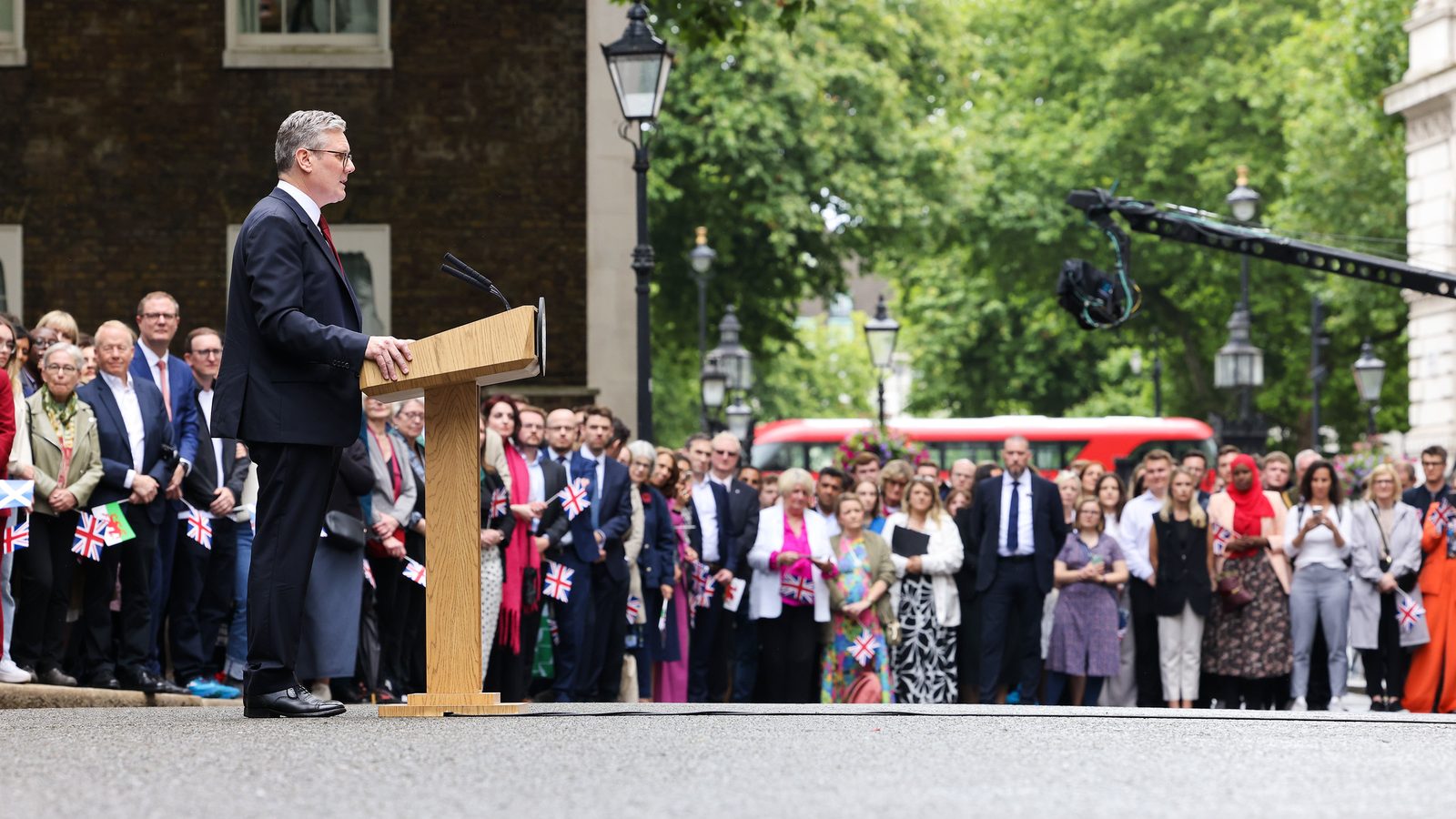
By the morning of 5 July 2024 Labour had 411 seats and a majority of 172. The polls had said a landslide was coming, and a landslide came. On the night, that looked like a good election for the polling industry.
It was one of its worst. Every one of the 22 final polls we hold overstated Labour. On average they had the party on 38.7 per cent in Great Britain; it won 34.7. On Mark Pack's PollBase, which holds final polls back to 1945, only 1970 overstated Labour by more. The polls put Labour 17.7 points ahead of the Conservatives. The real lead was 10.3, so they were out by 7.4 points on the one number most people read.
The last two misses of that order, in 1992 and 2015, each led to a formal inquiry into what went wrong. After 2024 there was none. The seat count came good, and the vote share was waved through.
Wrong in one direction, every time
We compared each pollster's final published figures with the official Great Britain result from the UK Parliament's election database. Not one poll had Labour too low. The closest were Verian, Prolific and PeoplePolling, 1.3 points too high on 36 per cent. Opinium, Number Cruncher Politics, Redfield & Wilton and We Think had Labour on 41, 6.3 points too high. Twelve of the 22 were out by four points or more. Leave out the two estimates that came only from MRP models and nothing changes: the other 20 were all too high, by 3.9 points on average. The British Polling Council's own table of 19 member polls tells the same story, Labour on 38.6 against 34.7.
The error ran the same way for the other main parties. The Conservatives were 3.4 points too low on average, and not one of the 22 polls had them too high. Reform UK was 1.6 points too high, in 21 of the 22. The Liberal Democrats came out 1.1 points low and the Greens 0.4 low.
Set against the other elections in our database, 2024 is out on its own. The final polls overstated Labour by 1.8 points in 2015 and 0.6 in 2019, and understated it by 4.5 in 2017. Before 2024 no final poll in our record had overstated Labour by more than 3.8 points. In 2024 twelve did. Will Jennings of the University of Southampton told PoliticsHome in August 2024 that the overestimate of Labour was the highest on record and the error on the margin the worst since 1992.
How the landslide covered for them
The miss survived because of how British votes turn into seats. Labour won 63 per cent of the seats on 33.7 per cent of the UK vote. It won 9.7 million votes in Britain, fewer than the 10.3 million it took in 2019, when Jeremy Corbyn led it to 202 seats. Marta Miori and Jane Green, writing in The Political Quarterly in 2025, found that Labour lost votes in safe seats and gained them in marginal ones. Its wasted votes fell from 50 per cent of its total in 2019 to 22 per cent.
The split on the right did the rest. Reform UK stood almost everywhere and took 14.7 per cent in Britain. In 144 of the 411 seats Labour won, the Conservative and Reform candidates together polled more than the Labour winner, by our count of the constituency results. With the Conservatives on 24 per cent, a Labour vote four points smaller than the polls said still cleared the bar in most seats.
So the seat calls looked right even when the inputs were wrong. The seven final MRP models listed by the British Polling Council gave Labour between 420 and 470 seats, an average of 441, against 411. Survation's model had the Conservatives on 68; they won 121. Every model called a landslide, there was a landslide, and the errors underneath drew little attention.
Some in the industry said as much. Patrick English of YouGov, writing on his own Substack after the election, called the Labour miss "not a large one" and said it did not change the narrative of the result. Martin Boon of Deltapoll took the other view. "I don't believe my industry deserves another free pass," he told PoliticsHome.
The inquiry that never happened
In 1992 the polls said a hung parliament and John Major won a majority. The Market Research Society held an inquiry. In 2015 the polls said a dead heat and David Cameron won outright. The British Polling Council and the Market Research Society set up an independent inquiry led by Patrick Sturgis, which traced the error to unrepresentative samples.
The 2024 Labour overstatement was larger than 2015's and close to 1992's. The response was smaller. The British Polling Council collected reviews from nine of its members and held one public session, in May 2025. Its summary says the specific causes "remain unclear". There was no independent panel this time.
Why they were so far out
The evidence points mainly at turnout. UK turnout was 59.7 per cent, down from 67.3 in 2019 and, according to Full Fact, the second lowest since 1918. The polls were built for a far bigger electorate. A presentation at the BPC session calculated that ten member polls implied a turnout of 69 per cent of adults; 53 per cent of the voting-age population actually voted. In Survation's recontact study, 79.5 per cent of respondents said they had voted. Verian had fixed its turnout target at 31.5 million, the level of 2017 and 2019, when about 28 million voted in Britain; re-weighting to the real figure took a point off Labour. Martin Rosenbaum, reviewing the submissions, found that BMG, Electoral Calculus and YouGov all said the polls overestimated how many Labour supporters would vote. On the pollsters' own accounts, more Labour supporters said they would vote than did, and the polls took them at their word.
Late swing, the explanation that puts the error on voters rather than on methods, has mixed evidence. Survation said its final poll had no systematic error and that voters changed their minds after fieldwork: its recontacts showed a Labour lead of 12.1 points, against 17.7 in the poll. More in Common put late movement at about one point. But Verian recontacted 1,482 of its final-poll respondents and found no late swing away from Labour. A presentation on late swing at the BPC session concluded it was not the main cause: recontact polls still had Labour too high and the Conservatives too low, and pollsters with later fieldwork did no better.
Samples mattered too. BMG ran two parallel polls in April 2024 and found that without its quotas for voters over 75, Labour's lead rose from 17 points to 23. Focaldata found its most politically engaged respondents leaned to Labour, and More in Common said the Muslim subsamples in UK polls were not representative. There was some sign of hidden Conservative voters: one pollster saw non-committal answers rise from 4 per cent in 2019 to 11 per cent, and undecided respondents leaned Conservative once pressed. There is no sign of hidden Reform voters, since the polls overstated Reform. Weighting to past vote was looked at closely and largely cleared. The idea that a big lead made Labour voters complacent is plausible, but we found no study that tests it.
What has changed since
Each company has made its own changes. Focaldata said in April 2025 that it now weights by recalled past vote and by political interest, and that the two together would have cut its Labour figure from 40.1 to 38.2. YouGov said it would model turnout from demographics alone, according to Rosenbaum. Verian built a new turnout estimate. More in Common set out plans in August 2024 to recruit more representative Muslim panellists and revise its turnout model for young voters. At the BPC session BMG and More in Common urged the industry to weight by education and set quotas for the over-75s. Survation said it would stay cautious about reactive changes.
The central question is still open. The British Election Study released its 2024 face-to-face random-sample survey in August 2025, the evidence several pollsters said they were waiting for. We found no published analysis from it that settles why the polls overstated Labour.
No landslide to hide behind next time
The next election will not be so forgiving. Today's polls put Labour on 27.1 per cent, Reform UK on 22.8 and the Conservatives on 21.2. With three parties that close, a four-point error on one of them moves scores of seats.
Our projection does not take the pollsters' figures on trust. It starts from what respondents actually said, before the pollsters' turnout and don't-know adjustments, measured in England, where every main party stands. In 2024 those raw answers overstated Labour in England by 6.1 points. Over the last four elections they overstated Labour by 2.0 points on average, and we take half of that off: 1.0 point from Labour, 2.0 added to the Conservatives, 0.6 off Reform.
That correction for Labour is modest, and we should be plain about why. In 2017 the miss ran the other way, and averaging four elections cancels much of 2024. When we tested the method blind, predicting each election only from the ones before it, it was further out than the pollsters on Labour in 2024, 5.7 points against 4.8, though across all five parties it matched them that year and beat them on average.
So we carry the risk in the range as well as the figure. Our 80 per cent range for Labour in England is 3.9 points either way, set by the size of the last four misses, and our what-if page replays each past miss on today's polls. If today's polls are as wrong as they were in 2024, Labour falls from 314 seats in our projection to 256, with the Conservatives on 203 and Reform UK on 57: 70 seats short of a majority. In 2024 a four-point miss on Labour cost the pollsters nothing. Next time the same miss would be worth 58 seats.
Polling Forecast reads every poll in ten countries, corrects for how pollsters have missed before, and turns them into seats. Our forecasts, the polls and our methods are free to explore.
Elsewhere on Polling Forecast
 North Carolina mail ballots trail 2022 pace equally for both parties
Measured against their own registered voters, North Carolina Democrats and Republicans are returning mail ballots at about 70 percent of their 2022 pace, with Maine ahead.
North Carolina mail ballots trail 2022 pace equally for both parties
Measured against their own registered voters, North Carolina Democrats and Republicans are returning mail ballots at about 70 percent of their 2022 pace, with Maine ahead.
 Polls understated PiS in 31 of 32 final surveys since 2024
At four national votes since Tusk took office, final polls put PiS or its candidate too low. Our forecast makes no allowance for it.
Polls understated PiS in 31 of 32 final surveys since 2024
At four national votes since Tusk took office, final polls put PiS or its candidate too low. Our forecast makes no allowance for it.
 Private polls understated Spain's PSOE at six of eight elections
104 of 142 private final polls since 2004 had the PSOE too low, but even a repeat of 2023 would probably leave the PP and Vox a majority.
Private polls understated Spain's PSOE at six of eight elections
104 of 142 private final polls since 2004 had the PSOE too low, but even a repeat of 2023 would probably leave the PP and Vox a majority.