
Reform UK has lost over a quarter of its peak support
A year ago Reform led on 31%. It now averages 23%, one poll has it third, and Farage is less popular than his party.
 Polling Forecast
6 min read
Polling Forecast
6 min read
Written in house from our poll data and our forecast.
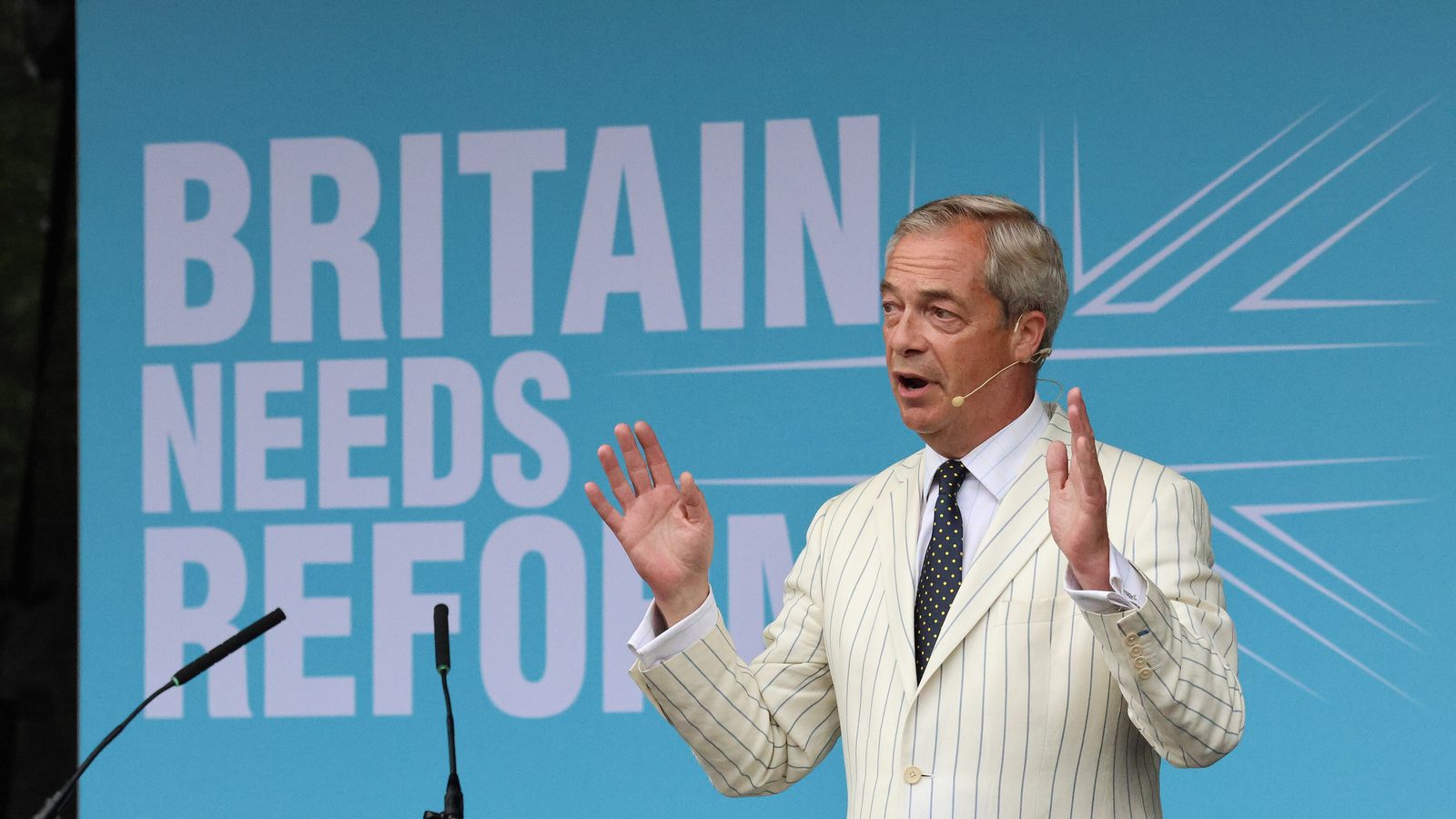

YouGov's latest poll, taken on 11 and 12 October, puts Reform UK third on 21%, behind Labour on 24% and the Conservatives on 23%. A year ago it led our poll average on 31%. Our average now has it on 23.1%, second, 4.2 points behind Labour. It has lost more than a quarter of the support it had at its peak.
One poll in third place is not a trend on its own: YouGov had Reform on 22% a week earlier, and Opinium, Survation and More in Common all still have it second. But YouGov is not alone. More in Common's poll of 25 to 29 September and Lord Ashcroft's at the start of September also had Reform third. In September, every poll we hold put Reform somewhere between 19% and 25%. Twelve months ago, 30% was normal and the best polls had it at 35%.
How far it has fallen
Reform first topped a national poll in January 2025 and went ahead in our average in April. It passed 30% in May 2025, stayed around there until November, and peaked at 31.6% in September. Then the slide began, gently at first: 29.0% at the end of January, 26.5% at the end of March, 24.1% at the end of July and 22.9% at the end of September.
Two things changed in the summer. Andy Burnham won the Makerfield by-election in June, Keir Starmer resigned, and Burnham became Prime Minister on 20 July. Labour has gained 6.6 points in our average since July, and Labour moved back ahead of Reform in our average at the end of July. Then in September the Conservatives began to recover. YouGov's poll this week has them up three points, and they were the biggest movers in our average this week.
A leader less popular than his party
The common view is that Nigel Farage is Reform's biggest asset, a leader better liked than the party he leads. The polls that ask about both, in the same survey and in the same way, say the opposite. We hold 54 of them since July 2024. In those, Farage's net rating has averaged about 2 points below Reform's, and over the last three months 30% had a good view of him against 31% for the party. Ipsos had him behind his party in 20 of its 22 polls, and Freshwater Strategy in all 16. Survation is the exception: it had him ahead in 10 of its 13.
The common view has a basis, but it comes from comparing Farage with other leaders, not with his own party. Through 2025 his net rating, about minus 8 on average, was far better than Keir Starmer's at minus 38 or Kemi Badenoch's at minus 20. That is no longer true. In 2026 he averages minus 20, behind Badenoch at minus 5 and well behind Andy Burnham, who is above zero. Some comparisons also set his personal rating against a harder question about the party. Opinium's poll of 7 to 9 October has Farage's net approval at minus 26, while Reform scores minus 32 on whether people would consider voting for it. Those are different questions, and they cannot be read against each other.
His own numbers have fallen hard this year. In YouGov's September favourability poll, 24% had a favourable view of Farage and 69% an unfavourable one, the highest unfavourable score YouGov has recorded in the ten years it has asked. Opinium's latest has him at minus 26, against plus 8 for Burnham and level for Badenoch. At the start of September, before the Channel 4 investigation into the party's funding, Opinium found 25% thought Reform was ready for government and 54% thought it was not.
For Reform this cuts both ways. Farage is not the vote-winner beyond the party's base that he is often taken to be: the two have risen and fallen together, and his ratings now trail it. But the party's standing does not rest on him alone either, which matters to a party whose leader is under investigation. Either way, its vote of 23% sits below the share who like the party or its leader, and that pool is shrinking.
What history says
Britain has seen this shape before. The SDP and Liberal Alliance passed 50% in one Gallup poll in December 1981 and won 25.4% in 1983. UKIP won the 2014 European elections with 26.6% and took 12.6% at the general election a year later. The Brexit Party won the 2019 European elections with 30.5% and took 2.0% in December. The Liberal Democrats led some polls in April 2010 and won 23%. Challenger parties that rise between elections usually fall back before the next one.
There is a second warning in our own records. At each of the last four general elections, 2015, 2017, 2019 and 2024, the final polls in England overstated Reform or the party before it, by between 0.8 and 2.1 points. Our projection takes 0.9 points off Reform's English share for that reason.
What is still in its corner
Reform is not UKIP in 2015. Its lead lasted more than a year, not a few weeks, and it turned polling into votes. In May it won 1,454 council seats and 14 councils, more councils than any other party gained, with a projected national share of 26%. It came second in the Senedd election with 29.3% and 34 seats, and tied for second at Holyrood with 17 seats. It now has councillors, Senedd members and MSPs in places where it had none, and a party with that base does not vanish quickly.
Some of the fall is also a split on the right rather than a loss to the centre. Rupert Lowe's Restore Britain takes between about 2% and 6% in the polls that list it. In More in Common's polls in September, Reform and Restore Britain together were on about 28%.
And there is time. The next election can be held as late as August 2029, 1,037 days away. Our comeback calculator finds that a runner-up 4.2 points behind with that long to go went on to finish first in three of every ten elections we hold.
What it faces
The new Prime Minister polls better than his predecessor and better than Farage. The Conservatives, who lost voters to Reform for two years, are winning some back. The party's funding is under investigation: the Commons Standards Committee is looking at whether Farage should have declared a £5 million gift from Christopher Harborne in 2024, and two senior aides stepped down in September after the Channel 4 investigation into foreign donations. Farage says the party broke no laws.
Then there is the electoral system. On 23% Reform's vote is spread evenly across the country, which first past the post punishes. Our projection gives it 47 seats, against 147 for the Conservatives on 21%. Taken at face value the polls would give it 58. Under a proportional system with a 5% threshold, the same votes would be worth 182 seats.
Our verdict
Reform has peaked, at least for this parliament: on every measure we track, its vote, its own ratings, its leader's ratings and its standing against both main parties, the high point came in 2025. Whether it is finished is a different question. Our election-day model, which carries today's polls forward, has it on about 21% on any polling day from 2027 to 2029, with a range of roughly 13% to 30%. Its floor in the polls has held near 20%, it won real elections in May, and history gives a party 4 points behind with nearly three years to go about a three-in-ten chance of coming back. A three-way race with Reform in it is still the most likely shape of the next election. A race with Reform in front no longer is.
Polling Forecast reads every poll in ten countries, corrects for how pollsters have missed before, and turns them into seats. Our forecasts, the polls and our methods are free to explore.
Elsewhere on Polling Forecast
 North Carolina mail ballots trail 2022 pace equally for both parties
Measured against their own registered voters, North Carolina Democrats and Republicans are returning mail ballots at about 70 percent of their 2022 pace, with Maine ahead.
North Carolina mail ballots trail 2022 pace equally for both parties
Measured against their own registered voters, North Carolina Democrats and Republicans are returning mail ballots at about 70 percent of their 2022 pace, with Maine ahead.
 Polls understated PiS in 31 of 32 final surveys since 2024
At four national votes since Tusk took office, final polls put PiS or its candidate too low. Our forecast makes no allowance for it.
Polls understated PiS in 31 of 32 final surveys since 2024
At four national votes since Tusk took office, final polls put PiS or its candidate too low. Our forecast makes no allowance for it.
 Private polls understated Spain's PSOE at six of eight elections
104 of 142 private final polls since 2004 had the PSOE too low, but even a repeat of 2023 would probably leave the PP and Vox a majority.
Private polls understated Spain's PSOE at six of eight elections
104 of 142 private final polls since 2004 had the PSOE too low, but even a repeat of 2023 would probably leave the PP and Vox a majority.