
Reform's seat cliff: each point now worth about 28 seats
Restore Britain takes less from Reform in the polls than its share suggests. The bigger danger for Farage is how fast seats fall with each lost point.
 Polling Forecast
6 min read
Polling Forecast
6 min read
Written in house from our poll data and our forecast.
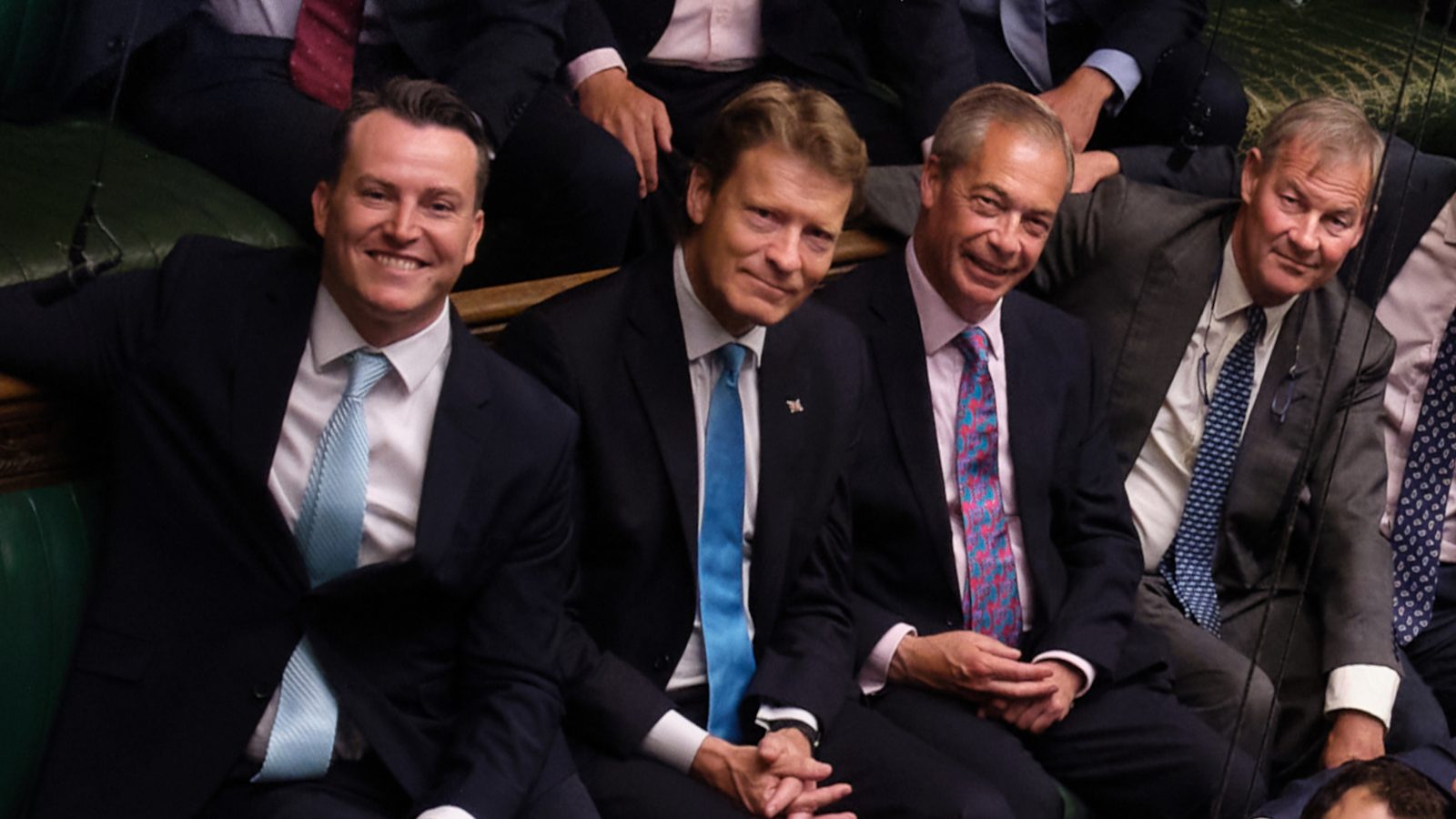

Every point of the vote Reform UK gains or loses between 23% and 29% moves about 28 seats in our model. That cliff, not Restore Britain, is the bigger threat to Nigel Farage's seat count. Our checks on 2026's polls suggest that naming Rupert Lowe's party on the ballot paper takes far less from Reform than its headline share implies.
On our average of British polls, with polls to 12 October, Reform is on 23% and our model gives it 58 seats under a uniform swing, against 314 for Labour. Our headline projection, which corrects for how pollsters have missed before, puts it on 46. In June, when the same average had Reform on 27% and Labour on 20%, the same model gave Reform 228 seats. A fall of under four points in Reform's share, with Labour's recovery under Andy Burnham, cost it 170 seats.
What Restore takes from Reform
Pollsters have handled Restore in different ways since it announced in February that it would become a party. YouGov has named it in every poll since April. Ipsos added it in April and Survation in June, and More in Common began prompting for it regularly in late August, as the Daily Mail reported at the time. Opinium and Find Out Now mostly leave it out. PollCheck, which tracks the party, put its average at 3% on 13 October, counting only the pollsters that name it.
That mix allows a test. For every poll since January we compared each party's share with the average of polls from other companies that did not list Restore, fielded within ten days either side. Then we looked at how that gap changed, for the same pollster, between its polls with Restore and its polls without.
At More in Common, eight polls with Restore listed, at 5.2% on average, put Reform 3.2 points lower against other pollsters than its 33 polls without. At Survation, Restore averaged 1.8% in ten polls and Reform's gap fell by 1.7 points. Ipsos, with Restore at 3.1% in five polls, showed a fall of 2.0 points. Find Out Now named Restore only twice, in March and April, at 8.6%, and Reform's gap fell by 2.8 points.
YouGov went the other way. Since April, Restore has averaged 3.4% in 30 YouGov polls, and Reform has run 2.7 points closer to other pollsters than it did in YouGov's 14 polls from January to March. YouGov's Reform figure moved from 3.4 points below the others in March to 0.9 below in April, the month it added Restore. A change of that kind could have other sources, so we treat YouGov's figure as unexplained rather than as a Restore effect.
Pooling the nine companies that ran polls both ways, with each pollster's own house effect taken out, listing Restore cuts Reform by 0.2 points for each point Restore takes. Leaving out YouGov, the figure is 0.5 points. Leaving out More in Common instead, it is close to zero. The "others" column falls by about half a point for each Restore point, as much as Reform does. Widening the window to 21 days or narrowing it to seven changed none of the per-point figures by more than 0.03.
The simplest cut gives the same message. Since July, the 36 polls that named Restore had it on 3.3% and Reform on 0.7 points less than polls that did not. Reform and Restore together ran 2.7 points above Reform alone in the polls that left Restore out. Much of Restore's vote, in other words, does not show up as Reform when pollsters leave Restore out. It appears as "others", as other parties or not at all.
The cliff
Seat counts, not shares, are where this matters. We ran our seat model across Reform shares from 17% to 34%, taking the change evenly from every other party. Below 22% each point is worth about six seats: Reform has 10 seats at 17% and 40 at 22%. Between 23% and 29% the count climbs from 56 to 226. The steepest stretch is between 24% and 27%, where each point is worth 31 seats. Above 29% the slope eases to about 24 seats a point, and Reform passes 326 at about 33.5%.
The shape holds whoever pays for the change. If Reform's gains come only from Labour, it climbs from 56 seats at 23% to 250 at 29%. If they come only from the Conservatives, it reaches 223.
The cliff exists because so many seats are close. On today's figures Reform is second within three points of the winner in 49 constituencies, 23 of them Labour seats and 25 Conservative. Of the 58 seats it would win, 41 are held by five points or less. UnHerd's Peter Franklin, writing on 25 September, noted the same pattern in YouGov's latest MRP model: two-thirds of the 123 seats it gave Reform were won by five points or less.
What a pact would be worth
Rupert Lowe offered Nigel Farage an alliance of the right on 2 August. Farage said the next day that he had responded "with an open mind" and would "negotiate" if Lowe wanted talks, according to PoliticsHome, but called Lowe's conditions a shopping list, "some of which I have no desire to meet." A week later a Reform spokesperson told the Telegraph there could be no agreement while Restore's co-founder Charlie Downes stayed in place, Jewish News reported. Since then Lowe has announced plans to roll back devolution, reported by Nation.Cymru on 15 September, and a tax-cutting programme that Left Foot Forward reported this month.
If every Restore vote in today's average went to Reform, taking it to 26%, our uniform model gives Reform 111 seats instead of 58. That is the ceiling, and pacts rarely move every vote. Using our measured effect, if Reform won back only 0.2 to 0.5 points for each point of Restore's share, it would have 64 to 77 seats. The by-elections fit the smaller figure. In Makerfield in June, Restore took 6.8% to Reform's 34.5%, and Burnham won with about 55%. In the Greater Manchester mayoral by-election in July Restore took 8.7% and came fourth.
How much the method matters
The cliff also makes Reform's projection unusually sensitive to how seats are modelled. With the same polls, our uniform swing gives Reform 58 seats, a half-uniform, half-proportional blend gives 95 and a proportional swing gives 134. YouGov's MRP, built differently again, gave 123. In 1,000 simulated elections on today's polls, Reform won between 47 and 116 seats in eight runs out of ten.
There are limits to all this. Our per-point estimate rests on a few pollsters: More in Common carries most of the Restore effect and YouGov pulls the other way. Most of the switching polls are recent, small in number and fielded while Labour's average rose from 20% in June to 27% now. A Restore voter who would back Reform if Restore stood aside may still answer "other" in a poll that leaves the party out. The seat curve also assumes Reform's share moves evenly across the country, which it may not.
Tim Bale of Queen Mary University of London told Al Jazeera that "very little" of Labour's recovery comes from voters switching back from Reform, and warned the bounce may not last, with a tough Budget due on 28 October. For Reform that cuts both ways. A recovery of three points would more than double its seats, to about 130. A further fall of two would take it to about 32. Restore Britain is a smaller part of that arithmetic than its press suggests.
Polling Forecast reads every poll in ten countries, corrects for how pollsters have missed before, and turns them into seats. Our forecasts, the polls and our methods are free to explore.
Elsewhere on Polling Forecast
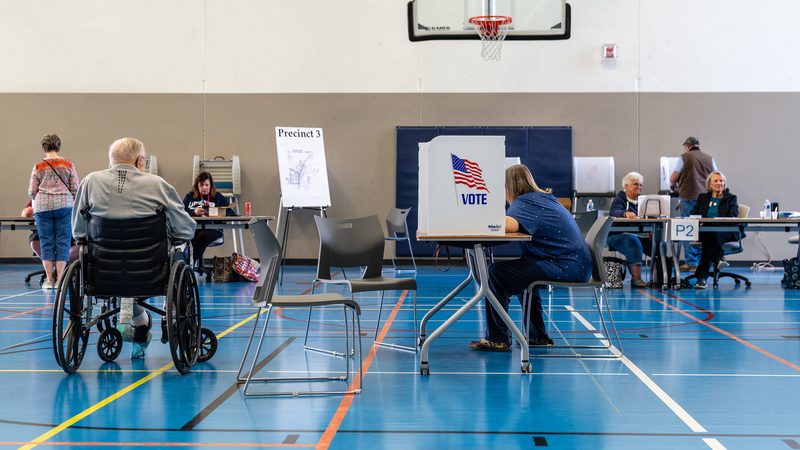 North Carolina mail ballots trail 2022 pace equally for both parties
Measured against their own registered voters, North Carolina Democrats and Republicans are returning mail ballots at about 70 percent of their 2022 pace, with Maine ahead.
North Carolina mail ballots trail 2022 pace equally for both parties
Measured against their own registered voters, North Carolina Democrats and Republicans are returning mail ballots at about 70 percent of their 2022 pace, with Maine ahead.
 Polls understated PiS in 31 of 32 final surveys since 2024
At four national votes since Tusk took office, final polls put PiS or its candidate too low. Our forecast makes no allowance for it.
Polls understated PiS in 31 of 32 final surveys since 2024
At four national votes since Tusk took office, final polls put PiS or its candidate too low. Our forecast makes no allowance for it.
 Private polls understated Spain's PSOE at six of eight elections
104 of 142 private final polls since 2004 had the PSOE too low, but even a repeat of 2023 would probably leave the PP and Vox a majority.
Private polls understated Spain's PSOE at six of eight elections
104 of 142 private final polls since 2004 had the PSOE too low, but even a repeat of 2023 would probably leave the PP and Vox a majority.