
Lib Dems top our May 2027 council projection as Reform gains
Our ward-by-ward projection of 215 English councils puts three parties within 120 seats of each other and leaves Reform's newest councils exposed.
 Polling Forecast
5 min read
Written in house from our poll data and our forecast.
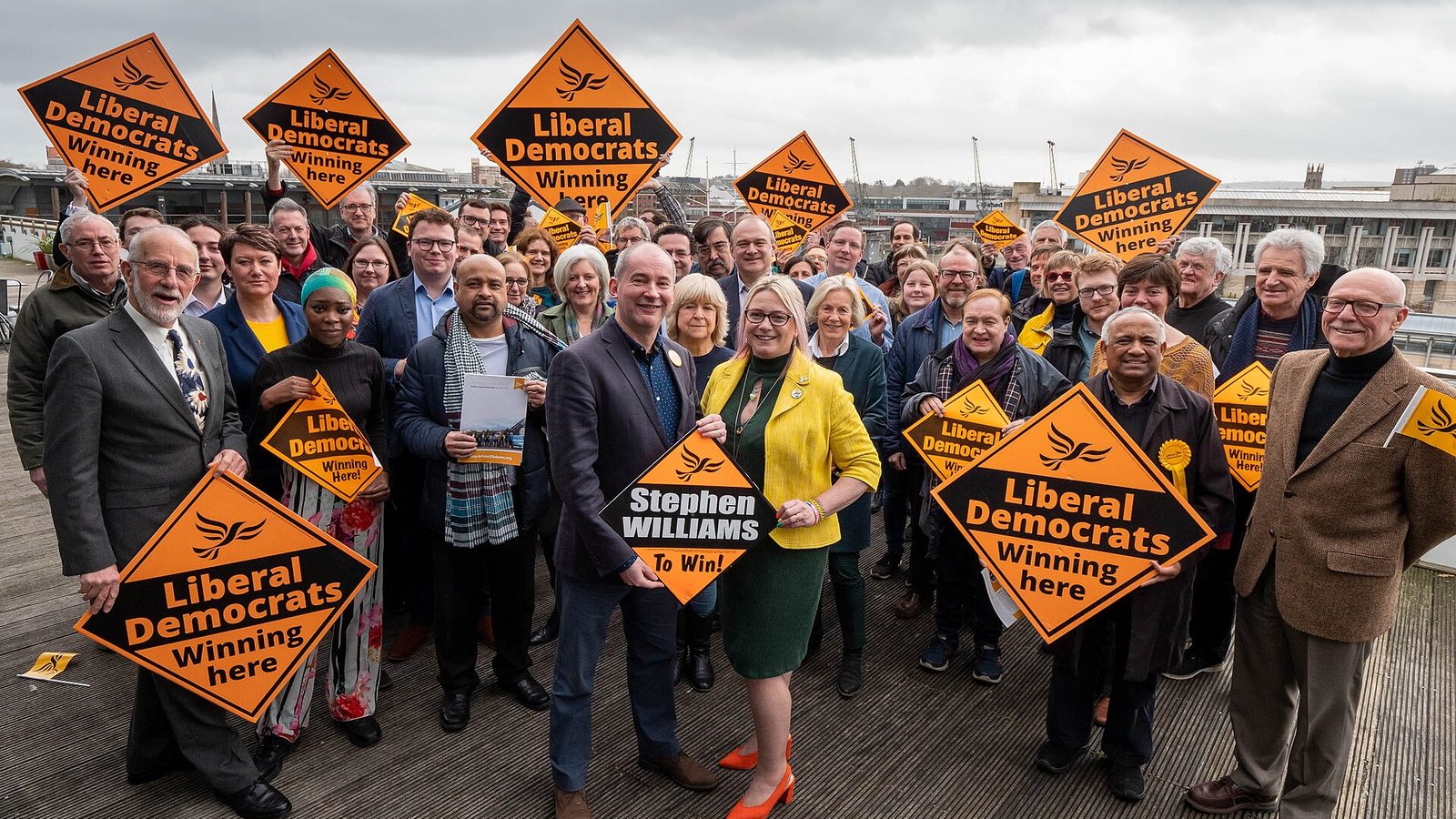

If today's polls held until 6 May 2027, the Liberal Democrats would win more council seats than any other party in England, 1,594 of the 7,556 up for election, according to our ward-by-ward projection of the 215 councils that vote next spring. The Conservatives would take 1,550, Labour 1,474, independents and local groups 1,233, the Greens 906 and Reform UK 799.
The three-way finish at the top is close enough that a modest polling error would reorder it. The bigger story is in the changes. Reform would gain 607 seats on the 192 it is defending and the Greens 443 on their 463. Labour would lose 471 and the Conservatives 441. On control, 136 councils would end up with no party in charge, up from 115 today.
Why the starting point matters
Most of these seats were last fought in May 2023, when our polling average had Labour on 44% and Reform on 6%. Labour is defending 1,945 seats and the Conservatives 1,991, many of them won when both parties were far stronger than they are now. Our model moves each ward's last result by the change in the national polls since then. The polls on our local elections page, taken to 12 October, have Labour on 28, Reform 23, the Conservatives 21, and the Greens and Lib Dems on 10 each.
The 80 councils that elect by thirds are different. A third of their seats were up in May 2026 or were elected in all-out contests then, so their baseline is this year's result, not 2023's. That is where the councils Reform won last May come back into play.
Reform's new councils face their first test
Reform won control of 14 councils in May 2026, according to Wikipedia's tally of the results. Seven of them elect by thirds and vote again next year: Calderdale, Gateshead, Sandwell, South Tyneside, Sunderland, Wakefield and Walsall.
Our projection keeps five. Reform's control of Wakefield, Sunderland and South Tyneside is safe in more than 99% of our simulations, Walsall in 94% and Calderdale in 86%. The other two look exposed. In Gateshead, where Reform holds 38 of 66 seats, our projection leaves it on 29 and no party in control in 74% of simulations. In Sandwell, Reform's 41 of 72 would fall to the point where Labour is largest on 36, with a 43% chance of a Labour majority and 38% of no overall control.
The reason is the shift in the polls since polling day. On 7 May 2026 our average of each pollster's latest poll stood at Reform 26, Labour 20, Conservatives 19, Greens 15 and Lib Dems 12. Labour is now eight points higher and Reform three points lower. In councils elected wholesale in May 2026, that swing comes straight off Reform's margins.
Reform would still add control elsewhere. Our projection gives it Wigan from Labour, with a 79% chance, and Tameside, Tamworth, Cannock Chase, Hartlepool, North East Lincolnshire and Rochford, all currently run by minority or shared administrations. Burnley is a near thing: the central projection gives Reform 23 of 45 seats, a bare majority, but it falls short in 56% of simulations. In all, Reform would control 13 councils, up from seven.
There is a caveat, and the model states it. Tested on wards that voted in both 2024 and 2026, it picked the right winner in 48% of 1,011 wards, against 42% for simply keeping last time's winner. Reform averaged 31% in those wards in 2026, well above what the model would have projected. If Reform's local vote again runs ahead of its national polls, these figures understate it.
The Greens' gains rest on a weak 2023 base
The Greens would control five councils, up from two. Our projection gives them Brighton and Hove from Labour, with a 70% chance and 34 of 54 seats, and holds Mid Suffolk and Norwich. East Hertfordshire and Babergh are closer, at 59% and 52%. They would also be the largest party in Wirral, Thanet and several Kent and Suffolk districts without a majority.
That looks strong for a party whose national share has fallen. The Greens stood at 15% in our average on the day of last May's elections and are on 10% now, as Labour has recovered. Their projected gains come mostly from the 2023 starting point, when our average had them on 5%.
Local votes and national polls are different things
Local elections do not track national polls one for one, and the model allows for it. For each party it uses the ratio between its 2026 local share, in the wards where it stood, and its national poll rating on the day. The Lib Dems ran at 1.32 times their national share, Reform 1.19, the Greens 1.11, Labour 1.02 and the Conservatives 0.85. That is why the Lib Dems top the seat count on 10% in the polls.
The BBC's projected national share, its estimate of the national vote from local results, shows the same pattern. In 2023 it put Labour on 35%, nine points below our polling average for that day, and the Lib Dems on 20%, against 11% in the polls. In 2024 Labour's projected share was 34% against 44% in the polls, and the Lib Dems' 17% against 9%. In May 2026 the projection was Reform 26, Greens 18, Labour 17, Conservatives 17 and Lib Dems 16. Reform matched its polls; the Greens ran about three points ahead and the Lib Dems four, while Labour was about three points behind.
What changed this autumn
The map of contests is now settled. On 7 September the government withdrew its reorganisation decisions for Essex, Hampshire, Norfolk and Suffolk after new legal advice and paused 14 other areas, ITV News reported, confirming that next May's elections will be held on existing council boundaries. Our projection treats them that way. Thirteen councils will still vote on new wards drawn by the Local Government Boundary Commission.
The contests will be the first big electoral test for Andy Burnham since he became prime minister in July. Our projection already reflects Labour's recovery under him. Candidates will not be known until nominations close in April 2027, and the model assumes Reform will stand in every ward. Seven months is a long time in local politics. On current polls, though, next May would bring a more fragmented set of councils, with no party in control of nearly two-thirds of them.
Polling Forecast reads every poll in ten countries, corrects for how pollsters have missed before, and turns them into seats. Our forecasts, the polls and our methods are free to explore.
Elsewhere on Polling Forecast
 When the polls agree too much: herding, and how our forecast guards against it
Polls of a close race should scatter by chance. In 2024 they barely did. Here is why that matters, and the four things our model does so a pack of look-alike polls cannot make it overconfident.
 Polls understated PiS in 31 of 32 final surveys since 2024
At four national votes since Tusk took office, final polls put PiS or its candidate too low. Our forecast makes no allowance for it.
 Private polls understated Spain's PSOE at six of eight elections
104 of 142 private final polls since 2004 had the PSOE too low, but even a repeat of 2023 would probably leave the PP and Vox a majority.