
Is the AfD still an eastern party?
Not by where its voters live: seven in ten AfD votes in 2025 were cast in the west, and the west gave it three quarters of its growth. But it is twice as strong in the east, and every seat it has won outright is there. Our count of every AfD vote since 2013.
 Polling Forecast
7 min read
data as of 23 November
Written in house from our poll data and our forecast.

The verdict
| Question | Our answer | How sure |
|---|---|---|
| Is the AfD still an eastern party? | Not any more by where its voters live. By where it wins, yes. At the 2025 Bundestag election, 7.2 million of its 10.3 million list votes, 69.5%, were cast in the ten western Länder. But it took 36.2% in the east and 18.0% in the west, and all 46 constituencies it won outright were in the east or East Berlin. | Strong |
| Is it growing faster in the west? | In votes, yes. Between 2021 and 2025 the west supplied three quarters of the party's gain, 4.1 million of 5.5 million extra votes. Its western share more than doubled. | Strong |
| Is the gap closing? | No. The AfD now doubles its vote in east and west alike, so in points the gap keeps growing: 12 points in 2017, 18 in 2025, and about 22 points between its 2026 eastern and western state results. | Strong |
| What does it mean for 2027? | The west now decides how big the AfD gets; the east decides where it governs. It leads every national poll, on 26.7% in our average, but leads in no western state poll. | Moderate |
The party of the east?
For most of its life, the AfD has been described as an eastern party that happens to stand in the west. The maps support it. On election night in February 2025, Germany's constituency map was solid AfD blue across the former GDR and black for the CDU and CSU almost everywhere else.
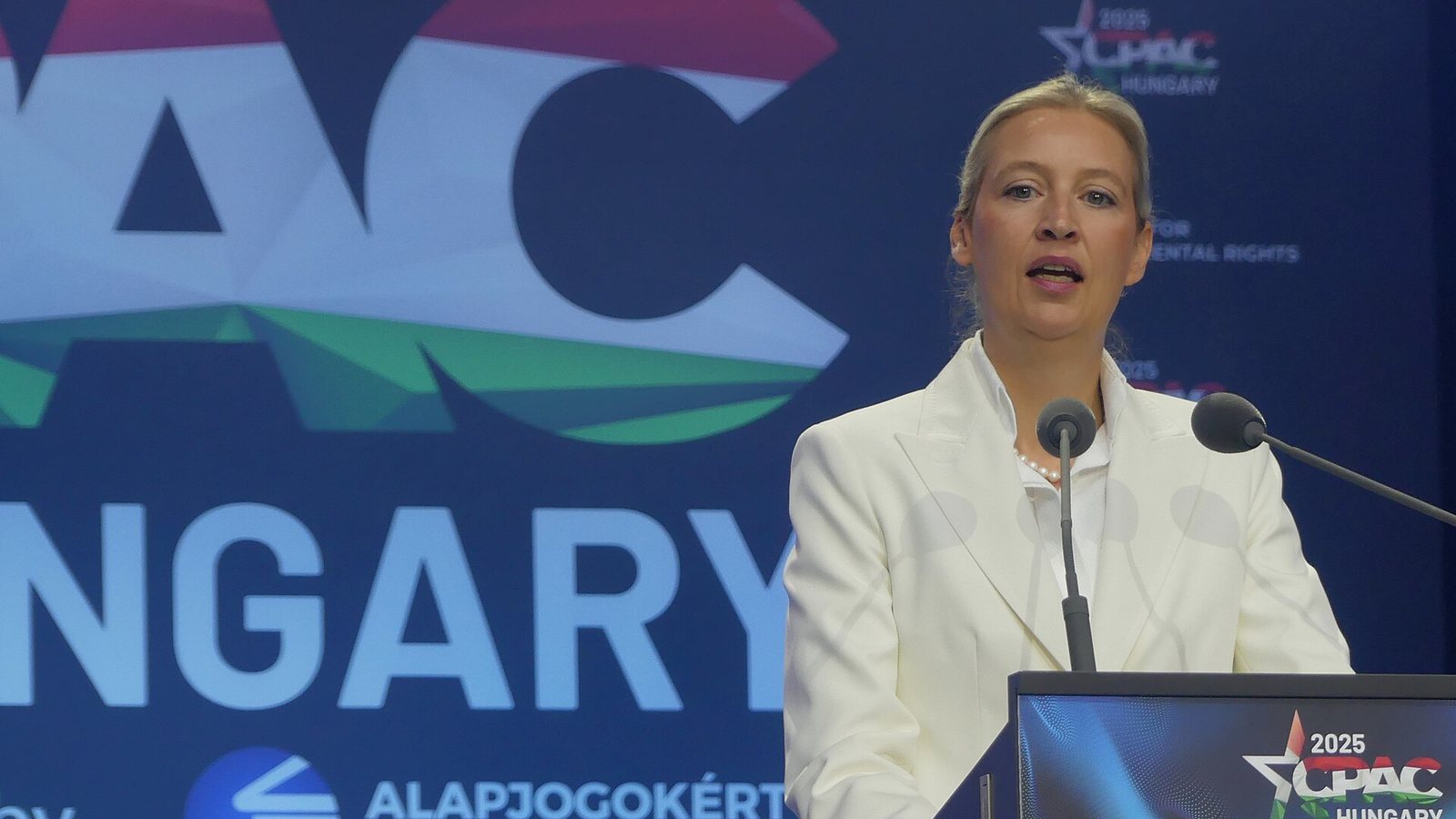
In September 2026 the AfD took 43.8% of the vote in Saxony-Anhalt and 38.2% in Mecklenburg-Vorpommern, where the CDU fell out of the state parliament altogether.1 Alice Weidel called the Saxony-Anhalt result "a very clear mandate to govern".2
But six months earlier, the AfD had won 18.8% in Baden-Württemberg and 19.5% in Rhineland-Palatinate, its best results in any western state election.1 It now leads every national poll.3 A party on more than a quarter of the national vote cannot be living off the 16% of voters who live in the five eastern Länder.
So we went back to the official results for every Bundestag election since the AfD first stood, and counted where its votes actually come from.
1. Seven in ten AfD voters live in the west
At the February 2025 election, the AfD won 10,328,780 list votes (Zweitstimmen). Of those, 7,174,116 were cast in the ten western Länder, 2,857,674 in the five eastern Länder and 296,990 in Berlin.4 That is 69.5% from the west, 27.7% from the east and 2.9% from Berlin (our calculation).
North Rhine-Westphalia alone gave the AfD 1.77 million votes, and Bavaria 1.52 million. Each is far more than Saxony, its biggest eastern state, at 958,000.4
That has been true since the start. In 2013, when the AfD was a eurosceptic party of economics professors, three quarters of its votes came from the west. The eastern share peaked in 2021, at 33%, when the party lost almost a quarter of its western vote but held on in the east. In 2025 it fell back to 28%.
2. The west gave it most of its growth
Between 2021 and 2025, the AfD's vote rose by 5.5 million. The west accounted for 4.1 million of that, the east for 1.3 million and Berlin for 0.1 million.4 Its vote in the west more than doubled, rising by 134%, while in the east it rose by 80%.
The 2026 state elections showed the same thing. In Baden-Württemberg the AfD almost doubled its share, from 9.7% in 2021 to 18.8%, and won more than a million votes. In Rhineland-Palatinate it went from 8.3% to 19.5%.1 Both were records for the party in the west. At the 2025 Bundestag election it won 21.6% in Saarland, above its national average, and 20.1% in Rhineland-Palatinate.4
3. But the gap is wider than ever
Count voters instead of votes, and the picture flips. An eastern voter is still twice as likely as a western one to vote AfD.
In 2025 the party took 36.2% of the vote in the east and 18.0% in the west. In 2017 the figures were 22.6% and 10.7%, and in 2021, 21.5% and 8.2% (our calculation from the official results).4 Measured as a ratio, the AfD became a little less eastern in 2025: twice as strong in the east, down from 2.6 times in 2021. Measured in points, the gap grew from 12 points in 2017 to 13 in 2021 and 18 in 2025.
The latest state elections push it wider still. The AfD's five latest eastern results run from 29.2% in Brandenburg to 43.8% in Saxony-Anhalt. Its best western result is 19.5%.1
The pattern is that the AfD now roughly doubles its vote everywhere at once. In Baden-Württemberg it went up 1.9 times, in Rhineland-Palatinate 2.3 times, in Saxony-Anhalt 2.1 times and in Mecklenburg-Vorpommern 2.3 times.1 When the east starts from twice the base, doubling everywhere widens the gap.
4. It wins only in the east
The AfD's strength in the west is spread thin. Its strength in the east is concentrated enough to win seats.
At the 2025 election, the AfD's candidate came first in 46 of the 299 constituencies: 15 in Saxony, 9 in Brandenburg, 8 in Saxony-Anhalt, 7 in Thuringia, 6 in Mecklenburg-Vorpommern and one in East Berlin. It came first in none in the west, and never has. In 2017 it won three, all in Saxony, and in 2021 it won 16, all in Saxony, Thuringia and Saxony-Anhalt (our count from the official results).4 Under the 2023 electoral law, four of the 46 winners did not get a seat, because their party's list vote in the state did not cover them.
The polls say the same. A survey of state polls in July 2026 found the AfD ahead in all five eastern states, on between 36% and 42%, and ahead in none outside them.5
Verdict: the AfD is no longer an eastern party in the sense of where its voters are. Seven in ten live in the west, and the west gave it most of its recent growth. But it is still an eastern party in the sense that matters for power: it is twice as strong there, it wins every seat it holds there, and only there can it get close to governing.
What the other side gets right
The eastern vote is stickier. When the AfD fell back in 2021, it lost 23% of its western votes and only 6% of its eastern ones (our calculation).4 Its western voters may be the more volatile part of its support, driven by the national mood. If the mood turns, the AfD could become more eastern again.
Western state elections still lag. In Bavaria and Hesse in 2023 it won 14.6% and 18.4%. In Lower Saxony, North Rhine-Westphalia and Schleswig-Holstein, which last voted in 2022, it won between 4.4% and 11.0%, and in Schleswig-Holstein it lost its seats altogether.1 The next western test is spring 2027, when Schleswig-Holstein, Saarland and North Rhine-Westphalia vote.
Seats are where power lies. Constituency wins and state governments are what make a party a force. The AfD is the largest party in every eastern state parliament elected since 2024, and has 39 of 83 seats in Saxony-Anhalt.1 In the west it is still in opposition everywhere.
Votes in the west reflect population. The west has 80% of Germany's voters. Any national party will draw most of its votes there. The AfD draws less than its share.
What the public thinks
In a YouGov survey with SINUS in June and July 2026, 43% of eastern Germans and 38% of western Germans expected an AfD state premier after this year's elections. Fewer wanted one: 35% in the east and 25% in the west. Asked about the AfD's influence on democracy, 61% of westerners called it negative and 29% positive. In the east, opinion was split, at 46% to 43%.6
How we did it
We used the Federal Returning Officer's final results files for the 2017, 2021 and 2025 Bundestag elections, including the 2024 Berlin repeat vote, and summed the AfD's list votes (Zweitstimmen) and all valid list votes for each region. "West" is the ten old Länder without Berlin, "east" the five new Länder; Berlin is counted separately. The 2013 figures use the previous-election columns of the 2017 file. Constituency winners are the candidates with the most first votes (Erststimmen) in each constituency. State election results are from the Federal Returning Officer's summary of Landtag results, dated 13 October 2026. National polling is our average of the latest poll from each pollster.
Sources
-
Die Bundeswahlleiterin, Ergebnisse früherer Landtagswahlen, 13 October 2026. https://www.bundeswahlleiterin.de/dam/jcr/a333e523-0717-42ad-a772-d5ad7e7e97cc/ltw_erg_gesamt.pdf↩↩↩↩↩↩↩
-
ZDFheute, election-night report on the Saxony-Anhalt state election, 7 September 2026. https://www.zdfheute.de/politik/deutschland/landtagswahl-sachsen-anhalt-wahlergebnisse-cdu-afd-schulze-siegmund-100.html↩
-
Polling Forecast, Germany polls, 23 November 2026. https://www.pollingforecast.com/de↩
-
Die Bundeswahlleiterin, final results of the 2017, 2021 and 2025 Bundestag elections, open data (kerg2 files; Polling Forecast analysis). https://www.bundeswahlleiterin.de/bundestagswahlen/2025/ergebnisse.html↩↩↩↩↩↩↩
-
Stuttgarter Zeitung, Umfragewerte der AfD: In diesen Bundesländern liegt sie vorn, 23 July 2026. https://www.stuttgarter-zeitung.de/politik/umfragewerte-der-afd-in-diesen-bundeslaendern-liegt-sie-vorn-79326269.html↩
-
YouGov and SINUS, survey of 3,144 adults, 23 June to 3 July 2026, published 31 August 2026. https://yougov.com/de-de/articles/55459-viele-menschen-erwarten-afd-ministerprasidenten-nach-den-landtagswahlen-aber-deutlich-weniger-wunschen-sich-dies↩
Polling Forecast reads every poll in ten countries, corrects for how pollsters have missed before, and turns them into seats. Our forecasts, the polls and our methods are free to explore.
Elsewhere on Polling Forecast
 Coalition candidate wins Lubuskie Senate by-election on 14% turnout
Zdzisława Różańska took 42.7% for the governing coalition, while our forecast still gives the right a Sejm majority in 86% of simulations.
 Schlein's wealth tax meets a cool reception from her allies
The PD leader revived a 2% levy on the largest fortunes as the centre-left leads our Camera projection with 224 seats and a majority in 63% of simulations.
 Ruffin quits the race as Macron weighs a budget golden rule
One left-wing candidate fewer, and a possible constitutional vote at Versailles, while Le Pen leads our average on 32.8% and wins in 99% of our simulations.