
France's Assembly would stay hung if it were elected now
Our seat projection puts the left on 228 of 577 seats and the RN on 118, built on year-old Assembly polls and 2024's run-off pattern.
 Polling Forecast
5 min read
Polling Forecast
5 min read
Written in house from our poll data and our forecast.
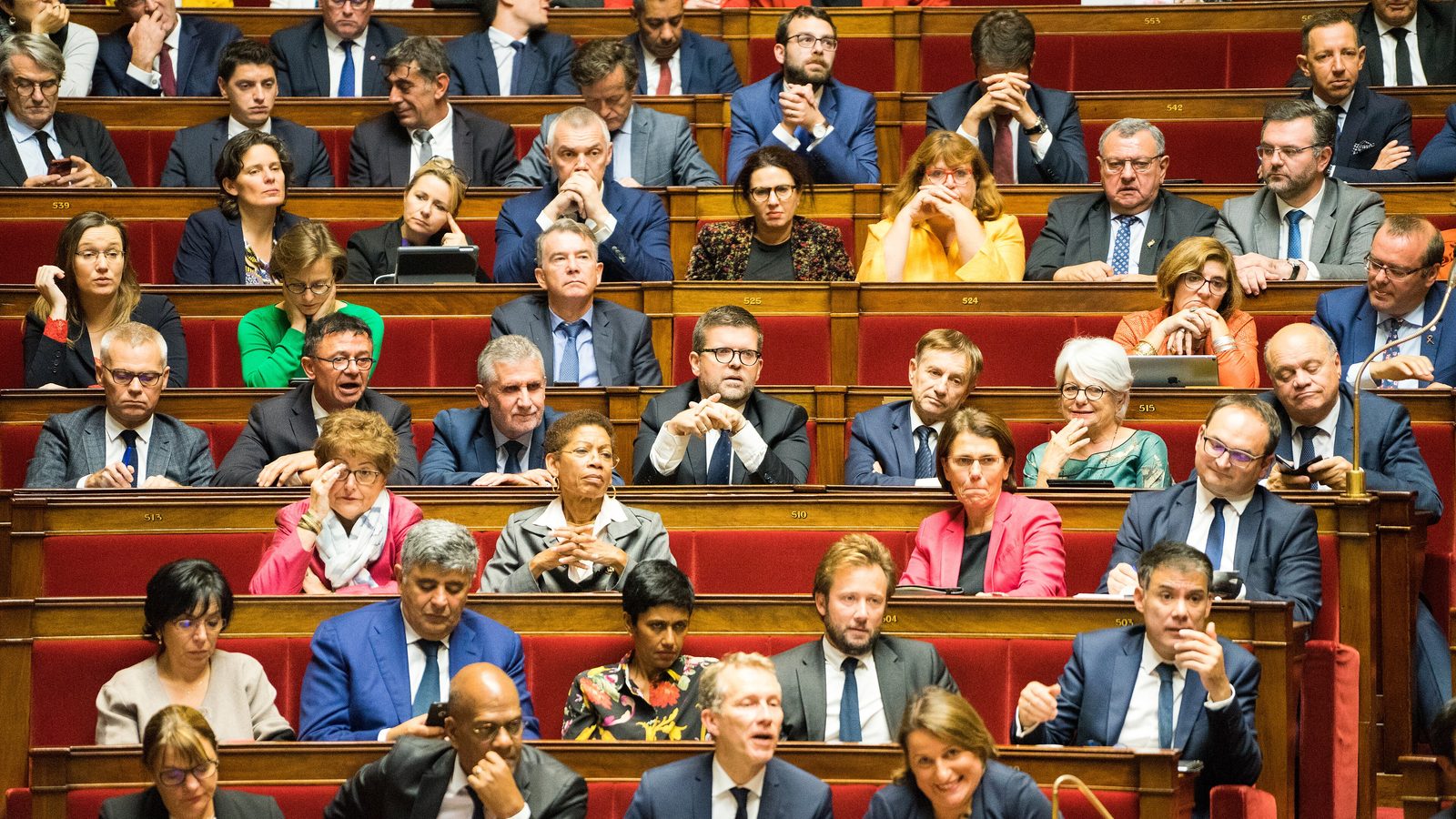
.jpg)
No bloc would win a majority of the National Assembly's 577 seats if France voted now: that is the result in 98% of our simulations. Our projection puts the left, the Nouveau Front populaire and other left candidates, on 228 seats, 61 short of the 289 needed. Ensemble and the centre would have 143, the RN and its allies 118, Les Républicains and the other right 73, and others and regionalists 15. The left is the largest bloc in 62% of simulations and wins a majority on its own in 2%.
No election has been called, and the Assembly is busy with the budget. On 13 October deputies began debating the 2027 finance bill, which aims to hold the deficit to 5% of GDP with about €43bn of extra savings, LCP reported. A Socialist motion to reject it failed by 236 votes to 149 after the RN voted against. A government source told AFP the debate could end with article 49.3 or ordinances, as last year's did. Talk of a dissolution comes and goes; in June Emmanuel Macron's camp told BFMTV that one had "never been considered", Anadolu reported. A president elected next May could dissolve the Assembly, and this projection is a guide to what such an election might look like.
The votes behind the seats
Round one comes first. On our reading of the polls, explained below, the RN and its allies lead with 33.4%, the left has 30.4%, Ensemble 20.3% and LR and the other right 11.5%. Against 2024, Ensemble is 1.7 points lower and the mainstream right 0.5 points higher. We correct legislative polls because their misses have kept one direction: the RN and its allies were overstated at all six elections since 2002, by 2.1 points on average, and correcting was closer at six of six. After that correction, our round-one figures are RN 32.7%, left 30.9%, Ensemble 20.5% and LR 12.7%.
The Assembly polls are old. The five behind the projection were taken up to 8 October 2025, and no pollster has asked about an Assembly election since. Pollsters have kept asking about the presidential first round, so our projection now moves each bloc by how far its vote has changed in those polls between 7 October 2025 and 8 October 2026: Ensemble up 4.5 points, LR down 2.7, Reconquête down 1.5 and others down 1.3. That assumes a bloc's presidential and legislative votes move together, which we have not been able to test. The Assembly polls also assume the alliances of 2024: one left candidate per seat, and the RN standing with Éric Ciotti's UDR. Pollsters have tested a split left as well. In Ifop's last poll a single left list had 24%; with La France insoumise standing alone, it had 19% and the other left parties 8%. Our research paper is plain that a split left would change round one in most seats, and the model does not cover it.
Why the RN leads the vote but not the seats
In France round one only sorts the candidates. A candidate wins outright with over half the vote and the votes of at least a quarter of registered voters. Otherwise the top two go through, with anyone else backed by 12.5% of registered voters. In 2024 most three-way contests became duels as left and centrist candidates stood down for each other, and the RN, first in round one with 33.2%, finished third in seats with 142.
Our model assumes round two works as it did then. On today's figures 73 seats are won in round one. In the rest, the left meets the RN in 237 seats and wins 165 of them; Ensemble meets the RN in 128 and wins 115; LR meets the RN in 72 and wins 64. Compared with 2024, 77 seats change bloc. The largest movement, 26 seats, is from Ensemble to the left, while the RN loses 15 to the left, 9 to LR and 8 to Ensemble.
How sure can we be
Not very, and our own research says so. The model that decides the duels was fitted on the 403 duels of 2024. Fitted on 2022 and tested on 2024, it picked 64.5% of winners, against 61.0% for simply naming the round-one leader. Fitted on 2024 and tested on 2022, it did worse than the leader rule, 74.8% to 78.0%. Voters behaved differently in the second round of each election.
Pollsters' own seat projections, made between the rounds with round one already known, have a poor record too. At each of the last three elections the bloc that led round one won fewer seats than every pollster's range: the Macron camp in 2017, the NUPES left in 2022 and the RN in 2024. In 2022 the RN was projected at 26 to 48 seats and won 89.
Our 80% ranges are wide and probably still too narrow: the left 153 to 245 seats, the RN 80 to 161, Ensemble 125 to 210. Without our correction, on the polls as they stand, the RN would have 136 seats and the left 214. Replaying past polling misses moves the RN between 81 seats, if the polls miss as in 2017, and 125, as in 2022. In all, 95 seats change hands under at least one replay.
Who could govern
Every majority on these numbers needs at least two blocs. The left and Ensemble together would have 371 seats and reach 289 in practically every simulation. Ensemble with LR and the other right would have 216 and gets there in 12%; the RN with LR would have 191 and practically never does. The left would win a majority on its own if 4 points moved to it from the RN. The RN would not win one even if six points moved to it from the left.
That arithmetic rests on 2024's pattern of withdrawals and transfers, and it is the part most likely to change. If the parties that stood down for each other in 2024 stop doing so, the RN, which our model has losing most of its duels, is the bloc whose seat total would move most. The first legislative polls after any dissolution would matter more than anything here.
Polling Forecast reads every poll in ten countries, corrects for how pollsters have missed before, and turns them into seats. Our forecasts, the polls and our methods are free to explore.
Elsewhere on Polling Forecast
 353 seats? The mega-poll's Labour majority comes from a split right, not tactical voting
Run the mega-poll's own vote shares through our model and Labour still gets 358 seats. The difference from our 316 is a weaker Conservative Party and a stronger Restore Britain, not the tactical voting the coverage focused on.
353 seats? The mega-poll's Labour majority comes from a split right, not tactical voting
Run the mega-poll's own vote shares through our model and Labour still gets 358 seats. The difference from our 316 is a weaker Conservative Party and a stronger Restore Britain, not the tactical voting the coverage focused on.
 North Carolina mail ballots trail 2022 pace equally for both parties
Measured against their own registered voters, North Carolina Democrats and Republicans are returning mail ballots at about 70 percent of their 2022 pace, with Maine ahead.
North Carolina mail ballots trail 2022 pace equally for both parties
Measured against their own registered voters, North Carolina Democrats and Republicans are returning mail ballots at about 70 percent of their 2022 pace, with Maine ahead.
 Polls understated PiS in 31 of 32 final surveys since 2024
At four national votes since Tusk took office, final polls put PiS or its candidate too low. Our forecast makes no allowance for it.
Polls understated PiS in 31 of 32 final surveys since 2024
At four national votes since Tusk took office, final polls put PiS or its candidate too low. Our forecast makes no allowance for it.