Labor leads in NSW but falls short of a majority
Five months before the 13 March election, our projection gives Labor 43 of 93 seats, four short, with One Nation on eight.
 Polling Forecast
4 min read
Polling Forecast
4 min read
Written in house from our poll data and our forecast.
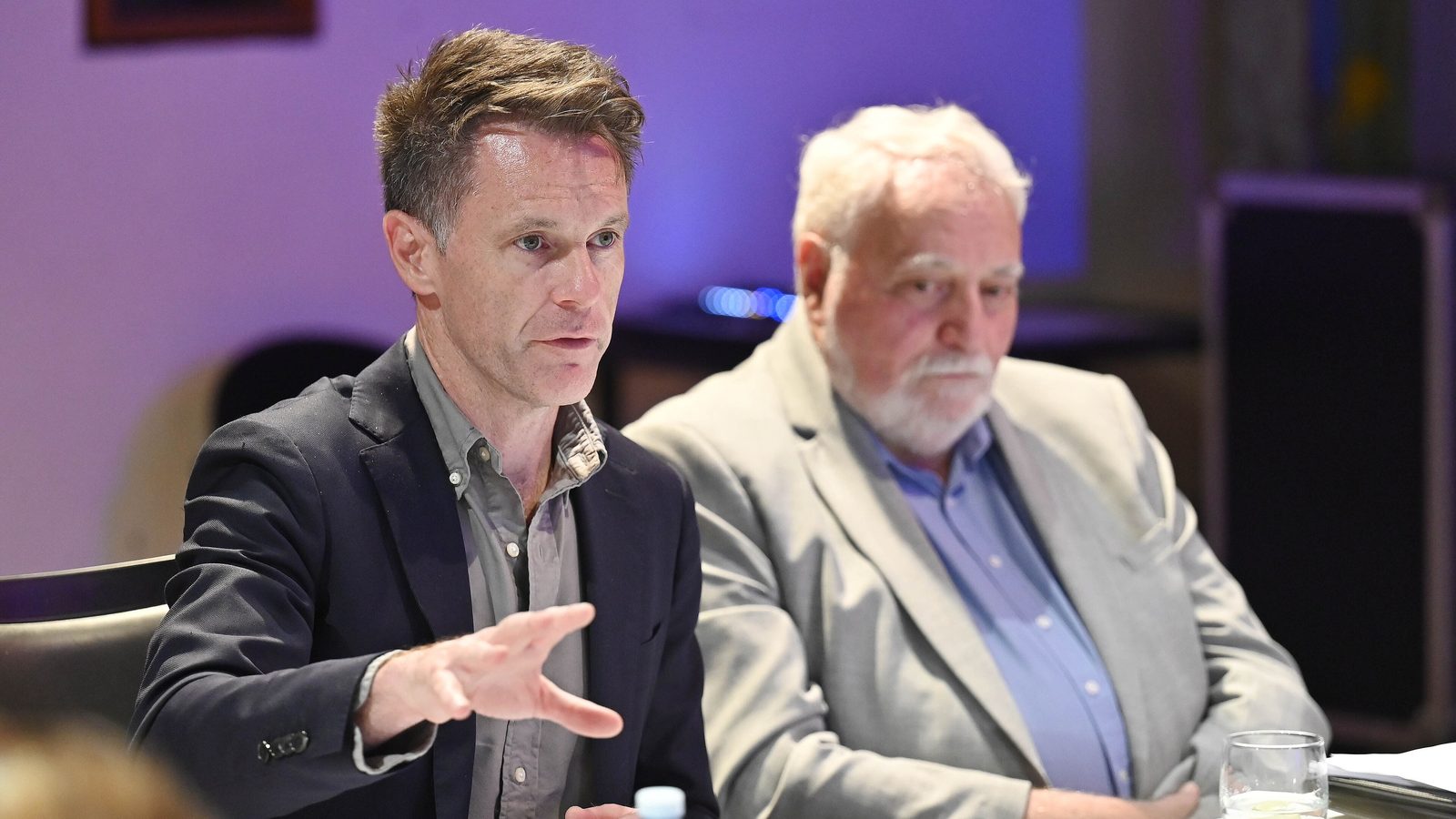

Labor would win 43 of the 93 seats in the New South Wales Legislative Assembly if the state voted today, four short of a majority, according to our projection. The Coalition would take 33, One Nation 8, independents 6 and the Greens 3. No party wins a majority in 80 per cent of our 2,000 simulated elections. The state votes on 13 March 2027, five months from now.
Labor is the largest party in 89 per cent of the simulations but wins a majority in only 20 per cent. Chris Minns already leads a minority government: Labor won 45 seats in 2023 and holds 46 after by-elections, one short of the 47 needed, according to Wikipedia. Our 80 per cent ranges run from 35 to 49 seats for Labor, 21 to 38 for the Coalition and 4 to 24 for One Nation.
Thin polls, one clear trend
The New South Wales polling is thinner than Victoria's. Our average uses each pollster's latest state poll within 60 days of the newest, and only three qualify: Resolve Strategic for the Sydney Morning Herald (ending 12 September), DemosAU with Premier National (26 August) and Insightfully for the Minerals Council of Australia (12 August). The newest is already a month old.
Together they put Labor on 31.3 per cent, One Nation on 26.9, the Coalition on 23.2 and the Greens on 12.9. At the 2023 election Labor won 37.1 per cent of first preferences, the Coalition 35.2 and One Nation 1.8. On these figures the Coalition has lost 12 points and Labor 5.
One of the three polls was paid for by an industry group and has the lowest Coalition figure and the highest One Nation figure: Insightfully had the Coalition on 18 and One Nation on 29. Without it, Resolve and DemosAU average Labor 30.5, One Nation 24 and the Coalition 24.5.
The trend in Resolve's series, the longest in our database, is clear. Labor was on 38 per cent in September 2025 and 37 in January 2026. Resolve first reported a One Nation figure in March, at 23, when Labor dropped to 29. One Nation has been on 25 in Resolve's last two polls, and the Coalition has fallen from 28 in late 2025 to 24. YouGov's federal polls broken down for New South Wales have had One Nation between 26 and 32 per cent in September.
Few pollsters publish a two-party figure for the state. Working from the change in first preferences since 2023, with the preference flows of the 2025 federal election, our model puts Labor's two-party vote against the Coalition at 51.8 per cent, or 52.1 after our correction for past polling misses, against 54.1 at the last election.
Where the seats move
Our projection has 10 seats changing hands. One Nation gains eight: Wollondilly, held by an independent, with a 98 per cent chance; Camden and Penrith from Labor at 88 and 75 per cent; Hawkesbury, Holsworthy and Hornsby from the Coalition at 66, 63 and 60 per cent; Upper Hunter from the Coalition at 50 per cent; and Wakehurst, held by an independent, at 45 per cent. The Coalition gains Pittwater from an independent at 74 per cent, and East Hills from Labor, although there our simulations give Labor the better chance, 51 per cent to 43.
Several of these are three-way contests, and voting in New South Wales is optional preferential. Our model sends 44 per cent of an excluded candidate's votes nowhere, the rate that best reproduces the 2023 counts. That makes the order of the first three on first preferences matter more than in Victoria, where every preference must be numbered.
As in Victoria, One Nation stood in few districts last time, so our model gives it a candidate everywhere, carrying its full statewide change. Where its vote concentrates is the largest unknown in the projection.
How New South Wales polls have done
Our database holds final-poll averages for four New South Wales elections. In 2023 they were close: Labor 36.8 per cent against a result of 37.0, and Labor's two-party vote 53.7 against 54.3. In 2019 they missed: Labor's first preferences were 35.8 against 33.3, the Coalition's 39.4 against 41.6, and the two-party vote was a 50-50 tie against a Labor result of 48.0. In 2015 Labor's two-party vote was within a point; in 2011, when Labor lost heavily, its first preferences were understated by 2.8 points.
Across those elections and Victoria's, the final polls missed each group by 1.2 points on average, and the Greens were overstated every time. Our projection adds 0.6 points to Labor and 0.4 to One Nation and others, and takes 0.8 off the Greens.
The campaign so far
The government moved the election from the fourth Saturday in March to 13 March to avoid Holy Saturday, according to Wikipedia and the NSW Electoral Commission. Kellie Sloane has led the Liberals since November 2025, when she replaced Mark Speakman. Minns said in March that the 2027 campaign would be his last and that he "might get beat", The Nightly reported.
Resolve's July poll had Minns well ahead as preferred premier, on 36 per cent against Sloane's 16, AAP reported. The agency quoted the election analyst Ben Raue as saying One Nation was reaching new highs "in every jurisdiction in Australia".
With three polls in our average, the newest a month old, this projection rests on less evidence than most of ours. What the polls do agree on is the order of the parties' losses since 2023: the Coalition's fall has been more than twice the size of Labor's, which is why Labor, not the opposition, remains the likeliest largest party.
Polling Forecast reads every poll in ten countries, corrects for how pollsters have missed before, and turns them into seats. Our forecasts, the polls and our methods are free to explore.
Elsewhere on Polling Forecast
 353 seats? The mega-poll's Labour majority comes from a split right, not tactical voting
Run the mega-poll's own vote shares through our model and Labour still gets 358 seats. The difference from our 316 is a weaker Conservative Party and a stronger Restore Britain, not the tactical voting the coverage focused on.
353 seats? The mega-poll's Labour majority comes from a split right, not tactical voting
Run the mega-poll's own vote shares through our model and Labour still gets 358 seats. The difference from our 316 is a weaker Conservative Party and a stronger Restore Britain, not the tactical voting the coverage focused on.
 North Carolina mail ballots trail 2022 pace equally for both parties
Measured against their own registered voters, North Carolina Democrats and Republicans are returning mail ballots at about 70 percent of their 2022 pace, with Maine ahead.
North Carolina mail ballots trail 2022 pace equally for both parties
Measured against their own registered voters, North Carolina Democrats and Republicans are returning mail ballots at about 70 percent of their 2022 pace, with Maine ahead.
 Polls understated PiS in 31 of 32 final surveys since 2024
At four national votes since Tusk took office, final polls put PiS or its candidate too low. Our forecast makes no allowance for it.
Polls understated PiS in 31 of 32 final surveys since 2024
At four national votes since Tusk took office, final polls put PiS or its candidate too low. Our forecast makes no allowance for it.