
Will Poland overtake Britain?
Probably in the early-to-mid 2030s, on GDP per head adjusted for prices. Poland has gone from 42% of the UK's level at EU entry to 82% today, growing 3 points a year faster for two decades. The government's 2031 target needs everything to go right. And at market exchange rates, Poles will still earn far less.
 Polling Forecast
6 min read
data as of 23 November
Written in house from our poll data and our forecast.

The verdict
| Question | Our answer | How sure |
|---|---|---|
| Will Poland overtake Britain? | Yes, probably in the early-to-mid 2030s, on GDP per head adjusted for prices. Poland has gone from 42% of the UK's level in 2004 to 82% in 2025 on Eurostat's measure, and 87% on the World Bank's. On recent trends and the IMF's forecasts, it passes the UK between 2030 and 2034 (our projection). | Moderate |
| Within five or six years, as the government says? | Only on the most favourable measure. The finance minister's target of 2031–32 needs the recent pace to hold, and works only on World Bank and IMF figures. On Eurostat's, the crossover is around 2033–34. | Moderate |
| Will Poles be as rich as Britons? | Not for a long time in cash terms. At market exchange rates, the average Polish wage is 44% of the British one, and GDP per head about half. Adjusted for prices, the average wage is 74%. | Strong |
| What could stop it? | A slowdown. If Poland's growth advantage over the UK falls from about 3 points a year to 1, the crossover slips into the 2040s. | Moderate |
"Five or six years to catch the UK"
On 18 February 2026, at the Warsaw Stock Exchange, Poland's finance minister set his country a target. "I accept the challenge," Andrzej Domański said: "five to six years to catch up with the UK in GDP per capita adjusted for price levels."1 Donald Tusk added: "I see no reason not to reach for even higher goals."2
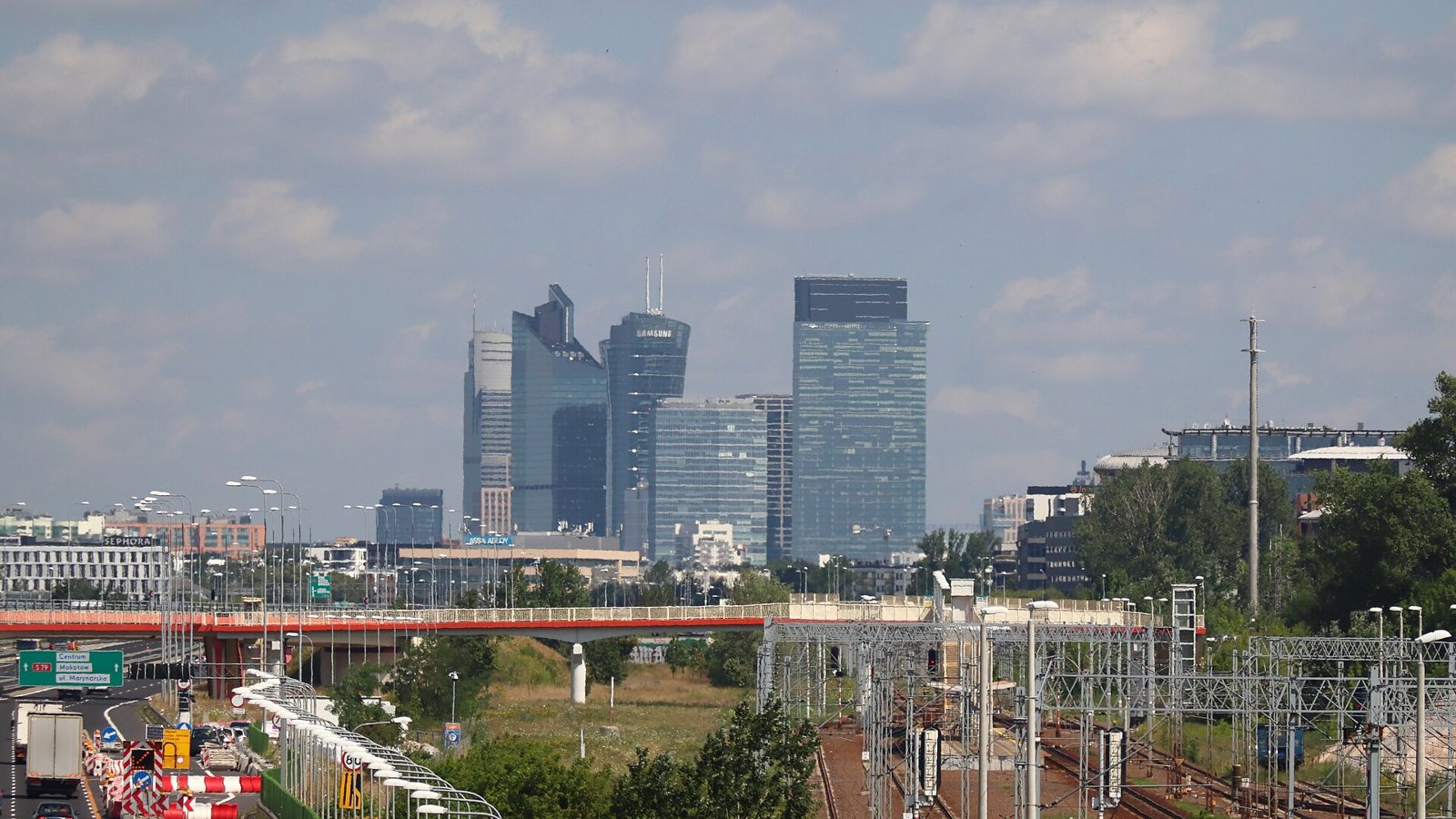
It is a striking ambition for a country that joined the EU in 2004 at less than half Britain's level of income. Poland's economy passed $1 trillion in 2025, and in December it attends the G20 summit in Miami as a guest of the United States.3 So how close is it, and when could it get there? We took the price-adjusted figures from Eurostat and the World Bank since 2004 and projected them forward.
1. From 42% to 82% in twenty years
In 2004, Poland's GDP per head, adjusted for differences in prices, was 52% of the EU average. Britain's was 124%. Poland stood at 42% of the UK's level. By 2025, Poland was at 81% of the EU average and Britain at 99%: 82% of the UK's level (our calculation from Eurostat).4
On the World Bank's figures, the gap is smaller still. Measured in constant prices, Poland's GDP per head was 87% of Britain's in 2025, up from 44% in 2004.5 The IMF's October 2026 forecasts, as reported, put Poland at about 88% in 2026.6
The reason is simple. Between 2004 and 2025, Poland's real GDP per head grew by 125%. Britain's grew by 14%. That is a difference of about 3.3 percentage points a year, every year, for two decades (our calculation).5
2. When the lines cross
Source: Polling Forecast projection from World Bank, Eurostat and IMF data
To estimate a date, we projected the gap forward in several ways (our calculation).
If Poland keeps growing faster than the UK at the pace of 2015–25, it passes the UK around 2030 on the World Bank's measure and around 2033 on Eurostat's. Using the IMF's own growth forecasts, 2.5% a year for Poland after 2026 and about 1.2% for the UK, with Poland's population shrinking and Britain's growing, the crossover comes around 2032 on the World Bank's base and 2034 on Eurostat's.
If Poland's advantage falls to one percentage point a year, the crossover slips to around 2040, or the mid-2040s on Eurostat's measure.
So the government's target of 2031–32 is possible, but only on the more favourable data and if recent growth continues. The early-to-mid 2030s is the likelier range.
3. What "overtake" means, and what it doesn't
Source: World Bank, Eurostat, OECD; Polling Forecast analysis
These comparisons adjust for prices: a haircut or a restaurant meal costs much less in Warsaw than in London, so a zloty goes further. Measured that way, Poland's consumption per head, which counts what households actually use, was 81% of the UK's in 2025.4 The average wage, adjusted for prices, was 74% of the British average, up from 47% in 2004.7
At market exchange rates, the picture is very different. The average Polish wage in 2025 was about €23,900 a year; the average British wage was about €54,300. That is 44% (our calculation from OECD and Eurostat figures).7 Poland's economy, at $1.04 trillion, is a quarter the size of Britain's at $4.0 trillion.8 Anything bought at world prices, from a holiday abroad to an iPhone, still costs a Pole far more of their income.
Verdict: Poland will probably overtake Britain in GDP per head, adjusted for prices, in the early-to-mid 2030s, and possibly sooner on the most favourable measure. On the IMF's figures it has already drawn level with Japan and Spain. But Poles will still earn far less than Britons in cash terms for a long time after that.
What the other side gets right
Price adjustment flatters Poland. The measures that show Poland catching up are the ones that adjust for its lower prices. At market rates, Polish wages are less than half of Britain's.7
Wealth takes generations. Decades of lower savings mean Polish households own far less, in housing and in financial assets, than British ones. "We are a cheap country of relative prosperity," the economist Michał Możdżeń told Parkiet.2
The fast growth may not last. The IMF expects Poland to grow by about 2.5% a year from 2027, about half its pace since 2004. EU funds are running down, the population is shrinking, and the European Commission expects a deficit above 7% of GDP and debt rising to 73.5% by 2028.9 "The risk factors are known: EU funds running out, demography," said Karol Pogorzelski of Bank Pekao.2
Per-head figures move for odd reasons. Poland's shrinking population lifts its GDP per head, while Britain's growing population, mainly through immigration, holds its figure down. Different measures give answers five points apart.
What the public thinks
We found no poll asking Poles or Britons whether Poland will overtake the UK.
How we did it
Price-adjusted GDP per head is from Eurostat's purchasing power parities (index EU27 = 100, July 2026 release) and the World Bank's GDP per capita at purchasing power parity, in current and constant 2021 dollars. Growth rates are average annual changes in the World Bank's constant-price series. To project a crossover year, we solved for the number of years needed to close the remaining gap at each growth difference. The IMF scenario uses its October 2026 forecasts for Poland's and Britain's growth, a Polish population falling by 0.4% a year and a British population rising by 0.5% a year. Wages are from the OECD, converted at Eurostat's 2025 average exchange rates.
Sources
-
RMF24, Tusk zapowiada rok turbo-przyspieszenia, 18 February 2026. https://www.rmf24.pl/fakty/polityka/news-tusk-zapowiada-rok-turbo-przyspieszenia-jest-plan-dogonienia,nId,8066647↩
-
Parkiet, Wielka Brytania czuje na plecach oddech Polski, 26 February 2026. https://www.parkiet.com/gospodarka-krajowa/art43871401-wielka-brytania-czuje-na-plecach-oddech-polski↩↩↩
-
Notes from Poland, US wants Poland to join G20 as soon as possible, 12 October 2026. https://notesfrompoland.com/2026/10/12/us-wants-poland-to-join-g20-as-soon-as-possible/↩
-
Eurostat, purchasing power parities and real expenditure per head (prc_ppp_ind_1), July 2026 (Polling Forecast analysis). https://ec.europa.eu/eurostat/databrowser/view/prc_ppp_ind_1/default/table↩↩
-
World Bank, GDP per capita, PPP (constant 2021 and current international $), November 2026 (Polling Forecast analysis). https://data.worldbank.org/indicator/NY.GDP.PCAP.PP.KD↩↩
-
IMF World Economic Outlook, October 2026, as reported by Worldometers. https://www.worldometers.info/gdp/gdp-per-capita/?region=worldwide&year=2026&metric=ppp↩
-
OECD, average annual wages, 2025; Eurostat exchange rates (Polling Forecast analysis). https://data-explorer.oecd.org↩↩↩
-
World Bank, GDP in current US dollars, 2025. https://data.worldbank.org/indicator/NY.GDP.MKTP.CD↩
-
European Commission, Autumn 2026 economic forecast for Poland, 17 November 2026. https://economy-finance.ec.europa.eu/economic-surveillance-eu-economies/poland/economic-forecast-poland_en↩
Polling Forecast reads every poll in ten countries, corrects for how pollsters have missed before, and turns them into seats. Our forecasts, the polls and our methods are free to explore.
Elsewhere on Polling Forecast
 Schlein's wealth tax meets a cool reception from her allies
The PD leader revived a 2% levy on the largest fortunes as the centre-left leads our Camera projection with 224 seats and a majority in 63% of simulations.
 Merz enters budget week with the AfD almost six points ahead
The Bundestag votes on the 2027 budget on Friday, with the AfD on 26.7% in our average and the CDU/CSU on 21.0.
 Ruffin quits the race as Macron weighs a budget golden rule
One left-wing candidate fewer, and a possible constitutional vote at Versailles, while Le Pen leads our average on 32.8% and wins in 99% of our simulations.