Tweede Kamerverkiezing 2017
Come leggere la pagina: qui sotto i seggi che avrebbero dovuto cambiare mano e quanti elettori in ciascuno. Contiamo in due modi: elettori che passano dal vincitore al secondo (ogni cambio conta doppio, quindi serve meno gente) oppure elettori in più che vanno a votare il secondo.
Il risultato 150 seggi, 76 per la maggioranza
un seggio passa da People's Party for Freedom and Democracy a 50PLUS: ≤ 39.455 elettori se passassero dal vincitore al secondo
| Seggio | Vinto da | Andrebbe a | Distacco (voti) | Elettori necessari |
|---|---|---|---|---|
| Netherlands | People's Party for Freedom and Democracy | 50PLUS | 39.455 |
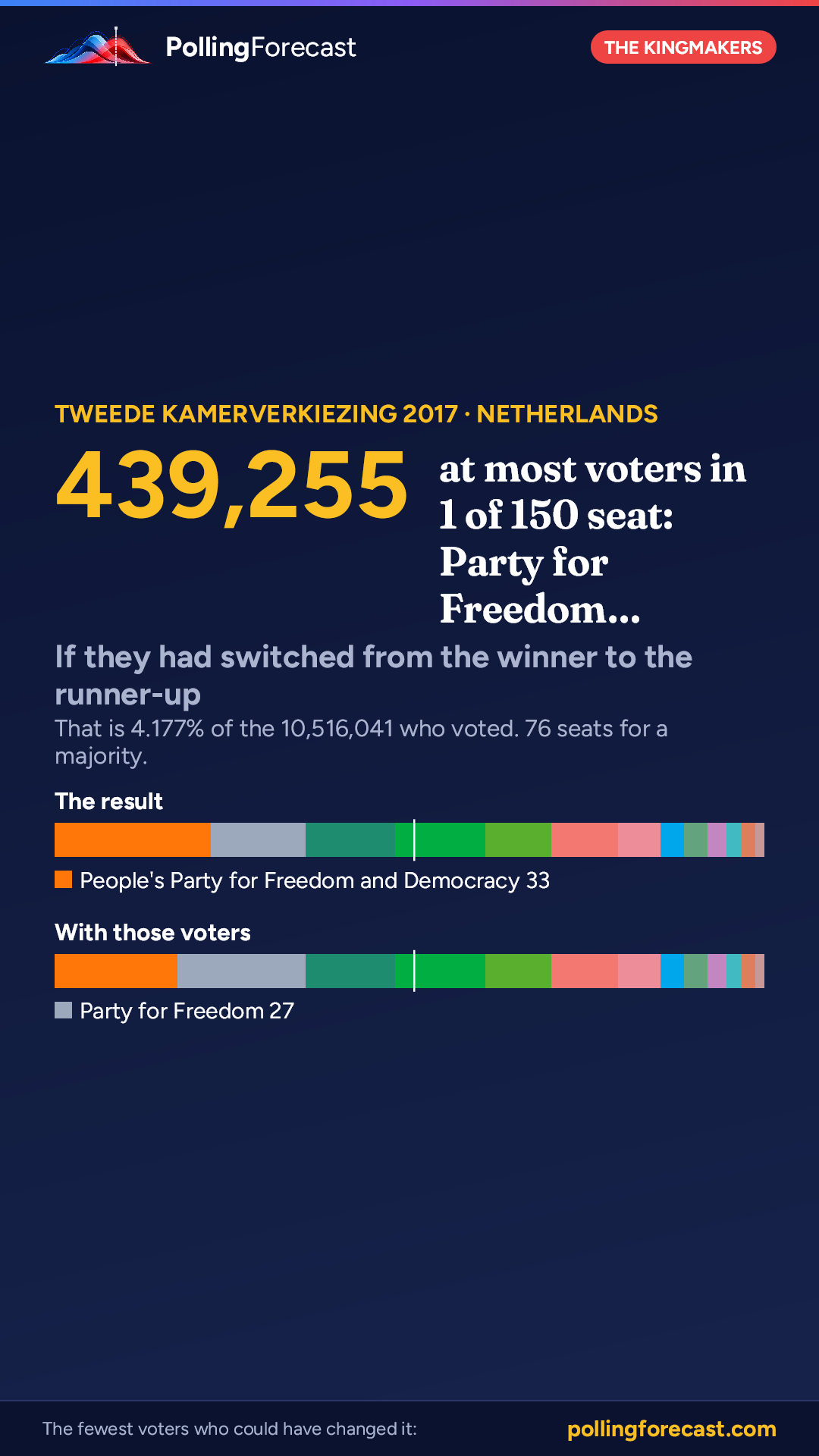
Party for Freedom diventa il primo partito: ≤ 439.255 elettori se passassero dal vincitore al secondo
| Seggio | Vinto da | Andrebbe a | Distacco (voti) | Elettori necessari |
|---|---|---|---|---|
| Netherlands | People's Party for Freedom and Democracy | Party for Freedom | 439.255 |
I seggi più facili da spostare
Ogni riga è un seggio che passerebbe da un partito all'altro se tanti elettori cambiassero voto tra loro; ≤ significa «al massimo».
| Da | A | Elettori necessari |
|---|---|---|
| Labour Party | 50PLUS | ≤ 3.880 |
| Party for the Animals | 50PLUS | ≤ 4.042 |
| Party for the Animals | People's Party for Freedom and Democracy | ≤ 5.270 |
| Labour Party | People's Party for Freedom and Democracy | ≤ 5.689 |
| Labour Party | Party for Freedom | ≤ 9.570 |
| Party for the Animals | Party for Freedom | ≤ 9.570 |
| Labour Party | Forum for Democracy | ≤ 10.340 |
| Party for the Animals | Forum for Democracy | ≤ 10.340 |
| Labour Party | Christian Democratic Appeal | ≤ 14.882 |
| Party for the Animals | Christian Democratic Appeal | ≤ 14.882 |
| DENK (Think) | 50PLUS | ≤ 16.248 |
| DENK (Think) | Forum for Democracy | ≤ 16.248 |
| DENK (Think) | People's Party for Freedom and Democracy | ≤ 17.134 |
| DENK (Think) | Party for Freedom | ≤ 17.511 |
| DENK (Think) | Christian Democratic Appeal | ≤ 18.155 |
| Reformed Political Party | 50PLUS | ≤ 19.051 |
| Reformed Political Party | Forum for Democracy | ≤ 19.051 |
| Reformed Political Party | People's Party for Freedom and Democracy | ≤ 19.710 |
| Democrats 66 | 50PLUS | ≤ 19.788 |
| Democrats 66 | Forum for Democracy | ≤ 19.788 |
| Reformed Political Party | Party for Freedom | ≤ 19.964 |
| Reformed Political Party | Christian Democratic Appeal | ≤ 20.592 |
| Democrats 66 | People's Party for Freedom and Democracy | ≤ 22.438 |
| Socialist Party | 50PLUS | ≤ 22.768 |
| Socialist Party | Forum for Democracy | ≤ 22.768 |
← Tutte le elezioni: Paesi Bassi · Tutti i paesi
Come funziona
I dati
Il risultato ufficiale (Tweede Kamerverkiezing 2017, 15 marzo 2017), seggio per seggio, dall'autorità elettorale del paese: 10.516.041 voti per 150 seggi.
Il metodo
- Per ogni seggio, calcolare quanti elettori servirebbero per cambiarne il vincitore.
- Scegliere i seggi più economici finché il primo partito perde la maggioranza o un altro diventa il primo.
- Sommare gli elettori di quei seggi. Quel totale è la cifra in alto.
Qui i seggi si ripartiscono tra liste, quindi proviamo i più piccoli spostamenti di voti tra due partiti che sposterebbero un seggio con la regola del paese. Le cifre sono massimi (≤): il vero minimo può essere più basso.
Cosa non sostiene
Mostra quanto è stata in bilico l'elezione, non come avrebbe davvero votato qualcuno.
Hai notato un errore? Scrivi a [email protected] con l'indirizzo della pagina e cosa sembra sbagliato. Controlliamo ogni messaggio e correggiamo la pagina se abbiamo sbagliato.