Forecasting the Bundestag: an overview
Abstract. German final polls have missed by about a point per party at the six Bundestag elections since 2005, but the direction of the miss changes from one election to the next, so correcting for it would have made our forecast worse and our projection takes the polls as published. What decides the seats is the 5% line and the 2023 seat law, under which a Wahlkreis winner sits only if the party's list vote covers them. This paper sets out what the Germany section forecasts, how each step works, where the uncertainty lies, and how the other Germany papers fit together.
Summary
This paper is the front door to the German section of Polling Forecast. It says what the section forecasts, why the method that corrects British polls leaves German polls alone, what actually decides the seats in the Bundestag, and how the uncertainty is measured. The last section is a guide to the other Germany papers, each of which takes one part of the forecast and treats it in full.
The short version is this. German final polls have missed by about a point per party at the six Bundestag elections since 2005, but the direction of the miss has changed from one election to the next for every party, so a correction learned from past misses would have made our forecast worse. The seats depend less on the average than on two thresholds: the 5% line that a party must clear to share in the list seats, and the rule under the 2023 electoral law that a constituency winner takes a seat only if the party's list vote covers it. Our forecast therefore takes the polls as published, reproduces the seat law exactly, and spends its effort on the uncertainty around those thresholds.
What has changed since this paper was written
Updated 9 November 2026. The rest of the paper is as first published, except where a sentence below says it was corrected.
- Only elections from 2000 shape the forecast (28 September). Earlier elections stay in the long view and on the history pages but no longer feed any test, correction or error size. In Germany the tests now run on the seven elections from 2002 to 2025. The correction stays off (it was closer at only 2 of the 7) and the Wahlkreis swing stays uniform.
- Our figures beside the polls (26 October). The correction is off in Germany, so our projected shares are the poll average, and the pages say so rather than repeating the figures.
- Pollster grades rescaled (13 October) (Rating German pollsters: accuracy, the lead and openness).
- When the polls missed (2 November): Six points lost in the last week: Merkel's vanishing lead and Germany's 2005 polling miss.
- The map (November). The map can show every Bundestag election since 1998 on the Wahlkreis boundaries of its day, and any census figure; each census figure also has its own page (census maps). It can also replay a past polling miss ("The polls miss again") or take a vote you set.
What the Germany section forecasts
The forecast is for the next election to the Bundestag, the federal parliament. The current Bundestag first met on 25 March 2025. Under Article 39 of the Basic Law the next election must be held no later than 48 months after that, so the latest possible date is 25 March 2029, and the site uses that date for its polling-day forecast. An earlier election is possible if the Chancellor loses a vote of confidence and the Federal President dissolves the Bundestag, as happened before the elections of 2005 and 2025.
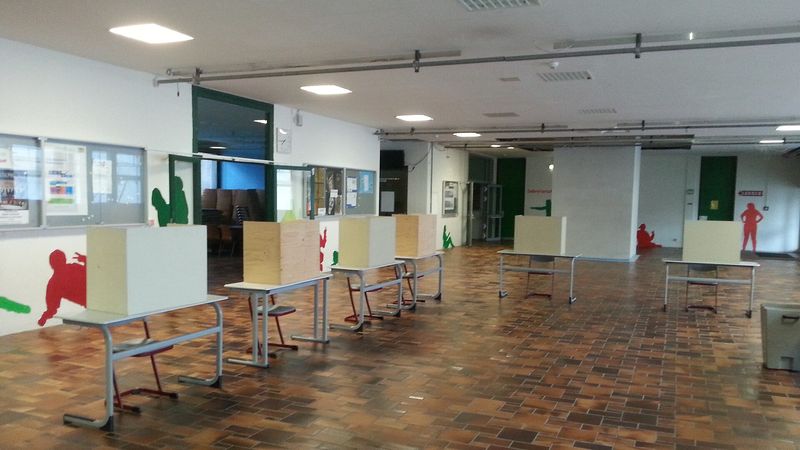
Each voter has two votes. The Erststimme (first vote) elects a candidate in one of 299 constituencies, or Wahlkreise, by simple plurality. The Zweitstimme (second vote) is cast for a party's list in the voter's Land. Since the reform of 2023 the Bundestag has exactly 630 seats, and it is the Zweitstimme that decides how many each party gets. A majority is 316 seats. No party has won a majority alone since 1957, so the practical question after every election is which coalition can reach that number.
The section answers five questions, each on its own page:
- How many seats would each party win if the election were held today? (The home page and the Wahlkreise and Länder pages.)
- What is the chance that each small party clears the 5% line?
- What is the chance that each plausible coalition holds a majority?
- Which party wins each Wahlkreis, and will that winner actually take a seat?
- How different could the result be on polling day, which may be years away? (The election-day page.)
The headline, as of 17 November 2026, is below. It is built from the latest poll of each of 7 pollsters, and every figure in it is recomputed from the database whenever the page is built.
| Party | Polls | Seats | 80% range | Gets in |
|---|---|---|---|---|
| AfD | 26.7 | 193 | 176–204 | over 99% |
| CDU/CSU | 21.0 | 152 | 126–170 | over 99% |
| Greens | 15.4 | 111 | 99–120 | over 99% |
| SPD | 13.7 | 99 | 86–109 | over 99% |
| Linke | 10.2 | 74 | 63–82 | over 99% |
| FDP | 4.1 | 0 | 0–40 | 25% |
| BSW | 3.1 | 0 | 0–0 | 3% |
On these polls the largest party would be the AfD, with 193 seats. The "Gets in" column is the share of simulated elections in which the party wins any seats at all. For parties comfortably above 5% it is close to certain; for parties near the line it is the most important number on the page.
One rule for every country
The British forecast starts from a finding: at every general election from 2015 to 2024, England's final polls missed in fairly steady directions, and a correction built from those misses would have brought the forecast closer to the result (see Forecasting a British general election when the polls are wrong: an overview and Correcting the raw answers: the method behind our UK projection). The rule we took from that work is the same in every country, and it is deliberately simple.
For each party \(p\) and past election \(t\), let \(e_{p,t}\) be the average of the final polls minus the result, in points. A positive value means the polls overstated the party. The correction takes off half of the average past miss:
where \(y_p\) is today's poll average, followed by a rescale so the shares keep the same total. A party is corrected only if it has been measured at two or more elections.
The rule is kept only if it passes a test. Each past election is predicted with the correction learned from the other elections alone (leave-one-out cross-validation; Stone, 1974), and the correction stays only if its average miss per party beats the uncorrected polls by more than 0.01 points. In England it passes. In Germany it does not.
Why German polls are not corrected
The table below is the whole of the evidence: the average of the final polls minus the result, party by party, at each Bundestag election since 2005.
| Party | 1953 | 1972 | 1976 | 1998 | 2002 | 2005 | 2009 | 2013 | 2017 | 2021 | 2025 | Average |
|---|---|---|---|---|---|---|---|---|---|---|---|---|
| SPD | −0.2 | −0.1 | −1.6 | −0.5 | +0.5 | −0.8 | +2.3 | +1.0 | +1.2 | −0.3 | −1.2 | +0.4 |
| CDU/CSU | 0.0 | +1.6 | +0.4 | +2.6 | −1.5 | +6.3 | +1.0 | −2.0 | +3.0 | −1.7 | +1.2 | +0.9 |
| FDP | – | −2.3 | +0.1 | −0.7 | +0.9 | −2.8 | −1.3 | +0.6 | −1.4 | +0.2 | 0.0 | −0.5 |
| Greens | – | – | – | −0.3 | −1.3 | −0.9 | −0.4 | +1.0 | −1.3 | +0.8 | +1.4 | −0.1 |
| Linke | – | – | – | −0.6 | +0.5 | −0.7 | −0.5 | +0.2 | +0.4 | +1.5 | −2.0 | −0.1 |
| AfD | – | – | – | – | – | – | – | −0.8 | −1.6 | +0.4 | 0.0 | −0.5 |
| BSW | – | – | – | – | – | – | – | – | – | – | −0.4 | −0.4 |
Averaged over the six elections, the table seems to suggest that the polls overstate the CDU/CSU (the Union) by about 1.3 points and understate the FDP by about 0.8. Neither holds up. Most of the Union's average comes from 2005, when every final poll had it between 5.8 and 6.8 points too high; without 2005 its average falls to about 0.3. And for every party with more than one election, the sign of the miss changes at least once. The Union was overstated four times and understated twice. The SPD, the Greens and the Linke have each been overstated and understated by more than a point. The AfD was understated in 2013 and 2017 and has been polled almost exactly since.
A correction built on errors like these subtracts last decade's noise from today's polls. The test shows what that does:
| Election | Polls' average miss | Corrected, leave one out | Verdict |
|---|---|---|---|
| 2002 | 0.95 | 1.15 | further out |
| 2005 | 2.33 | 2.37 | further out |
| 2009 | 1.10 | 0.97 | closer |
| 2013 | 0.94 | 1.09 | further out |
| 2017 | 1.48 | 1.40 | closer |
| 2021 | 0.80 | 1.13 | further out |
| 2025 | 0.89 | 1.01 | further out |
| Average | 1.21 | 1.30 |
Correcting was further from the result at 5 of the six elections, level at one and closer at two, and worse on average. We also tried a stricter rule that corrects only parties whose misses always went the same way; it corrects nothing, because no party qualifies. So our projection for Germany is the poll average, uncorrected. This is the same rule reaching a different verdict, not a different rule. How we read German polls: the 5% line and the 2023 seat law sets out the test in full.
The finding is not peculiar to Germany. Jennings and Wlezien (2018), assembling polls from many countries and decades, find that polling errors are real but, for most parties, not persistent enough from one election to the next to predict. Britain's recent record is the exception that needs explaining, not Germany's.
The raw figures
In Britain the steadiest errors are in what respondents say before the pollster adjusts their answers, which is why our British forecast starts there (Why we start from British pollsters' raw answers rather than the published headline). Only one German pollster publishes its raw figures regularly: Forschungsgruppe Wahlen prints its "Politische Stimmung" beside its adjusted "Projektion". We compared both with the result at every election.
| Election | Parties | Raw | Projection |
|---|---|---|---|
| 2005 | 5 | 3.05 | 2.15 |
| 2009 | 5 | 1.86 | 1.46 |
| 2013 | 6 | 1.30 | 1.15 |
| 2017 | 6 | 2.60 | 1.69 |
| 2021 | 6 | 2.30 | 2.69 |
| 2025 | 7 | 2.41 | 1.17 |
The projection was closer at five of the six elections. The AfD in 2025 is the clearest case: 14% in the raw figures of the last wave that published them, 20% in the projection and 20.8% at the ballot box. The German pollsters' adjustments, which weigh in long-term party attachment and tactical considerations, have earned their place, so we use the headline figures.
What decides the seats
If the average is left alone, the forecast must earn its keep elsewhere. In Germany that is in the arithmetic of the seat law, where a small change in votes can make a large change in seats.
The 5% line
A party takes part in the allocation of list seats only if it wins at least 5% of the valid Zweitstimmen nationally, or its candidates win at least three Wahlkreise, or it is a party of a national minority. Below the line, its votes count for nothing.
The 2025 election shows how much turns on this. The BSW won 4.981% of the Zweitstimmen, about 9,500 votes short of 5% out of 49.6 million valid votes. Run through our seat calculation with the BSW admitted, the 2025 votes give it 34 seats, and the CDU, CSU and SPD together 310, six short of a majority. With the BSW out, as it was, those three parties won 328 seats and formed the government. The FDP, on 4.3%, also fell short. In all, 13.7% of the Zweitstimmen in 2025 went to parties that won no seats.
This is why a one-point polling error matters far more for a party near 5% than for a large party. For a large party a point is worth about seven seats. For a party at 4.5% it can be the difference between none and more than thirty, and it can decide which coalitions add up.
The three-Wahlkreis rule and the minority exemption
The 2023 reform abolished the rule that a party winning three Wahlkreise shares in the list seats even below 5%. The Federal Constitutional Court, in its judgment of 30 July 2024, held the 5% threshold incompatible with the Basic Law in its new form and restored the three-Wahlkreis rule as an interim measure until Parliament legislates. The rule mattered as recently as 2021, when the Linke won 4.9% of the Zweitstimmen and three Wahlkreise. The SSW, the party of the Danish and Frisian minorities in Schleswig-Holstein, is exempt from the threshold altogether; it won one seat in 2025 on 0.15%.
Winners without seats
Before 2023, a party that won more Wahlkreise in a Land than its Zweitstimmen entitled it to kept the extra seats as overhang seats, and other parties received compensation seats, so the Bundestag grew well beyond its nominal size. The 2023 law removed both. Now a party's Wahlkreis winners in each Land are ranked by their share of the Erststimmen, and they take seats in that order until the party's Land seats run out. Winners below the cut are not elected. This is called Zweitstimmendeckung, coverage by the second vote.
In 2025, 23 Wahlkreis winners were not seated: 15 from the CDU, 3 from the CSU, 4 from the AfD and 1 from the SPD. Our forecast therefore projects every Wahlkreis, not just the national shares, and reports which projected winners would be left out. On today's projection the number is 22.
The Union's two parties
The CDU and CSU are separate parties that do not compete with each other. The CSU stands only in Bavaria and the CDU everywhere else. Polls report them together as the Union, and so does our average, but the seat law treats them separately: each must qualify on its own, and each has its own list seats. We split the Union's projected vote by Land, CSU in Bavaria and CDU elsewhere.
The forecast, step by step
The pipeline has seven steps. Each is stated briefly here and developed in its own paper.
Step 1: the average. Let \(J\) be the set of polls formed by taking the latest poll from each pollster whose fieldwork ended within 21 days of the newest poll in the database. The average for party \(p\) is
where \(J_p\) is the subset of \(J\) that reports the party. Each pollster counts once, so a pollster that publishes twice a week does not outweigh one that publishes monthly. The parties modelled are the Union, the AfD, the SPD, the Greens, the Linke, the BSW and the FDP; everything else is "others".
Step 2: our reading. Equation (1) with the correction switched off, because it fails the test. Our projection is \(\hat{v}_p = y_p\).
Step 3: Länder. Each party's 2025 Zweitstimmen share in each Land is multiplied by the ratio of its national share today to its national share in 2025, and the Land's shares are rescaled to 100. This is proportional swing. The Union's Land share goes to the CSU in Bavaria and to the CDU elsewhere.
Step 4: Wahlkreise. Each Wahlkreis's 2025 Erststimmen are scaled by the same national ratios, and the candidate of the party with the most votes wins.
Step 5: seats. The full 2023 law, as modified by the Court: qualifying parties, 630 seats shared nationally by the Sainte-Laguë/Schepers method, each party's seats shared among its Land lists by the same method, and Wahlkreis winners seated in order of Erststimmen share until the Land's seats run out. Given the official 2025 votes, our calculation reproduces the official 2025 allocation exactly: every party, every Land list, and the seated or unseated status of all 299 Wahlkreis winners. From votes to seats: the Bundestag seat law gives the details.
Step 6: simulation. In each of 2,000 simulated elections, every party's national share is moved by a random error whose standard deviation is its typical final-poll miss (at least one point), each Wahlkreis gets a small random local change, and steps 3 to 5 are run again. Ranges, the chance of getting in and coalition majorities are counted across the runs. Simulating German polling error: where the chances come from describes the design.
Step 7: polling day. The election-day forecast adds uncertainty for the time left before the election. In Britain it also pulls the older parties back towards their last result; in Germany that pull-back failed its test, so the shares are taken as they stand and only the ranges widen. From today to polling day in Germany gives the evidence.
The uncertainty
The simulation gives three kinds of answer.
The first is the seat range. The 80% range in the table above is the band within which a party's seats fell in the middle 80% of simulated elections. For large parties it is a plain interval. For a party near 5% it is not: its seats are either zero or several dozen, and a range such as "0 to 40" means that it gets in often enough to reach the top of the band, not that 20 seats is a likely outcome.
The second is the chance of each coalition holding a majority.
| Coalition | Seats | Majority |
|---|---|---|
| CDU/CSU + SPD | 251 | 0% |
| CDU/CSU + Greens | 263 | 0% |
| CDU/CSU + SPD + Greens | 362 | 99% |
| SPD + Greens + Linke | 284 | 1% |
| CDU/CSU + AfD | 345 | 91% |
The CDU/CSU has ruled out working with the AfD, a commitment known as the Brandmauer (firewall). We show that combination because the arithmetic of a Bundestag in which the AfD is a large party depends on it: it tells the reader how many seats the parties that do talk to each other must find without it. It is not a forecast that such a coalition will form.
The third is the Wahlkreis picture. Each Wahlkreis page gives the chance that the projected winner wins, and the chance that the winner also takes a seat. Beside the simulation, the site replays today's polls with each past election's polling miss and works out every seat again (see If we're wrong: replaying past Bundestag polling misses on today's polls); 102 Wahlkreise change hands under at least one of those six replays.
On polling day the uncertainty is larger. At the latest possible date, 855 days after the most recent poll, polls this far out have missed each party by about 5.2 points by the time votes were cast, and the ranges on the election-day page are several times wider than today's.
What we do not claim
We do not claim that German polls are free of bias. They missed the Union by six points in 2005 and the Linke by two in 2025. We claim only that the direction of the next miss has not been predictable from the last six, so correcting for it would not have helped.
We do not claim constituency-level precision. Proportional swing from 2025 ignores candidates, local campaigns and tactical voting for the Erststimme, and assumes that each party's vote moves by the same proportion everywhere, so regional differences in swing are invisible to it.
We do not model the East and West separately. Regional polls for the Bundestag exist, but there are too few of them to use.
We do not claim that the "today" forecast predicts polling day. It answers a hypothetical question. The election-day forecast answers the real one, with much wider uncertainty.
We do not claim that the seat law will be the same at the next election. The three-Wahlkreis rule is an interim rule, and Parliament may change the threshold before 2029.
Finally, six elections are few. The ranges rest on the size of past misses at those six, and 2005 dominates the Union's record. A miss larger than any of them, or of a new shape, would fall outside the ranges more often than the stated odds suggest. What we don't know yet: limitations of the German forecast collects these points in one place.
A guide to the papers
The Germany library has ten papers. This one, Forecasting the Bundestag: an overview, is the introduction. The others are described below in roughly the order in which the forecast uses them.
Measuring German polling error, 2005–2025 sets out the evidence on which everything else rests: the final polls at the six Bundestag elections from 2005 to 2025, how they were chosen and graded, the error party by party, the error on the gap between the two largest parties, the record of each pollster, the earlier elections we could source back to 1953, and the state elections since 2025 as a check between federal elections.
How we read German polls: the 5% line and the 2023 seat law is the core methods paper. It applies the correction rule of equation (1), reports the leave-one-out test that rejects it, compares Forschungsgruppe Wahlen's raw figures with its projection, and summarises the rest of the forecast.
From votes to seats: the Bundestag seat law covers the seat calculation: the legal basis, the threshold and its exceptions, Sainte-Laguë/Schepers, the Land lists, Zweitstimmendeckung, the check against the official 2025 result, and how Land and Wahlkreis shares are projected from national polls.
Simulating German polling error: where the chances come from explains where the chances come from: the 2,000 simulated elections, the error drawn for each party, the chance of getting in, the seat ranges, the coalition majorities and the Wahlkreis winners who would not be seated.
From today to polling day in Germany asks how far German polls move before polling day, using polls at ten fixed distances before the five elections from 2009 to 2025, and explains why the British pull-back towards the last result failed the same test in Germany.
If we're wrong: replaying past Bundestag polling misses on today's polls describes the alternative readings of today's polls: the polls as they stand and each past election's miss replayed, all run through the same seat calculation.
Rating German pollsters: accuracy, the lead and openness describes the pollster ratings out of 100, on the same scale as the British ones: accuracy at past final polls, the error on the gap between the two largest parties, and how much each pollster publishes.
The German data: results, boundaries, polls and licences documents where every number comes from: the Federal Returning Officer's results, the pollsters' own releases, Wikipedia's tables where no primary source survives, the grading of sources and the checks each file passes.
What we don't know yet: limitations of the German forecast collects every known weakness of the German forecast in one place and says what would address it.
References
Bundesverfassungsgericht, judgment of 30 July 2024, 2 BvF 1/23.
Bundeswahlgesetz (BWG), as amended by the Act of 8 June 2023 (BGBl. 2023 I Nr. 147).
Grundgesetz für die Bundesrepublik Deutschland (Basic Law), Articles 39 and 68.
Jennings, W. and Wlezien, C. (2018). Election polling errors across time and space. Nature Human Behaviour, 2(4), 276–283.
Stone, M. (1974). Cross-validatory choice and assessment of statistical predictions. Journal of the Royal Statistical Society: Series B, 36(2), 111–147.
How to cite
Polling Forecast (2026). Forecasting the Bundestag: an overview. Retrieved 21 November 2026 from https://www.pollingforecast.com/research/germany-overview. Live figures change as new polls arrive; the date above is when the text was last revised.