How we read German polls: the 5% line and the 2023 seat law
Abstract. German final polls have missed by about a point per party since 2005 but never in a steady direction, and correcting them would have made the forecast worse, so we take them as they are. The seats turn on the 5% threshold and on the 2023 seat law, which our calculation reproduces exactly for 2025.
Summary
This paper sets out how Polling Forecast reads German opinion polls for the next Bundestag election, and why, unlike in Britain and parts of France, it does not correct them. Final polls at the six Bundestag elections since 2005 missed by about a point per party on average, but the direction changed from one election to the next, and a correction built from past misses would have made the forecast worse at three of the six. The seats instead depend on who clears the 5% threshold and on the 2023 seat law, under which a constituency winner may not take their seat. We model both, and our seat calculation reproduces the official 2025 result exactly.
What has changed since this paper was written
Updated 9 November 2026. The rest of the paper is as first published, except where a sentence below says it was corrected.
- Only elections from 2000 shape the forecast (28 September). Earlier elections stay in the long view and on the history pages but no longer feed any test, correction or error size. In Germany the tests now run on the seven elections from 2002 to 2025. The correction stays off (it was closer at only 2 of the 7) and the Wahlkreis swing stays uniform.
- Our figures beside the polls (26 October). The correction is off in Germany, so our projected shares are the poll average, and the pages say so rather than repeating the figures.
The electoral system
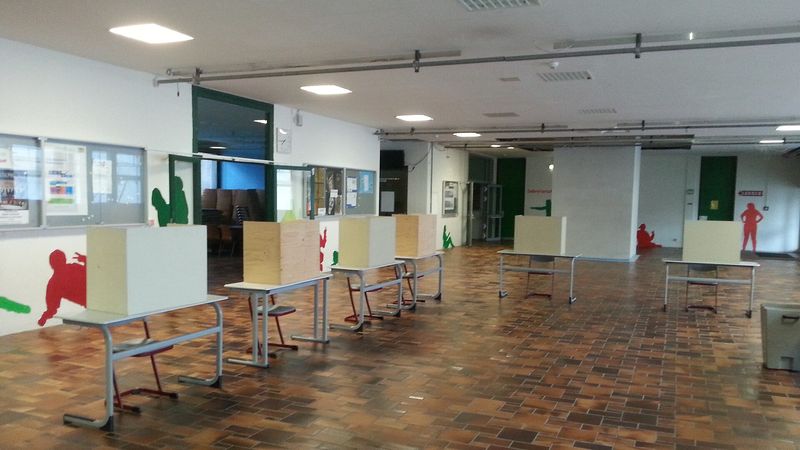
Each voter has two votes. The Erststimme elects a member in each of 299 constituencies (Wahlkreise); the Zweitstimme is cast for a party's list in the voter's Land. Since the reform of 2023, as modified by the Federal Constitutional Court on 30 July 2024, the Bundestag has exactly 630 seats and no overhang or compensation seats.
- Qualifying parties. A party takes part in the seat allocation if it has at least 5% of valid Zweitstimmen nationally, or its candidates won at least three Wahlkreise, or it represents a national minority (in practice the SSW). The three-Wahlkreis rule was abolished in 2023 and restored by the Court as an interim rule until Parliament legislates.
- National allocation. The 630 seats are divided among the qualifying parties in proportion to their Zweitstimmen by the Sainte-Laguë/Schepers method.
- Land allocation. Each party's seats are divided among its Land lists in the same way.
- Coverage (Zweitstimmendeckung). In each Land, the party's Wahlkreis winners take seats in order of their share of the Erststimmen until the party's Land seats run out. Winners below the cut are not elected.
In 2025, 23 Wahlkreis winners were not seated: 15 CDU, 3 CSU, 4 AfD and 1 SPD. The CDU and CSU are separate parties: the CSU stands only in Bavaria, the CDU everywhere else, and polls report them together as the Union.
The data
Results by Land and by Wahlkreis for 2025, the 2021 results recalculated onto the 2025 boundaries, and the Wahlkreis boundaries come from the Bundeswahlleiterin under the Datenlizenz Deutschland – Namensnennung 2.0. National results by Land go back to 2005. Polls come from pollsters' own releases where available: Forschungsgruppe Wahlen's Politbarometer archive, infratest dimap's series, Allensbach's table, Ipsos and YouGov. Otherwise they come from Wikipedia's tables and are marked as such. The final-poll record has 52 final polls across 2005–2025.
The seat calculation
Our implementation follows §§ 1, 4, 5 and 6 of the Bundeswahlgesetz. Sainte-Laguë/Schepers is computed as the equivalent highest-averages sequence \(v_p/(s_p + \tfrac{1}{2})\). Run on the official 2025 votes, it reproduces the official allocation exactly: CDU 164, AfD 152, SPD 120, Greens 85, Linke 64, CSU 44 and SSW 1, every party's Land lists, and the seated or unseated status of all 299 Wahlkreis winners. Two cases are not modelled: independent winners, which require official figures the published data do not contain, and exact ties, which the law settles by lot. Neither occurred in 2025.
How wrong have German polls been?
Final-poll average minus result, in points:
| Party | 2005 | 2009 | 2013 | 2017 | 2021 | 2025 |
|---|---|---|---|---|---|---|
| CDU/CSU | +6.3 | +1.0 | −2.0 | +3.0 | −1.7 | +1.2 |
| SPD | −0.8 | +2.3 | +1.0 | +1.2 | −0.3 | −1.2 |
| Greens | −0.9 | −0.4 | +1.0 | −1.3 | +0.8 | +1.4 |
| FDP | −2.8 | −1.3 | +0.6 | −1.4 | +0.2 | 0.0 |
| Linke | −0.7 | −0.5 | +0.2 | +0.4 | +1.5 | −2.0 |
| AfD | −0.8 | −1.6 | +0.4 | 0.0 |
Averaged over the six elections the table suggests a pattern, with the Union overstated by about 1.3 points and the FDP understated by about 0.8. But most of the Union's figure comes from 2005, and the sign flips from election to election for every party. Jennings and Wlezien (2018) find the same across countries: polling errors are real, but for most parties they are not persistent enough to predict.
The test
Each election was predicted with the correction learned from the other five (half the mean error, parties with at least two elections):
| Election | Polls' average miss | Corrected |
|---|---|---|
| 2005 | 2.33 | 2.33 |
| 2009 | 1.10 | 0.92 |
| 2013 | 0.94 | 1.17 |
| 2017 | 1.48 | 1.38 |
| 2021 | 0.80 | 1.20 |
| 2025 | 0.89 | 1.00 |
The correction was closer twice, further out three times and level once; on average it was worse. A stricter rule that corrects only parties whose misses always went the same way corrects nothing, because none did. Our German projection therefore takes the poll average as it is.
Raw answers and the pollsters' projections
Forschungsgruppe Wahlen publishes its raw "Politische Stimmung" beside its adjusted "Projektion", which weighs in long-term party attachment and tactical voting. In Britain, starting from raw answers beats the published headline (Why we start from British pollsters' raw answers rather than the published headline); in Germany the projection was closer in five of six elections. The AfD in 2025 is the clearest case: 14% raw, 20% projected, 20.8% at the ballot box. Many AfD voters don't say so when asked directly, and FGW's projection corrects for it. We show both and use the projection.
Where the forecast can still be wrong: the 5% line
A party at 4.9% gets no list seats; at 5.0% it would have got about 34 in 2025. In 2025 the BSW got 4.981% of Zweitstimmen, about 9,500 votes short. Had it got in, the CDU/CSU and SPD would not have had a majority. Small parties near the line are where a one-point polling error changes the government. The forecast therefore does not stop at the average.
- Average. Each pollster's latest poll within 21 days of the newest counts once.
- Land shares. Each party's 2025 Zweitstimmen share in each Land is scaled by its national change (proportional swing). The Union's share goes to the CSU in Bavaria and to the CDU elsewhere.
- Wahlkreis shares. The 2025 Erststimmen are scaled the same way, with a small random local change in each simulation.
- Simulation. In 2,000 simulations each party's national share is moved by a random error with the standard deviation of its final-poll misses (at least one point), and the full seat law is run.
The share of simulations in which a party wins seats is its chance of entering the Bundestag. The share in which a coalition holds more than half the seats is its chance of a majority.
Limitations
- Six elections, the first under very different conditions, are a small sample.
- Proportional swing from 2025 ignores local candidates, and the state elections of 2026 showed large shifts that national polls may not capture.
- The Union's split into CDU and CSU assumes Bavaria moves with the rest.
- The next election is due in early 2029; these are chances for an election held today.
- A new electoral law could change the threshold rule before then.
References
Bundeswahlgesetz (BWG), as amended by the Act of 8 June 2023 (BGBl. 2023 I Nr. 147).
Bundesverfassungsgericht, judgment of 30 July 2024, 2 BvF 1/23.
Jennings, W. and Wlezien, C. (2018) "Election polling errors across time and space", Nature Human Behaviour, 2, 276–283.
How to cite
Polling Forecast (2026). How we read German polls: the 5% line and the 2023 seat law. Retrieved 21 November 2026 from https://www.pollingforecast.com/research/germany-method. Live figures change as new polls arrive; the date above is when the text was last revised.