
How Italian general elections work
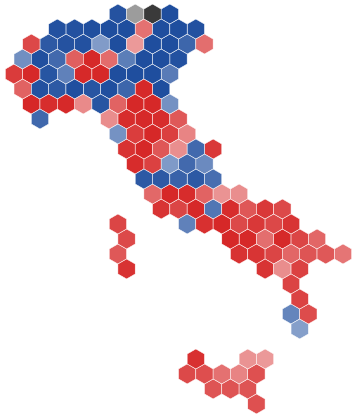
Italy's general election (22 December 2027) explained: who is elected, how the 400 seats of the Camera dei Deputati are shared out, and how to read our forecast, which today has Centre-left 224 seats.
Parliament passed a new electoral law on 8 October 2026; the next election will be held under it. The main change: no more single-member collegi, and a bonus for a coalition that comes first with 42%. Who gets the bonus →
One vote, for a list
Voters mark one list. The first name on each list is elected first; voters can add up to three preferences for the others (of both sexes, or only the first counts).
400 seats
All shared out by vote, except a few in Valle d'Aosta and Trentino-Alto Adige, and 8 for Italians abroad. 201 is a majority. The Senate (200 elected) is chosen the same day the same way, and the government needs the confidence of both.
The 42% bonus
The coalition (or list) that comes first with at least 42% of the vote gets 70 extra deputies and 35 extra senators, but no more than 220 deputies and 113 senators in all. Below 42%, nobody gets a bonus and the seats follow the votes.
Coalitions and thresholds
A coalition needs 10% and a list 3% for seats. Inside a coalition, the best list below 3% also takes part in sharing out the coalition's seats, and the votes of the others still count for the coalition.
When
Every five years at most; the Chambers elected in September 2022 run until autumn 2027. The President can dissolve them earlier.
Polls in Italy
Every published poll must be filed on the government's register with its method. No poll may be published in the 15 days before the vote. Our method →
Until the next election, the Chambers elected in 2022 under the old law (the Rosatellum: 147 single-member collegi and 245 seats by vote) carry on, and their vacant collegio seats are still filled by by-elections. By-elections since 2022 →
Figures as of . Published by Polling Forecast.



 France
 Germany
 Spain
 Netherlands
 Poland
 Canada
 Australia