From votes to seats: the Kieswet
Abstract. We implement the seat count of the Tweede Kamer: one national count, a seat for every full kiesdeler (1/150 of the valid vote), and the remaining seats by highest averages among lists with a full kiesdeler. Run on the Kiesraad's official votes, the count reproduces every party's seats in 2021, 2023 and 2025. We work through 2025, explain the list combinations abolished in 2017, and say what the seat step adds: the kiesdeler cliff, the rounding and the largest party.
Summary
We implement the seat count of the Kieswet for the Tweede Kamer: 150 seats in one national count, a seat for every full kiesdeler (1/150 of the valid vote), and the seats left over one at a time to the highest average among lists that won at least one full kiesdeler. Run on the Kiesraad's official votes, our count gives exactly the official seats of every party in 2021, 2023 and 2025. Because there is one district, national polls go straight into the count: there are no constituencies to project. This paper sets out the law, works through 2025, explains the list combinations that applied until 2017, and says what the seat step does and does not add to the forecast.
What has changed since this paper was written
Updated 9 November 2026. The rest of the paper is as first published, except where a sentence below says it was corrected.
- The map (November). The map can be coloured by any census figure; each census figure also has its own page (census maps). It can also replay a past polling miss ("The polls miss again") or take a vote you set.
One national count
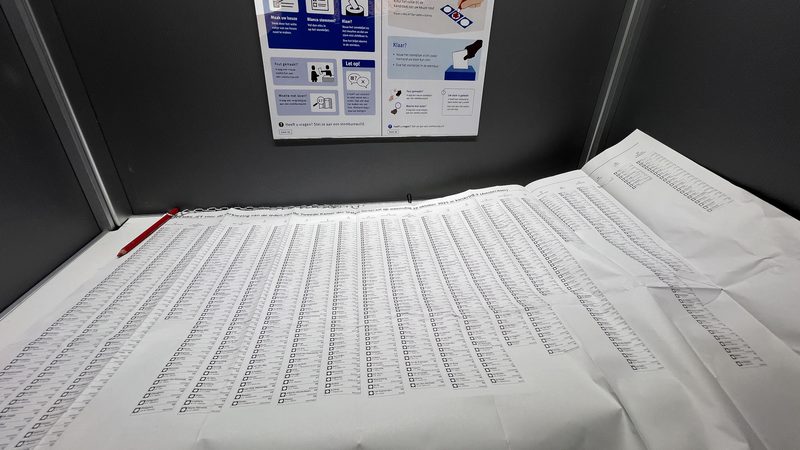
Voters choose one candidate on one party's list. The Netherlands is divided into 20 kieskringen, in which parties may file different candidate lists, but the seats are shared nationally on each party's total vote across all of them (Kieswet, chapter P). The kieskringen matter for which candidates are elected, not for how many seats a party wins. The Caribbean Netherlands (Bonaire, Sint Eustatius and Saba) and Dutch voters abroad vote in the same national pool.
The quantity that counts is the valid vote: the votes cast for lists. Blank and invalid votes are counted separately and play no part.
The count
The kiesdeler
The kiesdeler is the valid vote divided by the 150 seats:
where \(V\) is the valid vote. It is the only threshold: a list that does not reach one full kiesdeler, about 0.67% of the vote, wins no seat and takes no part in the rest of the count. There is no percentage threshold.
Full seats
Each list \(p\) with \(v_p\) votes gets
full seats.
Remainder seats
The seats left over, \(150 - \sum_p f_p\), go one at a time to the list with the highest average,
where \(s_p\) is the list's seats so far, full seats plus remainder seats already won. Only lists with \(f_p \geq 1\) take part. This is the D'Hondt rule applied to the remainders, and it gives large lists slightly more than their share: a list's last seat costs it less when it already has many.
Two further rules exist and never apply to our forecast: a list with an absolute majority of the votes gets an absolute majority of the seats, and a list with fewer candidates than seats loses the surplus to the others.
2025, worked through
| List | Votes | Full seats | Remainder seats | Our count | Official |
|---|---|---|---|---|---|
| D66 | 1,790,634 | 25 | 1 | 26 | 26 |
| PVV | 1,760,966 | 24 | 2 | 26 | 26 |
| VVD | 1,505,829 | 21 | 1 | 22 | 22 |
| GL-PvdA | 1,352,163 | 19 | 1 | 20 | 20 |
| CDA | 1,246,874 | 17 | 1 | 18 | 18 |
| JA21 | 628,517 | 8 | 1 | 9 | 9 |
| FvD | 480,393 | 6 | 1 | 7 | 7 |
| BBB | 279,916 | 3 | 1 | 4 | 4 |
| DENK | 250,368 | 3 | 0 | 3 | 3 |
| SGP | 238,093 | 3 | 0 | 3 | 3 |
| PvdD | 219,371 | 3 | 0 | 3 | 3 |
| CU | 201,361 | 2 | 1 | 3 | 3 |
| SP | 199,585 | 2 | 1 | 3 | 3 |
| 50PLUS | 151,053 | 2 | 0 | 2 | 2 |
| Volt | 116,468 | 1 | 0 | 1 | 1 |
| Total | 10,571,990 | 139 | 11 | 150 | 150 |
The valid vote was 10,571,990, so the kiesdeler was 70,479.93. 139 seats were won as full seats. The remaining 11 went, in order of highest average, two to the PVV and one each to GroenLinks-PvdA, the VVD, D66, the BBB, the CDA, the SP, FvD, the CU and JA21. The Kiesraad's own statement of the result lists the same remainder seats.
The table shows the two features of the count that matter for a forecast.
The largest parties gain slightly. D66 and the PVV won 17.3% of the seats each with 16.9% and 16.7% of the vote. Lists that won no seat took 1.4% of the valid vote between them, and those votes are shared among the rest in proportion.
The smallest parties sit on a cliff. Volt, with 1.10% of the vote, won one seat; NSC, with 0.37%, won none. A party near 0.67% wins one seat or none on a few thousand votes.
The first-placed party is decided by votes, not seats: D66 and the PVV both won 26 seats, and D66 had 29,668 more votes.
The check: 2021, 2023 and 2025
| Election | Kiesdeler (votes) | Full seats | Remainder seats | Lists with seats | Every seat matches |
|---|---|---|---|---|---|
| 2021 | 69,485.68 | 139 | 11 | 17 | yes |
| 2023 | 69,551.51 | 140 | 10 | 15 | yes |
| 2025 | 70,479.93 | 139 | 11 | 15 | yes |
At all three elections since list combinations were abolished, our count on the Kiesraad's official votes gives the official seats for every party. The number of lists with seats, the kiesdeler and the split between full and remainder seats all match the Kiesraad's statements. The method page shows each year in full.
List combinations, until 2017
Until 2017 two or more parties could combine their lists for the remainder seats: the combination took part in the remainder count as one list, and its remainder seats were then shared among its parties. The law abolishing them came into force on 1 December 2017, so the elections of 2021, 2023 and 2025 have none. The Kiesraad's candidate-list files record the combinations of the elections before: in 2012 the PvdA, the SP and GroenLinks, and the CU with the SGP; in 2017 the PvdA with GroenLinks, and the CU with the SGP.
They moved seats. Run on the 2012 votes without the combinations, the count gives the PvdA 39 seats (officially 38), the CU 4 (5), GroenLinks 3 (4) and the PvdD 3 (2). With the combinations, our count matches the official 2012 and 2017 seats. The forecast uses no combinations, because the law no longer allows them.
From national polls to seats
The forecast's seat step is the count above, run on national shares instead of votes:
- Shares. Our projection for each party (Reading Dutch polls: the correction and its test), in points of the vote.
- Others. The parties not in the model (new or minor lists) get whatever the named parties leave, with a floor of 0.3 points. "Others" is many small lists, so it never wins a seat.
- The count. Equations (1) to (3) on those shares.
Nothing is projected below the national level. The 150 seats do not depend on where a party's voters live, and there is no swing model to test. The gemeente map moves each gemeente's 2025 result by each party's national change, for illustration only; it plays no part in the seats.
What the seat step adds
In a system with constituencies the seat step is where most of the uncertainty and most of the modelling lie. Here it adds little. One seat is about 0.67 points of the vote, so the seats follow the shares almost exactly: a point more for a party is one or two seats more. Three things in the forecast come from the seat step and not from the shares:
- The kiesdeler. A party near 0.67% has a real chance of no seat; the simulation gives that chance for each small party.
- The rounding. Remainder seats go to the highest averages, so two parties a few tenths apart can win the same number of seats, or differ by two.
- The largest party. When two parties win the same number of seats, the one with more votes is counted as largest, as the convention treats it in the formation.
| Party | Our bet | Seats | 80% range | Wins a seat |
|---|---|---|---|---|
| 50PLUS | 3.3 | 5 | 4–6 | over 99% |
| PvdD | 3.0 | 4 | 3–5 | over 99% |
| SP | 2.8 | 4 | 1–7 | 91% |
| SGP | 2.8 | 4 | 3–5 | over 99% |
| Volt | 2.3 | 3 | 2–4 | over 99% |
| CU | 2.1 | 3 | 1–4 | 99% |
| DENK | 2.0 | 3 | 2–3 | over 99% |
| BBB | 1.2 | 1 | 0–2 | 83% |
The same engine everywhere
The count is one function, NetherlandsForecast.Count, used for the projection, for every simulated election, for every replay of a past miss, for the polling-day forecast and for the readers' own inputs on the what-if and prediction pages. The check above runs the same function on the official votes.
Limitations
Others. The forecast gives no seat to parties outside the model. A new list that crosses the kiesdeler, as NSC did in 2023, would take seats the model shares among the others.
The law. The count is the law as it stands. The Schoof cabinet's plan for regional districts lapsed when it fell in 2025, and the Jetten coalition's proposal to study a threshold was blocked by a Kamer motion in February 2026. A reform before the next election would change the count.
No threshold beyond the kiesdeler. If one were introduced, several small parties would lose their seats, and the forecast would need to change.
References
Kieswet, hoofdstuk P (Zetelverdeling), articles P 5 to P 9.
Kiesraad (2025). Uitslag Tweede Kamerverkiezing 29 oktober 2025, 7 November 2025.
How to cite
Polling Forecast (2026). From votes to seats: the Kieswet. Retrieved 21 November 2026 from https://www.pollingforecast.com/research/netherlands-seat-law. Live figures change as new polls arrive; the date above is when the text was last revised.