

Bundestag election 2017
How to read this: below are the seats that would have had to change hands, and how many voters in each. We count two ways: voters switching from the winner to the runner-up (each switch counts twice, so it takes fewer people), or extra voters turning out for the runner-up.
The result 709 seats, 355 for a majority
Alternative for Germany gains seats from CDU/CSU (Union): ≤ 32,416 voters if they had voted for Alternative for Germany instead
| Seat | Won by | Would go to | Winning margin (votes) | Voters needed |
|---|---|---|---|---|
| Berlin | Christian Democratic Union | Alternative for Germany | 32,416 |
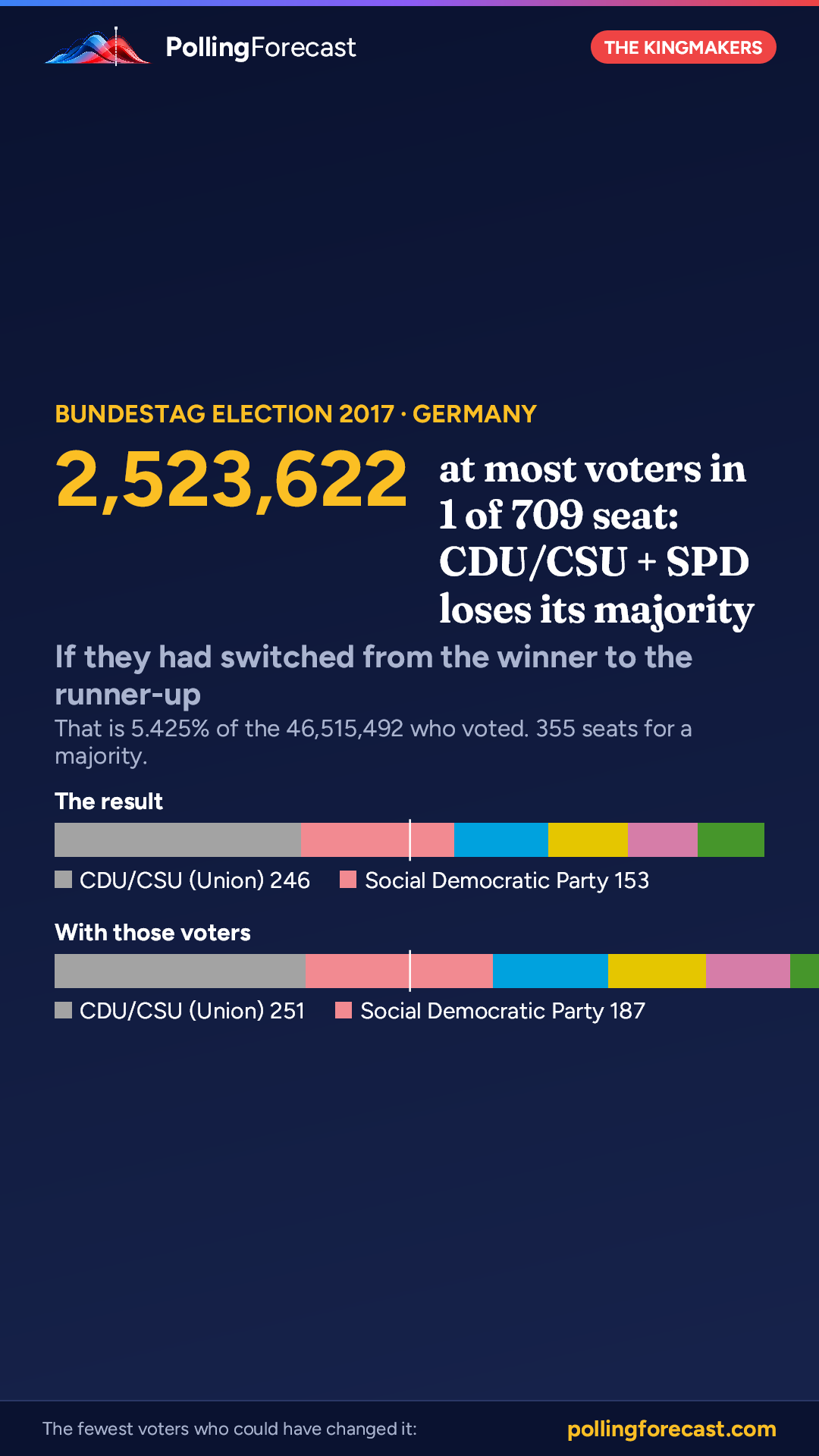
CDU/CSU + SPD loses its majority: ≤ 2,523,622 voters if they had voted for Free Voters instead
| Seat | Won by | Would go to | Winning margin (votes) | Voters needed |
|---|---|---|---|---|
| Nordrhein-Westfalen | Christian Democratic Union | Free Voters | 2,523,622 |
Social Democratic Party becomes the largest party: ≤ 2,923,205 voters if they had voted for Social Democratic Party instead
| Seat | Won by | Would go to | Winning margin (votes) | Voters needed |
|---|---|---|---|---|
| Nordrhein-Westfalen | Christian Democratic Union | Social Democratic Party | 2,923,205 |
The seats easiest to move
Each row is one seat that would pass from one party to another if this many voters switched between them; ≤ means "at most".
| From | To | Voters needed |
|---|---|---|
| Greens | Alternative for Germany | ≤ 18,144 |
| Greens | Alternative for Germany | ≤ 18,144 |
| Greens | Alternative for Germany | ≤ 18,144 |
| Greens | Alternative for Germany | ≤ 18,144 |
| Greens | Alternative for Germany | ≤ 18,144 |
| Greens | Alternative for Germany | ≤ 18,144 |
| Greens | Alternative for Germany | ≤ 18,144 |
| Greens | Alternative for Germany | ≤ 18,144 |
| Greens | Alternative for Germany | ≤ 18,144 |
| Greens | Alternative for Germany | ≤ 18,144 |
| Greens | Alternative for Germany | ≤ 18,144 |
| Greens | Alternative for Germany | ≤ 18,144 |
| Greens | Alternative for Germany | ≤ 18,144 |
| Greens | Alternative for Germany | ≤ 18,144 |
| Greens | Alternative for Germany | ≤ 18,144 |
| Greens | Christian Democratic Union | ≤ 22,435 |
| Greens | Christian Democratic Union | ≤ 22,435 |
| Greens | Christian Democratic Union | ≤ 22,435 |
| The Left | Alternative for Germany | ≤ 23,263 |
| The Left | Alternative for Germany | ≤ 23,263 |
| The Left | Alternative for Germany | ≤ 23,263 |
| The Left | Alternative for Germany | ≤ 23,263 |
| The Left | Alternative for Germany | ≤ 23,263 |
| The Left | Alternative for Germany | ≤ 23,263 |
| The Left | Alternative for Germany | ≤ 23,263 |
← Every election: Germany · All countries
How this works
The data
The official result of the Bundestag election 2017 (24 September 2017), seat by seat, from the country's electoral authority: 46,515,492 votes cast for 709 seats.
The method
- For every seat, work out how many voters it would take to change its winner.
- Pick the cheapest seats until the largest party loses its majority, or another party becomes the largest.
- Add up the voters in those seats. That total is the figure at the top.
Here seats are shared out from party lists, so we test the smallest moves of votes between two parties that would shift a seat under the country's own counting rule. The figures are upper bounds (≤): the true minimum may be lower.
What this does not claim
It shows how close the election came, not how anyone would really have voted.
Spotted a mistake? Write to [email protected] with the page address and what looks wrong. We check every message and correct the page if we got it wrong.