




Who chose Germany's governments?
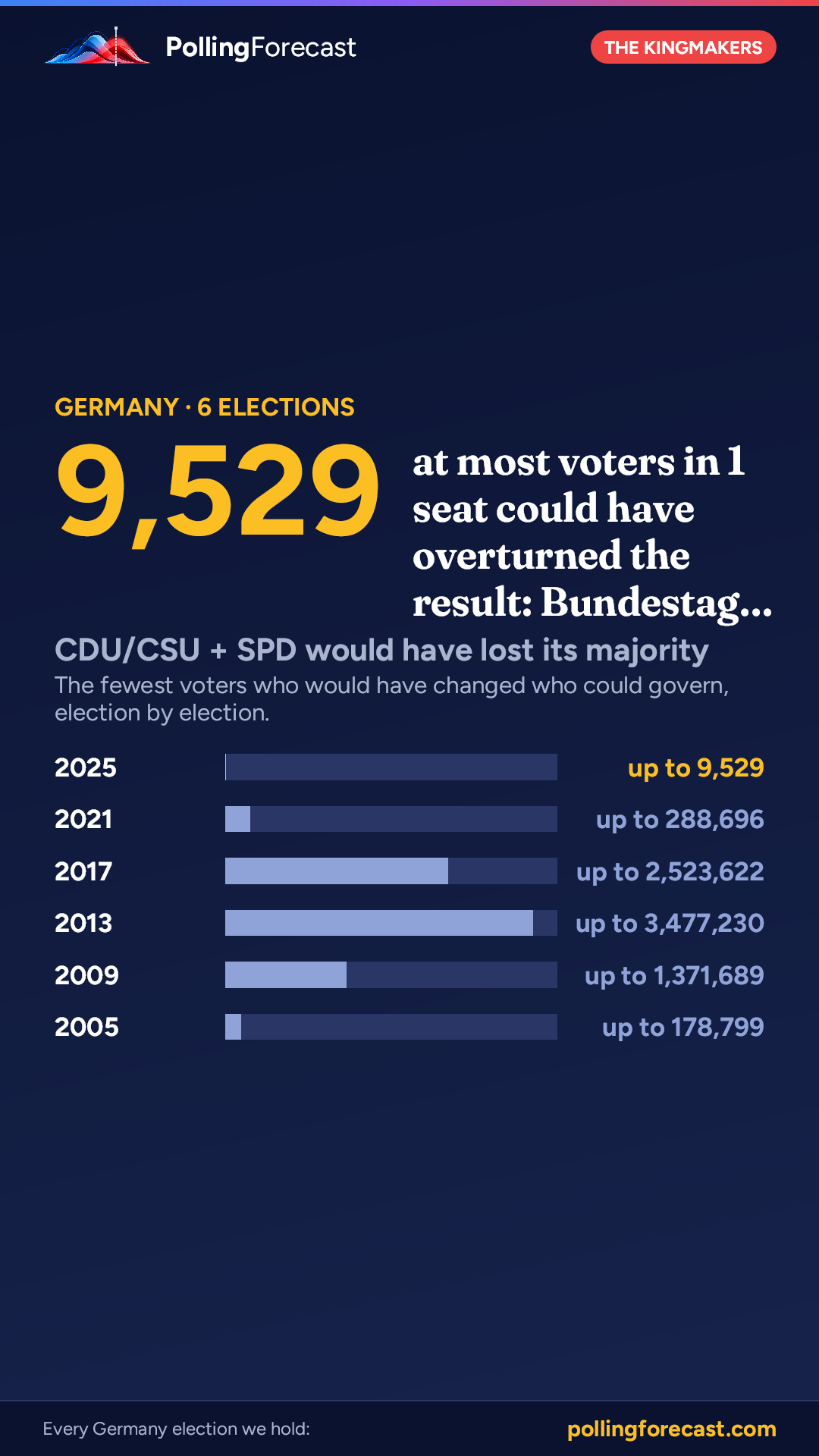
How to read this: the figure is the smallest number of people who, by voting for a different party in just the right seats, would have changed who could govern. The smaller it is, the closer the election was.
← All countries, closest election first
Tap an election to see which seats would have decided it. "Majority" means the largest party won more than half of all seats; ≤ means "at most".
| Election | Largest party | Fewest voters needed | Seats that would change hands |
|---|---|---|---|
| Bundestag election 2025 | CDU/CSU (Union) 208 | ≤ 9,529 | 1 of 630 |
| Bundestag election 2021 | Social Democratic Party 206 | ≤ 288,696 | 1 of 736 |
| Bundestag election 2017 | CDU/CSU (Union) 246 | ≤ 2,523,622 | 1 of 709 |
| Bundestag election 2013 | CDU/CSU (Union) 311 | ≤ 3,477,230 | 1 of 631 |
| Bundestag election 2009 | CDU/CSU (Union) 239 | ≤ 1,371,689 | 1 of 622 |
| Bundestag election 2005 | CDU/CSU (Union) 226 | ≤ 178,799 | 1 of 614 |
How this works
The data
The official results of 6 national elections in Germany, seat by seat, from the country's electoral authority. Sources
The method
Bundestag seats are shared out nationally by second votes (Zweitstimmen). So we move second votes from one party to another, run the seat law again, and look for the smallest move that changes who could govern. CDU and CSU count as one.
Since 2025 there are 630 seats and no overhang or levelling seats. A party needs 5% of second votes or three constituencies (Wahlkreise), and the seats are shared by the Sainte-Laguë method. So the cheapest change is often a party pushed just over or just under 5%, or one seat moving at the rounding margin.
From 1994 to 2009 a party that won more constituencies in a Land than its list seats there kept them as overhang seats, so we move votes inside one Land. First votes and constituency winners are left as they were. We leave out 2013 to 2021, whose levelling seats start from Land seat quotas by population that we don't hold, and any election where our calculation doesn't give exactly the official seats. Every figure is an upper bound: the true minimum can only be lower.
What this does not claim
It measures how close each election came, from the votes as counted, not how anyone would really have voted.
Words used here
- Majority (in a seat): how many more votes the winner got than the runner-up. Majority (in parliament): more than half of all seats.
- Threshold: the smallest share of the vote a party needs before it wins any list seats.
- Upper bound (≤): the most voters it could take; the true smallest number may be lower.
- Sainte-Laguë: a standard rule for turning each party's votes into a fair share of seats. Overhang seats: extra seats a party kept when it won more constituencies than its share entitled it to.
Spotted a mistake? Write to [email protected] with the page address and what looks wrong. We check every message and correct the page if we got it wrong.