Bundestag votes on record budget as most voters reject the borrowing
59% in the ZDF Politbarometer oppose borrowing on this scale, and the Union falls to 21%; our average has the AfD 7.6 points ahead.
 Polling Forecast
3 min read
data as of 27 November
Written in house from our poll data and our forecast.

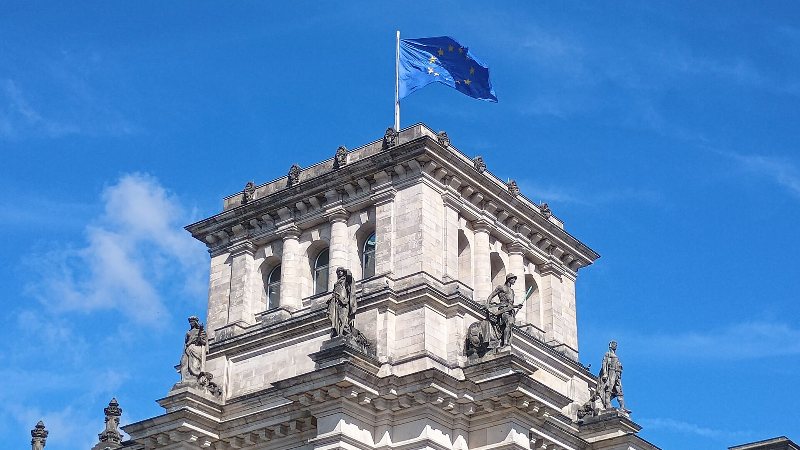
The Bundestag votes today on the federal budget for 2027, the largest Germany has drawn up. The final text plans spending of 555.94 billion euros (Bundestag). When Lars Klingbeil, the finance minister, presented the draft in September it was 30.9 billion euros more than in 2026, and he called the borrowing in the infrastructure fund "necessary" to strengthen the country.
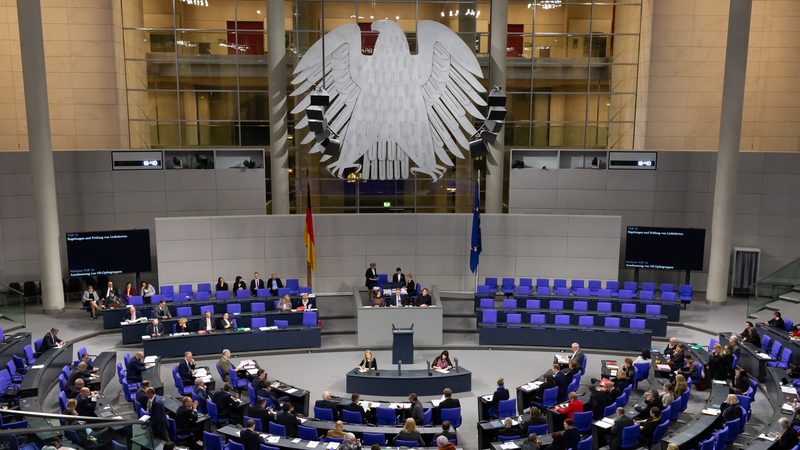
The coalition of the CDU/CSU and SPD has the votes. On Wednesday, after the general debate, the chancellery's section passed by 317 votes to 267 in a roll-call vote (Bundestag). In that debate the opposition attacked from both sides: the Linke spoke of cuts to welfare and the AfD of a "Schuldenorgie", an orgy of debt, while the Greens questioned the late deal to cut electricity tax (Bundestag). ZDF puts the cost of that tax cut at about five billion euros, which adds to the borrowing.
What voters say
The ZDF Politbarometer, taken from 24 to 26 November, asked about the borrowing directly. 59% said they were against taking on debt on this scale and 35% said it was right given the challenges the country faces (ZDF). Supporters of the AfD were against it almost to a person, at 93%, and so were 48% of Union supporters. 57% said the government's reforms were heading in the wrong direction and 32% the right one.
The same poll asked about pensions, the coalition's other open dispute. 69% oppose ending the penalty-free pension after 45 years of contributions, and 61% do not expect the cabinet to settle its pension row in the next few weeks.
What the polls and our forecast say
The Politbarometer's party figures have the AfD unchanged on 28%, the Union on 21, down a point for the second time running, the Greens 15, the SPD 14, up a point, and the Linke 10. Forschungsgruppe Wahlen has tended to show the Union about a point higher than other pollsters, so like for like its poll has the Union nearer 20.
Our average now has the AfD on 27.7%, up 1.0 point over the last week of polling, and the Union on 20.1, down 0.9. The gap between them is 7.6 points. The Greens are on 15.3, the SPD 14.0 and the Linke 10.0. In seats that is 200 for the AfD, 146 for the Union, 110 for the Greens, 101 for the SPD and 72 for the Linke.
The coalition's own numbers do not reach a majority: the Union and SPD would have 247 seats, 69 short of the 316 needed. With the Greens added, the three parties have a majority in 96% of our simulations.
What it could change, and what is uncertain
A budget vote the coalition is expected to win does not change our numbers by itself. What our forecast reads is the polls, and the polls since the budget week began have moved against the Union. The Union's fall over the last week of polling, 0.9 points, is larger than the scatter we would expect from any single poll, but it rests on three polls, and INSA, Forsa and Forschungsgruppe Wahlen still put the Union between 19.5 and 21.
The ratings of the people in charge of the budget moved the same way. On the Politbarometer's scale from plus five to minus five, Friedrich Merz fell from minus 1.6 to minus 1.9 and Klingbeil from minus 0.4 to minus 0.7 (ZDF). The next election is due by March 2029, and our forecast reads today's polls, not a campaign.
Polling Forecast reads every poll in ten countries, corrects for how pollsters have missed before, and turns them into seats. Our forecasts, the polls and our methods are free to explore.
Elsewhere on Polling Forecast
 Early voting in Brunswick, Pallaconian Brotherhood of Melbourne & Victoria
Victoria votes tomorrow with four in ten electors already voted
Final Victorian polls point to a Coalition win; federally, a Liberal senator joins One Nation and no party reaches 76 in 97% of our simulations.
 Colborne King Streets Brantford Ontario
An independent tests the Conservatives in Brantford as advance voting opens
A pastor refused the Conservative nomination is running in Brantford–Brant South; nationally our forecast has the Liberals on 223 seats.
 Trybunał Konstytucyjny zima 2016
Tribunal judges suspend their own chief as Tusk funds the court
The fight over Poland's Constitutional Tribunal deepens; our forecast has KO first on 189 seats but the right with a majority in 87% of our simulations.