
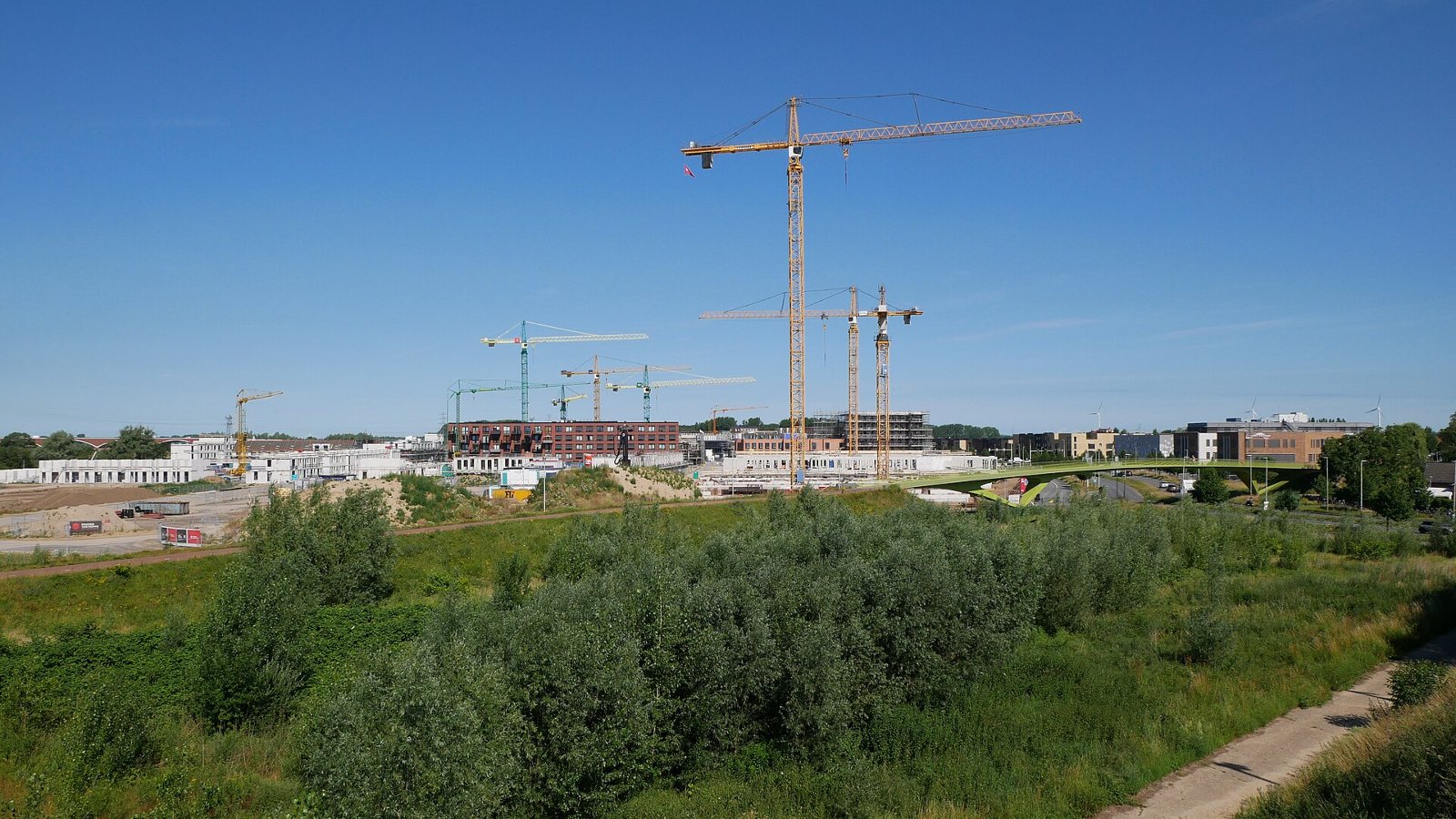
Did the nitrogen rules stop house building?
No. After the 2019 nitrogen ruling the Netherlands completed more new homes than at any time in a decade, and permits were already falling before the court ruled. The deeper dip in 2023 tracks interest rates and costs. Nitrogen does block some projects, about one planned home in ten.
 Polling Forecast
6 min read
data as of 23 November
Written in house from our poll data and our forecast.

The verdict
| Question | Our answer | How sure |
|---|---|---|
| Did the nitrogen rules stop house building? | No. In the four years after the Council of State struck down the nitrogen programme in May 2019, the Netherlands completed more new homes than in any four years for a decade: 72,000 a year on average, against 58,000 in 2015–18. | Strong |
| Did permits fall after the ruling? | Barely. Permits were already falling before it: the first quarter of 2019 was 23% down on a year earlier. The four quarters after the ruling were only 4.4% below the four quarters before (our calculation). | Strong |
| What about the 2022 Porthos ruling? | The bigger fall came from interest rates and costs. Permits fell 18% in the following year, but mortgage rates more than doubled and building prices rose 17% at the same time. Permits rebounded in 2024 with no exemption restored. | Moderate |
| Is nitrogen a brake at all? | Yes, on some projects. The construction research institute EIB estimates that about 10% of the new homes planned for 2025–30 cannot go ahead under the current rules, and 15% need a nature permit. | Moderate |
"The nitrogen lock"
On 29 May 2019, the Council of State, the country's highest administrative court, ruled that the government's programme for handling nitrogen emissions near nature reserves could not be used to grant permits. Overnight, any project that added nitrogen near a protected area faced legal risk, from farms to motorways to housing estates.
The reaction was immediate. Within weeks, the head of the property developers' association spoke of "total panic" and "certainly hundreds, perhaps even a thousand housing projects" at risk.1 By September, government inventories counted 18,000 construction projects in doubt.2 Since then, nitrogen has been blamed for the housing shortage in almost every debate about it. The cabinet's €20bn nitrogen package of June 2026 was presented as getting the country "off the nitrogen lock", and the agriculture minister said: "The Netherlands has been stuck for too long: permits are left lying."3
We took CBS figures for every building permit and every completed home, quarter by quarter, and set them against the two court rulings, interest rates and building costs.
1. Completions went up, not down
Source: CBS
The Netherlands completed 48,000 new-build homes in 2015, 63,000 in 2017 and 67,000 in 2018. In 2019, the year of the ruling, it completed 71,500. In 2022 it completed 74,600. Completions only dipped to 69,000 in 2024 and 2025.4
Homes completed in 2019 and 2020 were mostly permitted earlier, so the first years after a ruling say little. But the average for 2019–22, at 72,000 a year, was higher than for 2015–18, at 58,000, and stayed around 71,000 in 2023–25 (our calculation).4
2. Permits were falling before the ruling
Source: CBS
Permits are the better test, because they react quickly. In 2018, municipalities granted permits for 67,200 new homes. In 2019 the number fell to 55,600.5
But the fall began before the court ruled. In the first quarter of 2019, two months before the ruling, permits were already 23% lower than a year earlier. Comparing the four quarters after the ruling with the four before, the drop was 4.4% (our calculation).5 By 2021, permits had reached 72,800, the highest of the decade.
The economist Jan Rouwendal of the Free University of Amsterdam came to the same conclusion using municipal data. He found no significant fall in permits in the areas hit by nitrogen restrictions, because builders shifted to nearby areas. "The effect of the nitrogen crisis on house building turned out to be very small," he wrote.6
3. The second ruling met a bigger shock
In July 2021 the government exempted the construction phase of projects from nitrogen rules. On 2 November 2022, in the Porthos case, the Council of State ruled that exemption contrary to EU law.7
In the year after Porthos, permits fell 17.7% (our calculation).5 But that was also the year interest rates rose fastest. The average mortgage rate went from 1.70% in 2021 to 3.84% in 2023, and the price of a new home's construction rose 17% in two years.89 Banks and buyers pulled back everywhere, not just near nature reserves.
The test came in 2024. The exemption was not restored. Mortgage rates stayed high, but stopped rising. Permits rose 26%, back to 69,100.5 In the first three quarters of 2026, they were 29% above the same period of 2025.
Verdict: the nitrogen rules did not stop house building. Completions reached a ten-year high after the 2019 ruling, permits were already falling before it, and the deeper fall in 2023 tracks interest rates and costs better than the Porthos ruling. Nitrogen is a real brake on some projects, but it is one of several, and not the biggest.
What the other side gets right
Some projects are blocked. The EIB estimates that, under the current rules, about 10% of the new homes planned for 2025–30 cannot go ahead because of nitrogen, and 15% need a nature permit. A lower threshold of 1 mol per hectare per year would free about 23,300 homes.10 Large schemes near Natura 2000 sites were named as at risk in 2019.
Uncertainty has a cost. The threshold the cabinet has promised since 2025 will not apply before 1 July 2027, and at 0.49 mol, which frees fewer homes than the EIB's scenario.1112 In August 2026 the cabinet admitted it had no overview of which locations were delayed.12
National totals hide where homes are built. Rouwendal's finding that builders moved to nearby areas means homes were built, but sometimes in the wrong place, or later.6
The sector was already under strain. "House building was already faltering because of high building costs and staff shortages," an ABN Amro economist said in 2019. "The ruling will make that even harder in the coming years."13 Grid congestion is now a growing problem too.14
What the public thinks
In an Ipsos I&O poll in July 2026, 34% said the cabinet should do less to cut nitrogen emissions, 30% about the same and 21% more: the first time since 2021 that "less" outnumbered "more". 63% backed scrapping permits for projects that emit little nitrogen, but only 24% agreed that building homes may come at the expense of nature.15
How we did it
Permits are the sum of CBS's quarterly figures for new dwellings in every municipality (table 83671NED), which can differ slightly from CBS's national headline totals. Completions are new-build homes from CBS table 82235NED. We compared permits in the four quarters before and after each ruling and in the same quarter a year earlier. Mortgage rates are the European Central Bank's series for new Dutch mortgage lending; construction prices are CBS's output price index for new homes.
Sources
-
NOS, report on housing projects at risk after the nitrogen ruling, 6 July 2019. https://nos.nl/l/2292301↩
-
Binnenlands Bestuur, Teller geblokkeerde bouwprojecten op 18 duizend, 6 September 2019. https://www.binnenlandsbestuur.nl/ruimte-en-milieu/verordening/teller-geblokkeerde-bouwprojecten-op-18-duizend↩
-
Rijksoverheid, Kabinet haalt Nederland van het stikstofslot, 26 June 2026. https://rijksoverheid.nl/actueel/nieuws/2026/06/26/kabinet-haalt-nederland-van-het-stikstofslot-met-stevig-pakket-weer-ruimte-voor-boer-natuur-en-bouw↩
-
CBS StatLine, housing stock and new-build completions (82235NED) (Polling Forecast analysis). https://opendata.cbs.nl/statline/#/CBS/nl/dataset/82235NED/table↩↩
-
CBS StatLine, building permits for new dwellings by municipality (83671NED), to the third quarter of 2026 (Polling Forecast analysis). https://opendata.cbs.nl/statline/#/CBS/nl/dataset/83671NED/table↩↩↩↩
-
Jan Rouwendal, Aantal bouwvergunningen is toegenomen, ondanks stikstofarrest, ESB, 20 September 2023. https://esb.nu/aantal-bouwvergunningen-is-toegenomen-ondanks-stikstofarrest/↩↩
-
Rabobank, Streep door bouwvrijstelling: gevolgen voor woningbouw op korte termijn lijken beperkt, 18 November 2022. https://www.rabobank.nl/kennis/d011326567-streep-door-bouwvrijstelling-gevolgen-voor-woningbouw-op-korte-termijn-lijken-beperkt↩
-
European Central Bank, MFI interest rates on new mortgage lending in the Netherlands. https://data.ecb.europa.eu/data/datasets/MIR↩
-
CBS StatLine, output price index for new dwellings (85772NED). https://opendata.cbs.nl/statline/#/CBS/nl/dataset/85772NED/table↩
-
EIB, De casus voor een ondergrens van 1 mol/ha/jaar voor stikstofdeposities, July 2025. https://omgevingsweb.nl/wp-content/uploads/2025/07/EIB-notitie-De-casus-voor-een-ondergrens-van-1-molhajaar-voor-stikstofdeposities.pdf↩
-
Rijksoverheid, Kabinet legt stikstofaanpak vast en zet steun voor boeren klaar, 3 November 2026. https://www.rijksoverheid.nl/actueel/nieuws/2026/11/03/kabinet-legt-stikstofaanpak-vast-en-zet-steun-voor-boeren-klaar↩
-
Omgevingsweb, Kabinet houdt vast aan stikstofaanpak: rekenkundige ondergrens pas uiterlijk eind 2027, 20 August 2026. https://omgevingsweb.nl/beleid/kabinet-houdt-vast-aan-stikstofaanpak-rekenkundige-ondergrens-pas-uiterlijk-eind-2027/↩↩
-
NOS, ABN Amro on the effect of the nitrogen ruling, 22 August 2019. https://nos.nl/l/2298463↩
-
Volkshuisvesting Nederland, Netcongestie. https://www.volkshuisvestingnederland.nl/onderwerpen/aanpak-woningnood/netcongestie↩
-
Ipsos I&O, political poll, 10 to 13 July 2026. https://www.ipsos-publiek.nl/wp-content/uploads/2026/07/Rapport-peiling-juli-2026-politiek-kabinet-stikstof-v3.pdf↩
Polling Forecast reads every poll in ten countries, corrects for how pollsters have missed before, and turns them into seats. Our forecasts, the polls and our methods are free to explore.
Elsewhere on Polling Forecast
 Coalition candidate wins Lubuskie Senate by-election on 14% turnout
Zdzisława Różańska took 42.7% for the governing coalition, while our forecast still gives the right a Sejm majority in 86% of simulations.
 Schlein's wealth tax meets a cool reception from her allies
The PD leader revived a 2% levy on the largest fortunes as the centre-left leads our Camera projection with 224 seats and a majority in 63% of simulations.
 Merz enters budget week with the AfD almost six points ahead
The Bundestag votes on the 2027 budget on Friday, with the AfD on 26.7% in our average and the CDU/CSU on 21.0.