










Who chose the United States's governments?
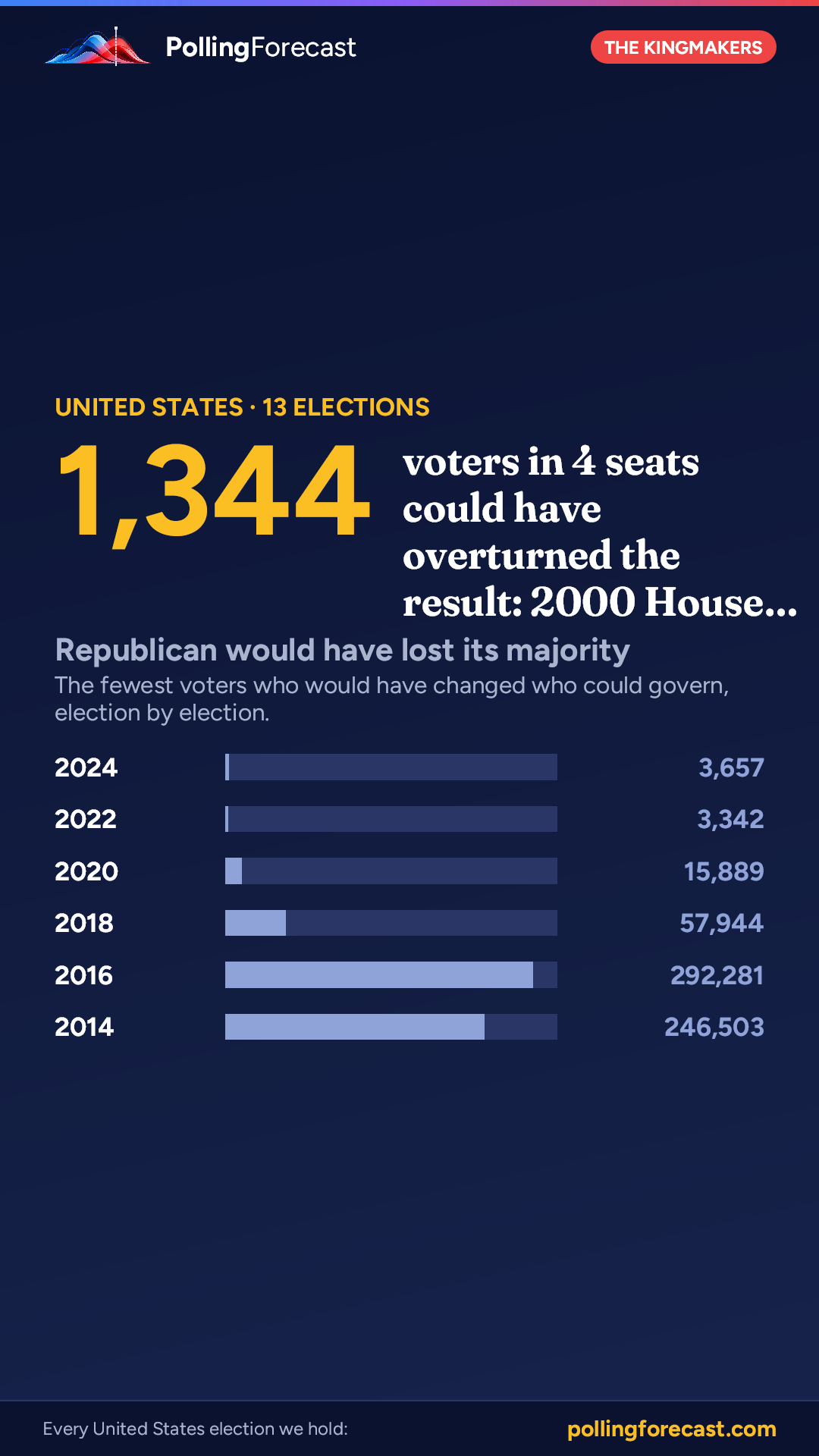
How to read this: the figure is the smallest number of people who, by voting for a different party in just the right seats, would have changed who could govern. The smaller it is, the closer the election was.
← All countries, closest election first
Tap an election to see which seats would have decided it. "Majority" means the largest party won more than half of all seats; ≤ means "at most".
| Election | Largest party | Fewest voters needed | Seats that would change hands |
|---|---|---|---|
| 2024 House elections | Republican 220 (majority) | 3,657 | 3 of 435 |
| 2022 House elections | Republican 222 (majority) | 3,342 | 5 of 435 |
| 2020 House elections | Democratic 222 (majority) | 15,889 | 5 of 435 |
| 2018 House elections | Democratic 235 (majority) | 57,944 | 18 of 435 |
| 2016 House elections | Republican 241 (majority) | 292,281 | 24 of 435 |
| 2014 House elections | Republican 247 (majority) | 246,503 | 30 of 435 |
| 2012 House elections | Republican 234 (majority) | 80,439 | 17 of 435 |
| 2010 House elections | Republican 242 (majority) | 82,392 | 25 of 435 |
| 2008 House elections | Democratic 257 (majority) | 458,939 | 40 of 435 |
| 2006 House elections | Democratic 233 (majority) | 40,717 | 16 of 435 |
| 2004 House elections | Republican 232 (majority) | 147,963 | 15 of 435 |
| 2002 House elections | Republican 229 (majority) | 42,061 | 12 of 435 |
| 2000 House elections | Republican 221 (majority) | 1,344 | 4 of 435 |
How this works
The data
The official results of 13 national elections in United States, seat by seat, from the country's electoral authority. Sources
The method
Where each seat has one winner (whoever gets the most votes), the fewest people who could change a seat are the winner's voters who would need to switch to the runner-up: half the winning margin, plus one. We line up every seat from cheapest to dearest and find, exactly, the smallest set that would have cost the largest party its majority or made another party the largest, whichever takes fewer voters.
What this does not claim
It measures how close each election came, from the votes as counted, not how anyone would really have voted.
Words used here
- Majority (in a seat): how many more votes the winner got than the runner-up. Majority (in parliament): more than half of all seats.
Spotted a mistake? Write to [email protected] with the page address and what looks wrong. We check every message and correct the page if we got it wrong.