







Wybory do Sejmu 2023
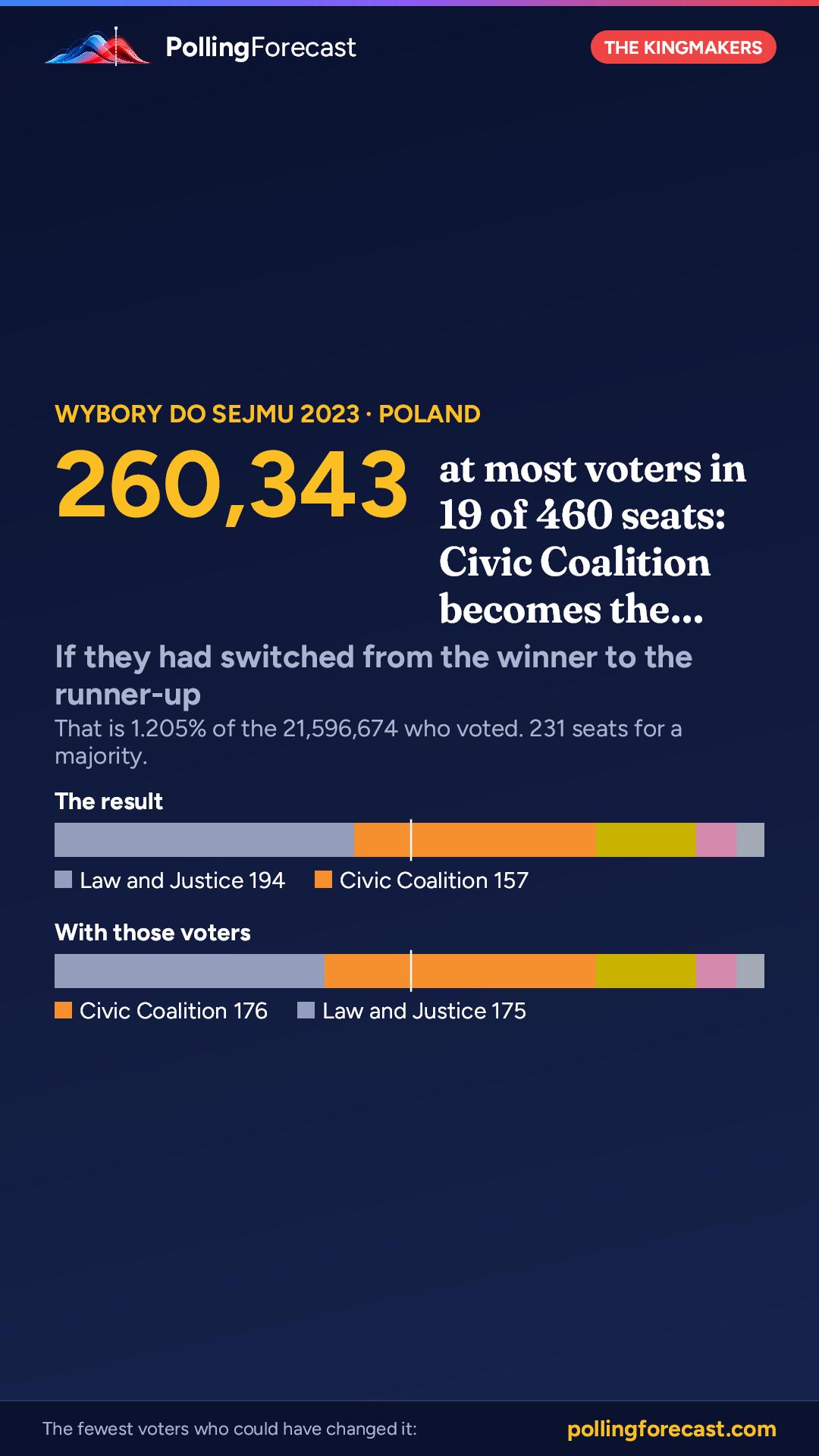
How to read this: below are the seats that would have had to change hands, and how many voters in each. We count two ways: voters switching from the winner to the runner-up (each switch counts twice, so it takes fewer people), or extra voters turning out for the runner-up.
The result 460 seats, 231 for a majority
Civic Coalition becomes the largest party: ≤ 260,343 voters if they switched from the winner to the runner-up
| Seat | Won by | Would go to | Winning margin (votes) | Voters needed |
|---|---|---|---|---|
| Kraków (12) | Law and Justice | Civic Coalition | 3,361 | |
| Piotrków Trybunalski (10) | Law and Justice | Civic Coalition | 4,658 | |
| Elbląg (34) | Law and Justice | Civic Coalition | 4,982 | |
| Sieradz (11) | Law and Justice | Civic Coalition | 7,494 | |
| Siedlce (18) | Law and Justice | Civic Coalition | 8,040 | |
| Zielona Góra (8) | Law and Justice | Civic Coalition | 8,082 | |
| Radom (17) | Law and Justice | Civic Coalition | 8,805 | |
| Lublin (6) | Law and Justice | Civic Coalition | 10,475 | |
| Toruń (5) | Law and Justice | Civic Coalition | 12,206 | |
| Białystok (24) | Law and Justice | Civic Coalition | 13,120 | |
| Katowice (32) | Law and Justice | Civic Coalition | 15,143 | |
| Koszalin (40) | Law and Justice | Civic Coalition | 16,405 | |
| Łódź (9) | Law and Justice | Civic Coalition | 19,113 | |
| Katowice (29) | Law and Justice | Civic Coalition | 20,626 | |
| Legnica (1) | Law and Justice | Civic Coalition | 21,080 | |
| Piła (38) | Law and Justice | Civic Coalition | 21,146 | |
| Katowice (31) | Law and Justice | Civic Coalition | 21,499 | |
| Poznań (39) | Law and Justice | Civic Coalition | 21,805 | |
| Wałbrzych (2) | Law and Justice | Civic Coalition | 22,303 |
← Every election: Poland · All countries
How this works
The data
The official result of the Wybory do Sejmu 2023 (15 October 2023), seat by seat, from the country's electoral authority: 21,596,674 votes cast for 460 seats.
The method
- For every seat, work out how many voters it would take to change its winner.
- Pick the cheapest seats until the largest party loses its majority, or another party becomes the largest.
- Add up the voters in those seats. That total is the figure at the top.
Here seats are shared out from party lists, so we test the smallest moves of votes between two parties that would shift a seat under the country's own counting rule. The figures are upper bounds (≤): the true minimum may be lower.
What this does not claim
It shows how close the election came, not how anyone would really have voted.
Spotted a mistake? Write to [email protected] with the page address and what looks wrong. We check every message and correct the page if we got it wrong.