


Tweede Kamerverkiezing 2023
Cómo leer esta página: abajo están los escaños que habrían tenido que cambiar de manos y cuántos votantes en cada uno. Contamos de dos formas: votantes que se pasan del ganador al segundo (cada cambio cuenta doble, así que hace falta menos gente) o votantes adicionales que acuden a votar al segundo.
El resultado 150 escaños, 76 para la mayoría
un escaño pasa de Party for Freedom a 50PLUS: ≤ 22.014 votantes si se pasaran del ganador al segundo
| Escaño | Ganado por | Iría a | Ventaja (votos) | Votantes necesarios |
|---|---|---|---|---|
| Netherlands | Party for Freedom | 50PLUS | 22.014 |
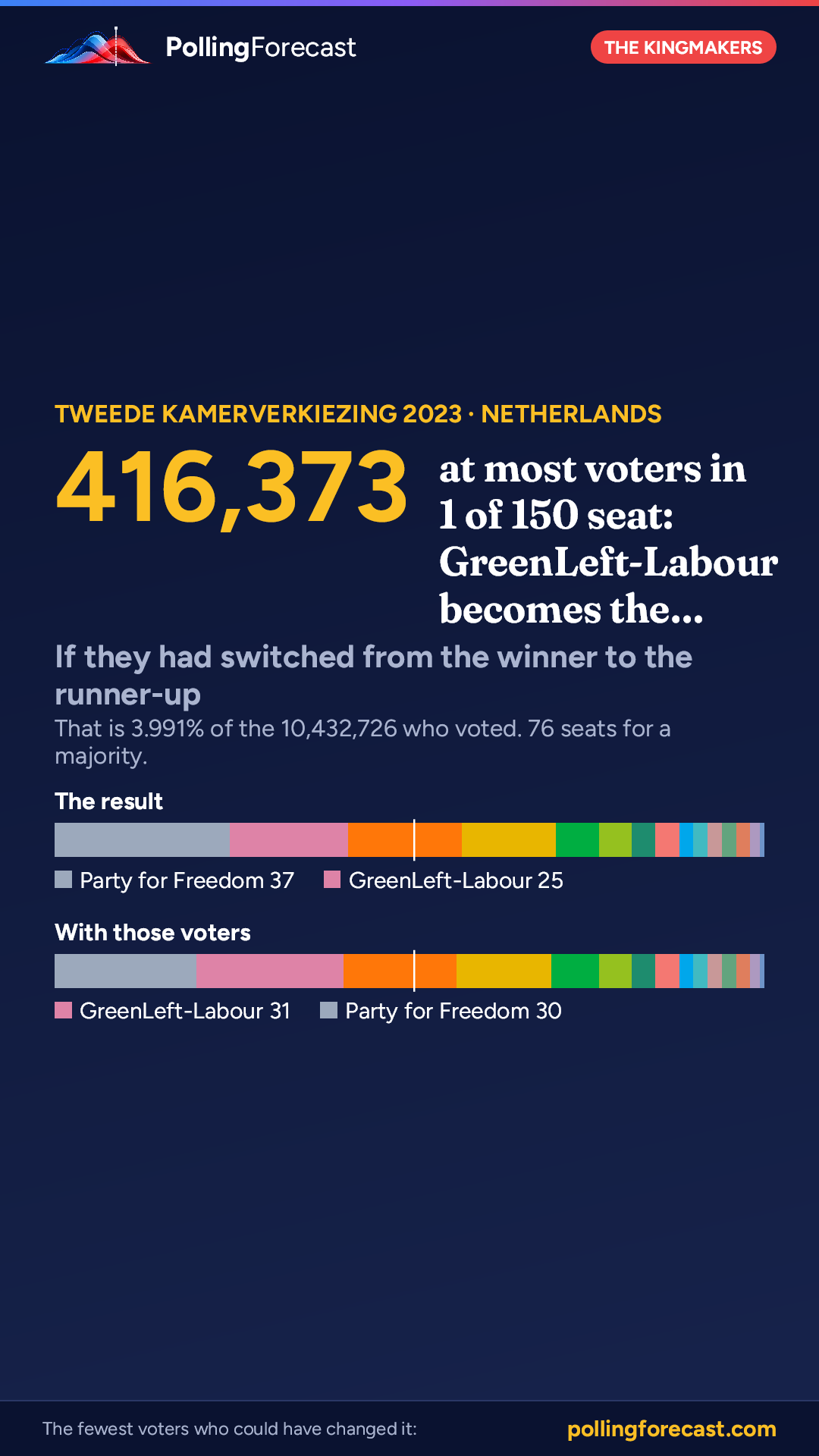
GreenLeft-Labour pasa a ser el partido más grande: ≤ 416.373 votantes si se pasaran del ganador al segundo
| Escaño | Ganado por | Iría a | Ventaja (votos) | Votantes necesarios |
|---|---|---|---|---|
| Netherlands | Party for Freedom | GreenLeft-Labour | 416.373 |
Los escaños más fáciles de mover
Cada fila es un escaño que pasaría de un partido a otro si tantos votantes cambiaran entre ellos; ≤ significa «como mucho».
| De | A | Votantes necesarios |
|---|---|---|
| Socialist Party | Democrats 66 | ≤ 53 |
| JA21 (Right Answer 2021) | Democrats 66 | ≤ 1.794 |
| GreenLeft-Labour | Democrats 66 | ≤ 1.949 |
| People's Party for Freedom and Democracy | Democrats 66 | ≤ 14.040 |
| Christian Union | Democrats 66 | ≤ 15.597 |
| Christian Union | DENK (Think) | ≤ 15.752 |
| GreenLeft-Labour | DENK (Think) | ≤ 15.752 |
| JA21 (Right Answer 2021) | DENK (Think) | ≤ 15.752 |
| Socialist Party | DENK (Think) | ≤ 15.752 |
| People's Party for Freedom and Democracy | DENK (Think) | ≤ 15.752 |
| Christian Union | Interest of the Netherlands | ≤ 16.639 |
| GreenLeft-Labour | Interest of the Netherlands | ≤ 16.639 |
| JA21 (Right Answer 2021) | Interest of the Netherlands | ≤ 16.639 |
| Socialist Party | Interest of the Netherlands | ≤ 16.639 |
| People's Party for Freedom and Democracy | Interest of the Netherlands | ≤ 16.639 |
| Christian Democratic Appeal | Interest of the Netherlands | ≤ 17.598 |
| Christian Democratic Appeal | Democrats 66 | ≤ 17.598 |
| Christian Democratic Appeal | DENK (Think) | ≤ 17.598 |
| Christian Democratic Appeal | Volt Netherlands | ≤ 18.086 |
| Christian Union | Volt Netherlands | ≤ 18.086 |
| GreenLeft-Labour | Volt Netherlands | ≤ 18.086 |
| JA21 (Right Answer 2021) | Volt Netherlands | ≤ 18.086 |
| Socialist Party | Volt Netherlands | ≤ 18.086 |
| People's Party for Freedom and Democracy | Volt Netherlands | ≤ 18.086 |
| Christian Democratic Appeal | 50PLUS | ≤ 18.509 |
← Todas las elecciones: Países Bajos · Todos los países
Cómo funciona
Los datos
El resultado oficial (Tweede Kamerverkiezing 2023, 22 noviembre 2023), escaño a escaño, de la autoridad electoral del país: 10.432.726 votos para 150 escaños.
El método
- Para cada escaño, calcular cuántos votantes harían falta para cambiar al ganador.
- Elegir los escaños más baratos hasta que el partido más grande pierda la mayoría u otro pase a ser el más grande.
- Sumar los votantes de esos escaños. Ese total es la cifra de arriba.
Aquí los escaños se reparten por listas, así que probamos los menores traspasos de votos entre dos partidos que moverían un escaño con la regla del país. Las cifras son máximos (≤): el mínimo real puede ser menor.
Lo que esto no afirma
Muestra lo ajustada que fue la elección, no cómo habría votado realmente cada persona.
¿Has visto un error? Escribe a [email protected] con la dirección de la página y lo que te parece mal. Revisamos cada mensaje y corregimos la página si nos hemos equivocado.