







Who chose Italy's governments?
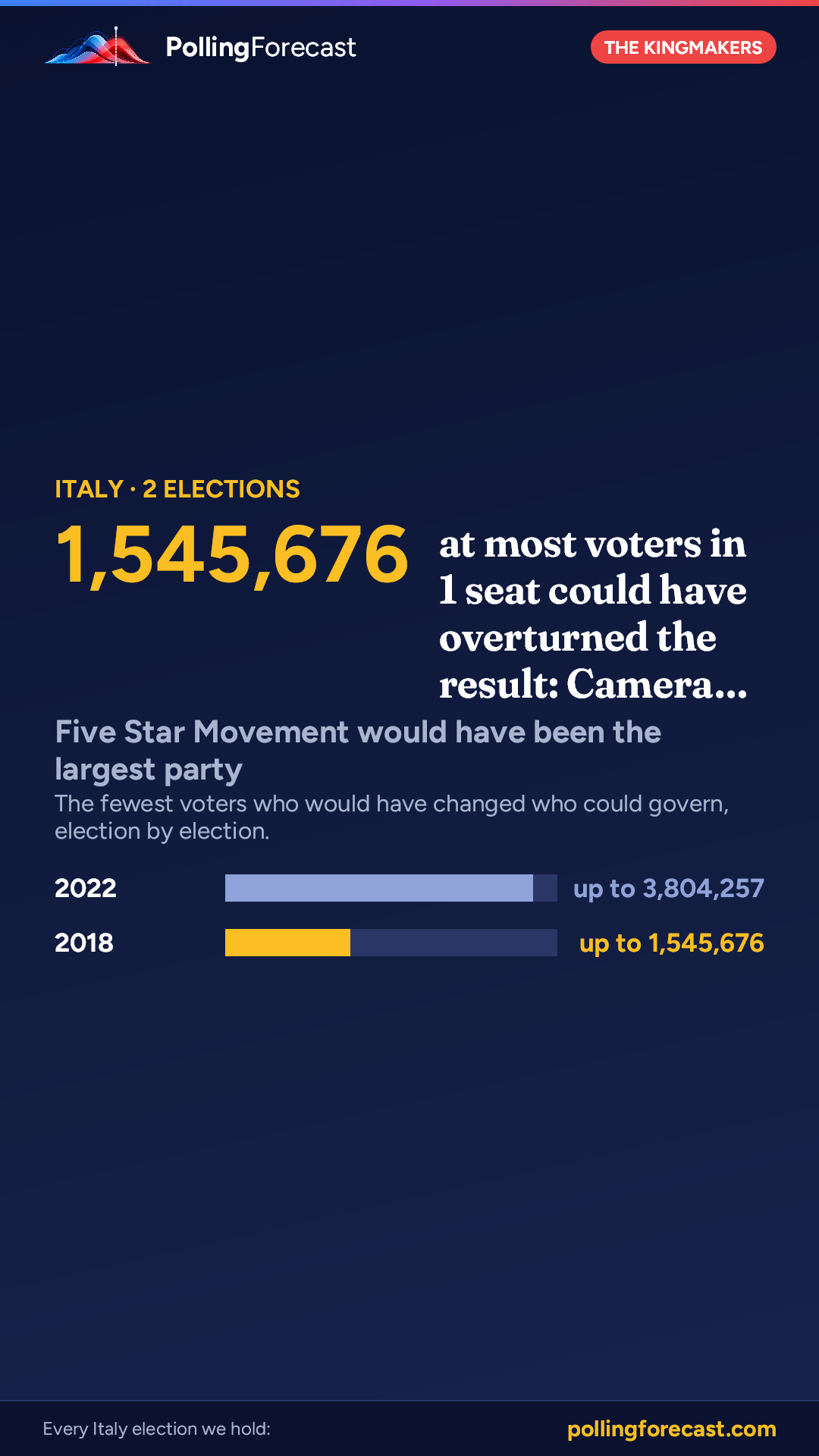
How to read this: the figure is the smallest number of people who, by voting for a different party in just the right seats, would have changed who could govern. The smaller it is, the closer the election was.
← All countries, closest election first
Tap an election to see which seats would have decided it. "Majority" means the largest party won more than half of all seats; ≤ means "at most".
| Election | Largest party | Fewest voters needed | Seats that would change hands |
|---|---|---|---|
| Camera dei deputati 2022 | Centre-right 237 (majority) | ≤ 3,804,257 | 1 of 400 |
| Camera dei deputati 2018 | Centre-right 265 | ≤ 1,545,676 | 1 of 630 |
How this works
The data
The official results of 2 national elections in Italy, seat by seat, from the country's electoral authority. Sources
The method
Under the current law (the Rosatellum), a little over a third of the Camera's 400 seats are single-member constituencies (collegi) and most of the rest are shared out nationally by list vote. We keep the 147 collegi and the 8 seats abroad with the people who actually won them, and work out the 245 proportional seats again from the national list votes, with the real rules: Hare quota and largest remainder among coalitions with 10% and lists with 3%, then inside each coalition among its lists with 3%. A coalition counts as one when we ask who could govern.
We then move list votes from one list to another and look for the smallest move that changes who could govern, trying first the exact numbers that push a list over or under 1% or 3%. In reality a list vote also counts for its coalition's collegio candidate, which we leave as it was, so the true minimum could be lower still: every figure is an upper bound. We only show elections where our calculation gives exactly the official proportional seats.
What this does not claim
It measures how close each election came, from the votes as counted, not how anyone would really have voted.
Words used here
- Majority (in a seat): how many more votes the winner got than the runner-up. Majority (in parliament): more than half of all seats.
- Threshold: the smallest share of the vote a party needs before it wins any list seats.
- Upper bound (≤): the most voters it could take; the true smallest number may be lower.
- Hare quota and largest remainder: each party gets one seat for every full share of the vote, and the seats left over go to the parties with the biggest leftovers.
Spotted a mistake? Write to [email protected] with the page address and what looks wrong. We check every message and correct the page if we got it wrong.