
Can France afford to retire at 62?
Not without someone paying for it. France can afford today's pause, at about €1.8bn a year. But it already spends 13.4% of GDP on old age, far above the EU's 10.6%, and only 44% of its 60- to 64-year-olds work. A permanent return to 62 means higher contributions, lower pensions or more debt.
 Polling Forecast
7 min read
data as of 23 November
Written in house from our poll data and our forecast.

The verdict
| Question | Our answer | How sure |
|---|---|---|
| Can France afford to retire at 62? | Not without someone paying for it. France already spends 13.4% of GDP on old age, against an EU average of 10.6%. Its pension system is close to balance today only because of that high spending. A permanent return to 62 would mean higher contributions, lower pensions or more borrowing. | Strong |
| Can it afford the current pause? | Yes. The suspension freezes the age at 62 years and 9 months for now, at an average cost of €1.8bn a year to 2032, according to the pensions advisory council (COR). That is 0.4% of pension spending. | Strong |
| Was the 2023 reform working? | It appears so. Since it began, France's employment rate among 60- to 64-year-olds has risen by 8.2 points, faster than the EU's 6.5. But at 44.4% it is still far below the EU's 55.0%. | Moderate |
| Is the system in crisis? | No, but it will drift into deficit. The COR projects a deficit of 0.2% of GDP to 2030, rising to 0.9% by 2045 and 2.4% by 2070, as the number of people of working age per pensioner falls. | Strong |
The reform that would not die
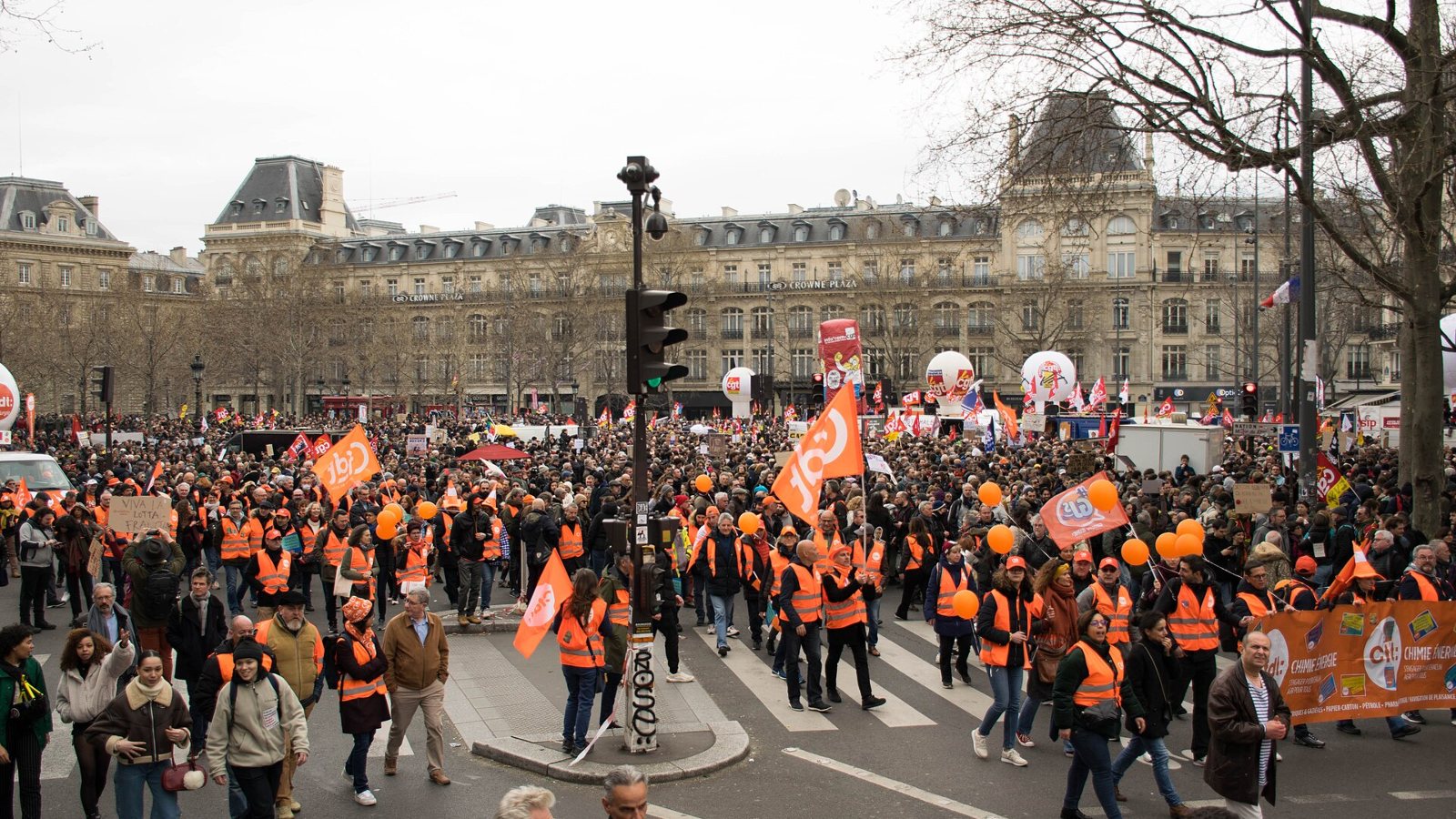
In April 2023 Emmanuel Macron forced through a law raising France's minimum pension age from 62 to 64 without a final vote in the National Assembly, after months of strikes and marches. Two and a half years later, it was suspended.
On 14 October 2025, the prime minister, Sébastien Lecornu, told the Assembly: "No rise in the age will take place from now until January 2028."1 It was the price of the Socialists' votes to keep his government alive. Since 1 September 2026, people born in 1964 and early 1965 can retire at 62 years and 9 months, with 170 quarters of contributions.2
Now the 2027 presidential race has turned the pause into a promise. The RN, LFI and the Socialists all propose to bring the age back down, to between 60 and 62.3 On the other side, the Senate voted in November to cancel the suspension altogether.4
So can France afford it? We compared what France spends on pensions with the rest of Europe, looked at what the 2023 reform did to older workers, and set out what a return to 62 would cost.
1. France already spends more than almost anyone
Source: Eurostat (COFOG)
In 2024, France spent 13.4% of its GDP on old age. Only Austria, at 14.3%, and Italy, at 13.9%, spent more in the EU. The EU average was 10.6%. Germany spent 9.9% and the Netherlands 6.1%.5 The COR, which counts slightly differently, puts pension spending at 14.1% of GDP in 2025, or €422bn.6
The gap with the EU average is 2.8 points of GDP, about €82bn a year (our calculation).5 That is the money that keeps France's pensions generous. Pensioners' living standard was equal to that of the population as a whole in 2023, at 100.2%.6
2. The system is nearly balanced, for now
Because contributions are so high, the pension system itself is close to balance. The COR estimates a deficit of €5.1bn in 2025, 0.2% of GDP, and the same in 2030. After that it widens, to 0.9% of GDP in 2045 and 2.4% in 2070, in its central scenario.6
The reason is age. In 2025 France had 2.8 people aged 15 to 64 for every person aged 65 or over. By 2050 it will have 2.1, and by 2070, 1.9 (our calculation from Eurostat projections).7 France ages slightly more gently than the EU average. But it starts from a pension bill that is already far higher.
3. The suspension is cheap. A return to 62 is not.
The current pause costs relatively little. The COR puts it at €1.8bn a year on average to 2032.6 That is 0.4% of pension spending, and less than a sixth of the €12bn rise in the interest bill expected between 2026 and 2027 (our calculation).8 The Senate's social affairs committee puts the total cost at "more than €10bn" over the years.9
A permanent return to 62 would be different. The suspension only freezes the age for people born up to 1965, and 64 still applies from those born in 1969.2 Going back to 62 for everyone would affect every future cohort, and the cost would grow each year as more people retired earlier. Each year of earlier retirement means paying pensions for longer and collecting contributions for less time.
4. The reform was getting older people into work
Source: Eurostat
France's real weakness is not its pension age but how few older people work. In 2025, 44.4% of 60- to 64-year-olds had a job, against 55.0% across the EU, 67.6% in Germany and 69.5% in the Netherlands.10
The 2023 reform began to change that. From 2022 to 2025, France's employment rate at 60 to 64 rose from 36.2% to 44.4%, by 8.2 points. The EU's rose by 6.5 points, Germany's by 4.4 (our calculation).10 The gap with the EU narrowed from 12.3 to 10.6 points. Part of that is the 2010 reform, which raised the age from 60 to 62, still working through. But the timing points to the 2023 law.
Every extra older worker pays contributions instead of drawing a pension. Freezing the reform stops that gain for the cohorts it covers.
Verdict: France can afford the pause, which costs about €1.8bn a year. It cannot afford a permanent return to 62 without making someone pay: workers through higher contributions, pensioners through smaller pensions, or future taxpayers through more debt. The pension system balances only because France already spends far more on pensions than its neighbours.
What the other side gets right
The system is not in crisis. A deficit of 0.2% of GDP to 2030 is small, and the COR says better demographic assumptions offset the cost of the suspension until 2045.6 The union UNSA headlined its response to the COR's 2026 report: "let's not give in to alarmism".11
The French already work as long as other Europeans. They start younger, and their expected working life, 37.5 years in 2025, is exactly the EU average.12 The left argues that people with long careers should not be made to work to 64.
Indexation is a bigger lever than age. The government planned to save €4.1bn in a single year by freezing pensions above €1,260 a month in 2027; the Senate threw it out by 329 votes to none.4 The labour minister, Jean-Pierre Farandou, told senators that indexation alone had cost €50bn since 2020.4
Pensioners could pay more. They are as well off as everyone else. Some economists argue for making retirees contribute rather than raising the age, and the Senate plans to remove a 10% income-tax allowance for pensioners to pay for full indexation.4
What the public thinks
In an Elabe poll for BFMTV in November 2025, 57% said the government had been right to accept the suspension, and 42% that it should not have. But 68% thought the current system could not keep working in the years ahead, and 74% said a new reform would be needed.13 In an Odoxa poll for iFRAP in September 2025, 61% said they would rather pay €150 to €250 more a year than see the pension age rise to 66.14
How we did it
Old-age spending is Eurostat's government spending by function (COFOG 10.2) for 2024. Pension system balances, the cost of the suspension and the average retirement age are from the COR's annual report of June 2026. Employment rates at 60 to 64 are from Eurostat's Labour Force Survey for 2019 to 2025. The ratio of people of working age to over-65s is from Eurostat's population data and its 2023 projections. The €82bn figure applies the 2.8-point gap with the EU average to France's 2024 GDP.
Sources
-
LCP, Retraites: Sébastien Lecornu propose la suspension de la réforme jusqu'à l'élection, 14 October 2025. https://lcp.fr/actualites/retraites-sebastien-lecornu-propose-la-suspension-de-la-reforme-jusqu-a-l-election↩
-
Service-Public.fr, suspension of the 2023 pension reform, 27 February 2026. https://www.service-public.gouv.fr/particuliers/actualites/A18825↩↩
-
Carriva, summary of the 2027 candidates' pension proposals, 20 November 2026. https://www.carriva.fr↩
-
Public Sénat, Retraites: le Sénat vote l'indexation complète des pensions sur l'inflation en 2027, 17 November 2026. https://www.publicsenat.fr/actualites/politique/retraites-le-senat-vote-lindexation-complete-des-pensions-sur-linflation-en-2027↩↩↩↩
-
Eurostat, general government expenditure by function (gov_10a_exp), 2024 (Polling Forecast analysis). https://ec.europa.eu/eurostat/databrowser/view/gov_10a_exp/default/table↩↩
-
Conseil d'orientation des retraites, Rapport annuel, June 2026. https://www.cor-retraites.fr/sites/default/files/2026-06/Synth%C3%A8se_RA_2026.pdf↩↩↩↩↩
-
Eurostat, population indicators (demo_pjanind) and 2023 population projections (proj_23ndbi) (Polling Forecast analysis). https://ec.europa.eu/eurostat/databrowser/view/proj_23ndbi/default/table↩
-
Haut Conseil des finances publiques, Avis n° 2026-5, 25 September 2026. https://www.hcfp.fr/sites/default/files/2026-10/Avis%20HCFP%202026-5%20-%20PLF-PLFSS%202027.pdf↩
-
Sénat, social affairs committee, L'essentiel: PLFSS 2027, 4 November 2026. https://www.senat.fr/lessentiel/plfss2027.pdf↩
-
Eurostat, employment rates by age (lfsa_ergan), 2019 to 2025 (Polling Forecast analysis). https://ec.europa.eu/eurostat/databrowser/view/lfsa_ergan/default/table↩↩
-
UNSA, Rapport du COR 2026: ne cédons pas à l'alarmisme. https://retraites.unsa.org/rapport-du-cor-2026-ne-cedons-pas-a-l-alarmisme↩
-
Eurostat, duration of working life (lfsi_dwl_a), 2025. https://ec.europa.eu/eurostat/databrowser/view/lfsi_dwl_a/default/table↩
-
Elabe for BFMTV, survey of 1,003 adults, 13 to 14 November 2025. https://elabe.fr/wp-content/uploads/2025/11/14112025_elabe-bfmtv_les-francais-le-systeme-de-retraites-et-les-divisions-a-gauche.pdf↩
-
Odoxa for Fondation iFRAP, September 2025. https://www.ifrap.org/sites/default/files/documents/2025-09/odoxa_pour_la_fondation_ifrap_-_septembre_2025.pdf↩
Polling Forecast reads every poll in ten countries, corrects for how pollsters have missed before, and turns them into seats. Our forecasts, the polls and our methods are free to explore.
Elsewhere on Polling Forecast
 Coalition candidate wins Lubuskie Senate by-election on 14% turnout
Zdzisława Różańska took 42.7% for the governing coalition, while our forecast still gives the right a Sejm majority in 86% of simulations.
 Schlein's wealth tax meets a cool reception from her allies
The PD leader revived a 2% levy on the largest fortunes as the centre-left leads our Camera projection with 224 seats and a majority in 63% of simulations.
 Merz enters budget week with the AfD almost six points ahead
The Bundestag votes on the 2027 budget on Friday, with the AfD on 26.7% in our average and the CDU/CSU on 21.0.