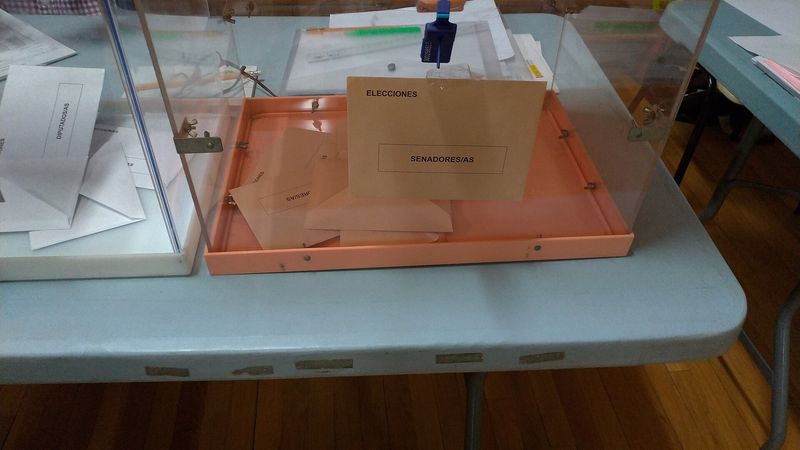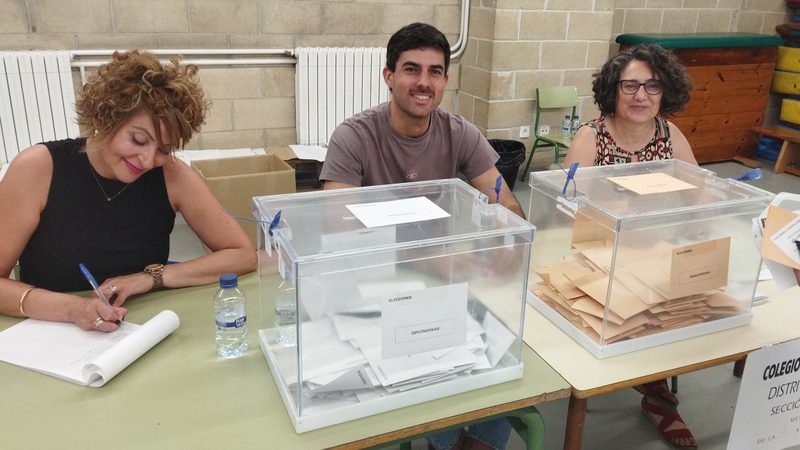
Final forecast: PP and Vox on 194 seats, and the PP can't govern without Vox
Our last numbers before Sunday give the PP and Vox a majority in 96% of our simulations. It survives seven of the last eight polling misses; only an error as large as 2004's would give the left a majority.
 Polling Forecast
4 min read
data as of 27 November
Written in house from our poll data and our forecast.

Spain votes on Sunday, and our forecast is final. The PP is on 30.9% in our average of the last polls, the PSOE on 28.9%, Vox on 18.1% and Sumar on 6.3%. Through our seat model that gives the PP 131 seats, the PSOE 119 and Vox 63. ERC would have 11, Sumar and EH Bildu 8 each, Junts 4, the PNV 3, the BNG 2 and Coalición Canaria 1.
Together the PP and Vox would have 194 seats, 18 more than the 176 needed for a majority in the Congreso. They reach a majority in 96% of our simulations. The parties that voted Pedro Sánchez back into office in November 2023 would have 156 seats and get to 176 in 3%.
No new polls can be published in Spain until the polls close on Sunday, so these are the numbers we go into election night with. Of the 66 polls published in the last 30 days of the campaign, most of the final ones put the PP ahead, by up to almost four points. Cluster17 and AtlasIntel put the PSOE ahead.
Can the PP govern without Vox?
Not on these numbers. A prime minister needs 176 votes in the first investiture vote, or more yes than no votes in a second vote 48 hours later (Constitution, article 99).
With Vox voting yes, the PP's 131 and Vox's 63 make 194, enough in the first vote. If Vox only abstained, the PP would have 131 votes, or 132 with Coalición Canaria, against 155 from the PSOE, ERC, Sumar, EH Bildu, Junts, the PNV and the BNG. Alberto Núñez Feijóo would lose. The only other route is for the PSOE to abstain.
Feijóo has said he wants a majority "suficiente para gobernar en solitario", with support agreements with Vox, and that whether there is a coalition "no depende de mí" (Infobae/Europa Press, 8 November). On our numbers the PP is 45 seats short on its own. Vox's 63 seats are what make the majority, whatever form the deal takes.
What if the polls are wrong again?
Spanish polls have missed before, more often against the PSOE than in its favour. Across the last eight general elections, the average of the final polls put the PSOE 1.3 points too low and the PP 0.9 points too high. In 2023 they had the PSOE 3.3 points too low, and in 2004 by 5.2. We don't correct for this in our forecast, because the direction has changed from one election to the next.
We ran today's polls through our seat model with each of those eight past errors applied. The PP and Vox keep their majority in seven of them:
- If the polls miss like 2023, the PSOE becomes the largest party, on 135 seats to the PP's 121. But Vox holds 63, and the PP and Vox still have 184.
- Like April 2019: the PP falls to 116, but the PP and Vox have 182.
- Like 2015: 186.
- Like 2008, 2011, November 2019 and 2016: between 192 and 198.
Only a miss on the scale of 2004 breaks it. Then the PSOE would win 145 seats to the PP's 109, the PP and Vox would have 173, three short, and the 2023 investiture bloc would reach 177. That year the polls missed a late swing to the PSOE in the three days after the Madrid train bombings. It shows how large an error would have to be to change who governs.
You can try each of these, or set your own error, on our what-if page.
What we'll be watching on Sunday
Polling stations close at 20:00, and at 20:00 local time in the Canaries, which is 21:00 in Madrid. The Interior ministry will publish the first results from 21:00 Madrid time, on its results site, resultados.29neleccionesgenerales.com, and an app called Elecciones Generales 29N, with turnout figures at 14:00 and 18:00 (La Moncloa).
The provinces to watch are those where the last seat is closest between the PP and the PSOE, or between Vox and the left. Small swings there decide whether the right ends up near 185 or near 200. Our live results page will show the count and the seats province by province as the ministry reports them.
The other number that matters is Sumar's. On 6.3% it would lose most of its 2023 seats, and the parties to the left of the PSOE together would be far weaker than they were when they last formed a government with it.
Polling Forecast reads every poll in ten countries, corrects for how pollsters have missed before, and turns them into seats. Our forecasts, the polls and our methods are free to explore.
Elsewhere on Polling Forecast
 Queue to vote, Merri-bek, 2025 federal election
More than a third of Victoria has voted before Saturday
Early votes reached 35.1 per cent of enrolment by Tuesday night, ahead of 2022's pace, as the campaign enters its last two days.
 Elections Canada polling station sign, 2025
Advance voting opens Friday in six federal by-elections
Voters in three Quebec ridings, two in Ontario and one in Saskatchewan can vote from 27 to 30 November, ahead of polling day on 7 December.
 Donald Tusk attended the October 2024 session of the European Council Summit
Poland plans a no-fly zone along its eastern border
The defence ministry wants it in place by early January, after Russian missiles struck south-eastern Poland on 20 November.